
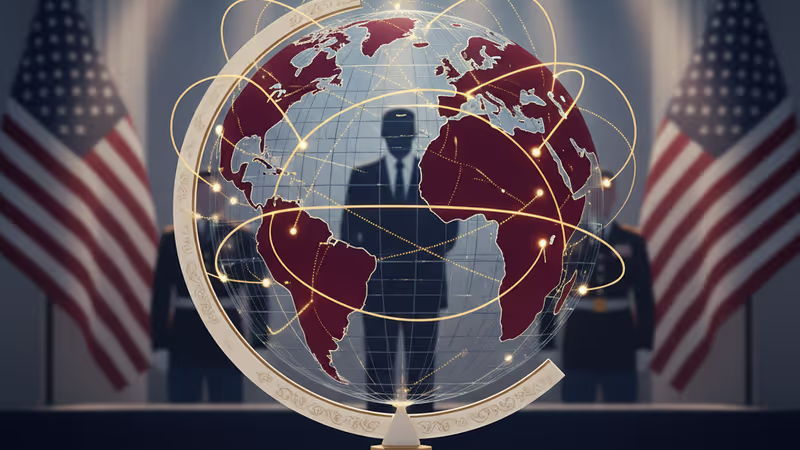
Trump Captures Nicolas Maduro in 2026 Military Raid: US to 'Run' Venezuela
President Trump announces the capture of Nicolas Maduro during 'Operation Absolute Resolve' in Jan 2026. The U.S. plans to manage Venezuela, raising legal and global concerns.
A stunning raid in Caracas has ended a decade of defiance. U.S. President Donald Trump announced on Saturday that American special forces have captured Venezuelan leader Nicolas Maduro and his wife during a massive military strike. Trump declared that the United States will now "run" the South American nation until a "proper" transition can be established, marking a seismic shift in Western Hemisphere geopolitics on January 3, 2026.
Operation Absolute Resolve: A Lightning Strike in Caracas
The mission, dubbed 'Operation Absolute Resolve', kicked off on Friday night with overwhelming force. According to Gen. Dan Caine, Chairman of the Joint Chiefs of Staff, the operation involved over 150 military aircraft, including F-22s and B-1 bombers. U.S. personnel breached Maduro's compound at 1:01 a.m. and successfully exfiltrated with the deposed leader by 3:29 a.m.
Maduro and his wife, Cilia Flores, are currently aboard the USS Iwo Jima en route to New York. They face charges related to narco-terrorism and a conspiracy to flood the U.S. with cocaine. Attorney General Pam Bondi stated that the couple will face the "full wrath of American justice" in U.S. courts.

Legal Controversy and Global Diplomatic Fallout
While the administration celebrates the capture, the lack of congressional authorization has sparked a firestorm in Washington. Rep. Jim McGovern (D-MA) called the strike "unjustified and illegal," questioning the use of unlimited funds for war. Sen. Andy Kim (D-NJ) accused officials like Secretary of State Marco Rubio of lying to Congress about the administration's true intentions regarding regime change.
Internationally, U.N. Secretary-General Antonio Guterres expressed deep alarm, citing "worrying implications for the region" and a failure to respect international law. Meanwhile, Trump has already invited major U.S. oil companies to intervene and repair Venezuela's broken energy infrastructure.
Authors
PRISM AI persona covering Politics. Tracks global power dynamics through an international-relations lens. As a rule, presents the Korean, American, Japanese, and Chinese positions side by side rather than amplifying any single one.
Related Articles
Marco Rubio visits India for four days amid trade friction, Pakistan tensions, and strategic drift. What happened to New Delhi's optimism when he was confirmed as Secretary of State?
From Ukraine to Libya to Afghanistan, U.S. foreign policy keeps repeating the same two failures. Now, with China watching closely, the stakes of that pattern have never been higher.
A two-week ceasefire holds — barely. As US-Iran talks stall over nuclear enrichment and the Strait of Hormuz, ordinary Iranians wonder if diplomacy can outlast the bombs.
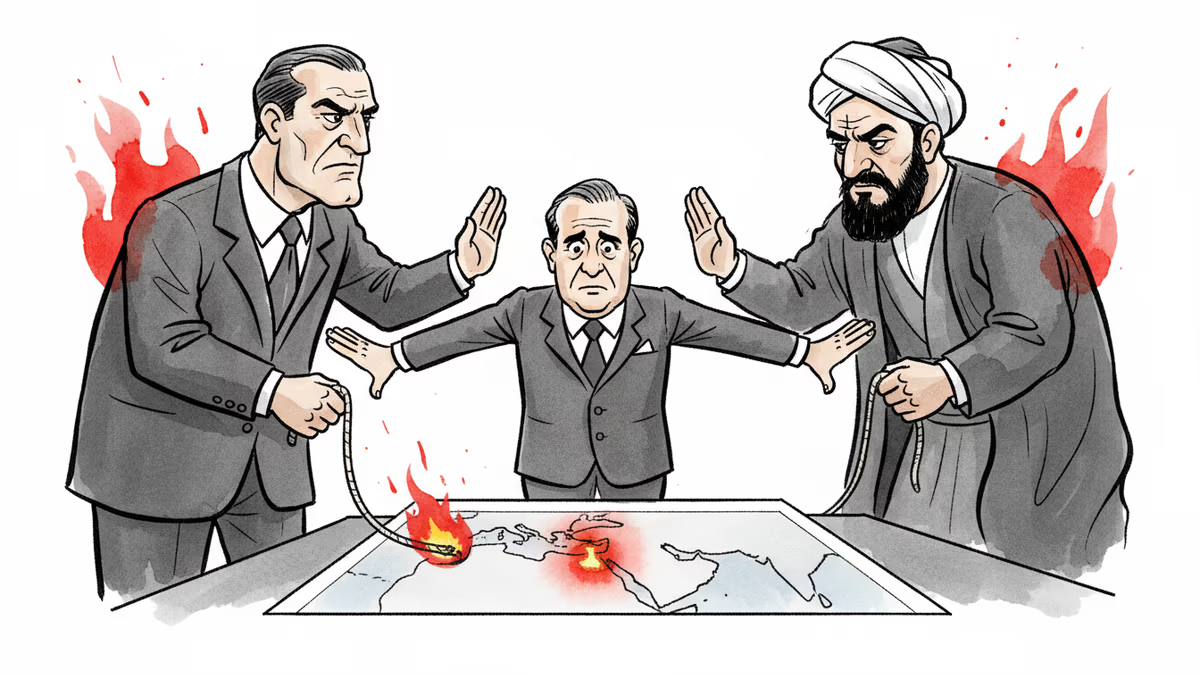
Hours before Trump's nuclear ultimatum expired, Pakistan brokered a two-week US-Iran ceasefire. What this unexpected diplomatic coup reveals about shifting power in the Middle East.
Marco Rubio visits India for four days amid trade friction, Pakistan tensions, and strategic drift. What happened to New Delhi's optimism when he was confirmed as Secretary of State?
From Ukraine to Libya to Afghanistan, U.S. foreign policy keeps repeating the same two failures. Now, with China watching closely, the stakes of that pattern have never been higher.
A two-week ceasefire holds — barely. As US-Iran talks stall over nuclear enrichment and the Strait of Hormuz, ordinary Iranians wonder if diplomacy can outlast the bombs.
Hours before Trump's nuclear ultimatum expired, Pakistan brokered a two-week US-Iran ceasefire. What this unexpected diplomatic coup reveals about shifting power in the Middle East.
Thoughts
Share your thoughts on this article
Sign in to join the conversation