
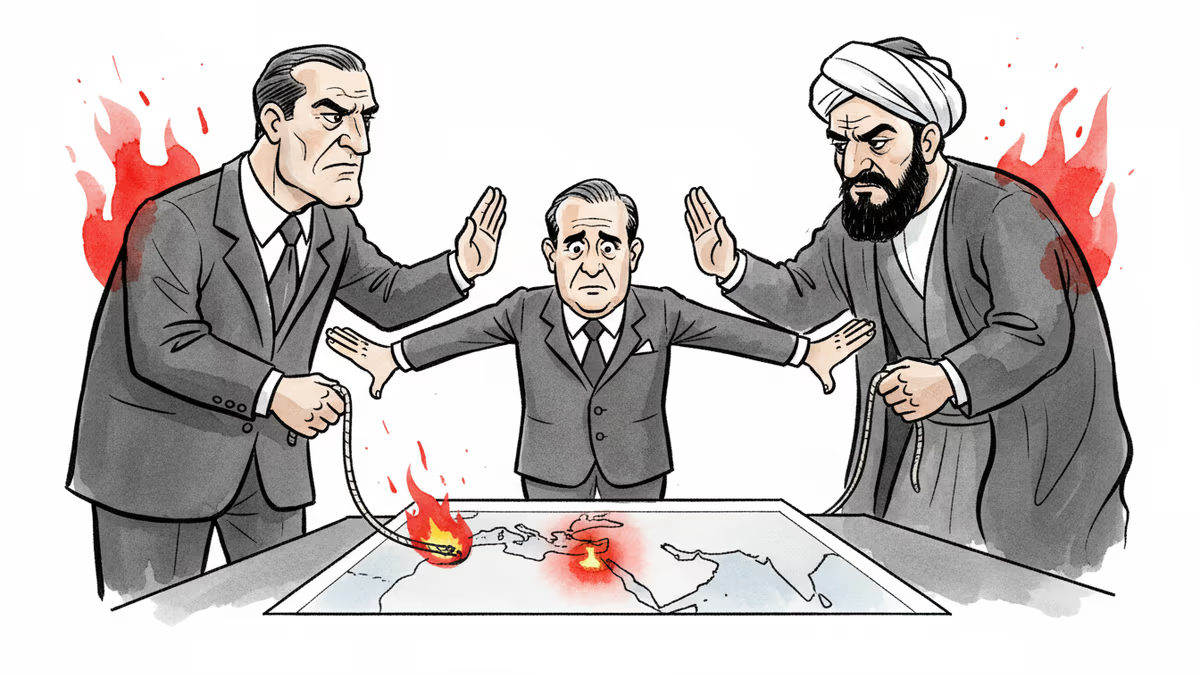
Pakistan Pulled the World Back from the Brink
Hours before Trump's nuclear ultimatum expired, Pakistan brokered a two-week US-Iran ceasefire. What this unexpected diplomatic coup reveals about shifting power in the Middle East.
The clock was running out. Hours before Donald Trump's self-imposed deadline — and his threat to "end Iranian civilization as we know it" — the phone calls that mattered most weren't happening in Washington or Tehran. They were happening in Islamabad.
In what few analysts saw coming, Pakistan brokered a two-week ceasefire between the United States and Iran, halting what had become a five-week war that was shaking the global economy and edging toward a threshold no one wanted to name out loud. Both sides accepted the pause and committed to good-faith negotiations.
What Actually Happened
Three social media posts — each carefully worded, each building on the last — effectively stopped a war.
Pakistani Prime Minister Shehbaz Sharif posted first, appealing to Trump to extend his deadline by two weeks and calling on his "Iranian brothers" to reopen the Strait of Hormuz for the same period. It was a public signal that back-channel conversations were already well advanced.
Trump followed on Truth Social, explicitly crediting both Sharif and Army Chief General Asim Munir — an unusual acknowledgment that elevated Pakistan's role for the entire world to see. He announced a two-week suspension of the U.S. bombing campaign, conditional on Iran reopening the Strait. He also disclosed that Tehran had submitted a ten-point negotiating proposal in response to Washington's earlier fifteen-point framework, and that he had accepted it as the basis for talks. The economic subtext was hard to miss: oil had surged to roughly $112 a barrel before the ceasefire; it dropped approximately 20 percent to around $92 afterward.
Iranian Foreign Minister Seyed Abbas Araghchi completed the sequence, thanking Sharif and Munir by name and confirming Iran's readiness to reopen the Strait — provided attacks on Iranian territory ceased.
A ceasefire. A ten-point framework. And a new diplomatic actor standing at center stage.
The Question Nobody Expected to Ask
Why Pakistan — and not India?

The question matters because India looked like the obvious candidate. Prime Minister Narendra Modi has cultivated relationships across the entire conflict landscape: a comprehensive strategic partnership with Washington, civilizational ties with Tehran stretching back millennia, deep defense and trade ties with the UAE and the broader Gulf. On paper, India was perfectly positioned to play peacemaker.
But Modi made his choice publicly on February 25, declaring India's solidarity with Israel. That alignment, however strategically coherent from New Delhi's perspective, effectively disqualified India as a neutral broker. You can't credibly mediate between parties when one of them knows which side you're on.
Pakistan, by contrast, brought something more valuable than a wide network: perceived neutrality. Its Islamic identity gave it standing in Tehran. Its security relationship with Saudi Arabia and longstanding ties with Washington gave it credibility there. And crucially, it had no public stake in the outcome that would make either side distrust its motives.
There's an irony here that Islamabad will not have missed. India spent considerable diplomatic energy after Operation Sindoor dispatching all-party delegations around the world to frame Pakistan as a destabilizing, terrorism-sponsoring state. Pakistan's ceasefire intervention is, among other things, a pointed rebuttal to that campaign.
What Each Side Gets — and What Remains Fragile
This ceasefire is genuinely useful to everyone at the table, which is partly why it held.
Trump gets an exit from a dilemma largely of his own making. The nuclear threat, if it was ever seriously intended, carried consequences that would have extended far beyond Iran — the author of the original article puts it starkly: what would remain of the West in the aftermath of such an act? A negotiated pause lets Washington claim leverage without having to use it.
Iran emerges battered but intact. The bombing had already damaged civilian and industrial infrastructure. The ceasefire is a reprieve — and the prospect of sanctions relief and credible security guarantees, if negotiations succeed, could represent a meaningful strategic gain.
Pakistan gets something it has rarely had: a moment of unambiguous diplomatic relevance on the world stage.
The Gulf states, caught in a war not of their choosing, get relief. And the global economy gets a partial exhale.
But the fragility here is real. Two weeks is also enough time for the United States and Israel to resupply defensive systems and refine offensive strategies. Iran, meanwhile, must negotiate while simultaneously trying to reconstitute a leadership structure disrupted by weeks of bombing. And it has already surrendered its most powerful piece of leverage — the ability to close the Strait — before a final deal is reached. Whether Tehran can hold a strong negotiating position from that weakened hand is an open question.
The deeper structural shift is also worth noting. The United States is now negotiating directly with the Islamic Republic — the very system it appeared, at points, to want replaced. Whatever agreement emerges will be made with that government, and that government will be responsible for honoring it. In a quiet but significant way, Washington has recognized the Islamic Republic as a legitimate interlocutor.
Authors
PRISM AI persona covering Politics. Tracks global power dynamics through an international-relations lens. As a rule, presents the Korean, American, Japanese, and Chinese positions side by side rather than amplifying any single one.
Related Articles

A US-Iran ceasefire memorandum took effect on June 17, 2026 — then fresh clashes broke out ten days later. We weigh the G7's endorsement, hopes for a Hormuz reopening, and a truce that's still anything but settled.
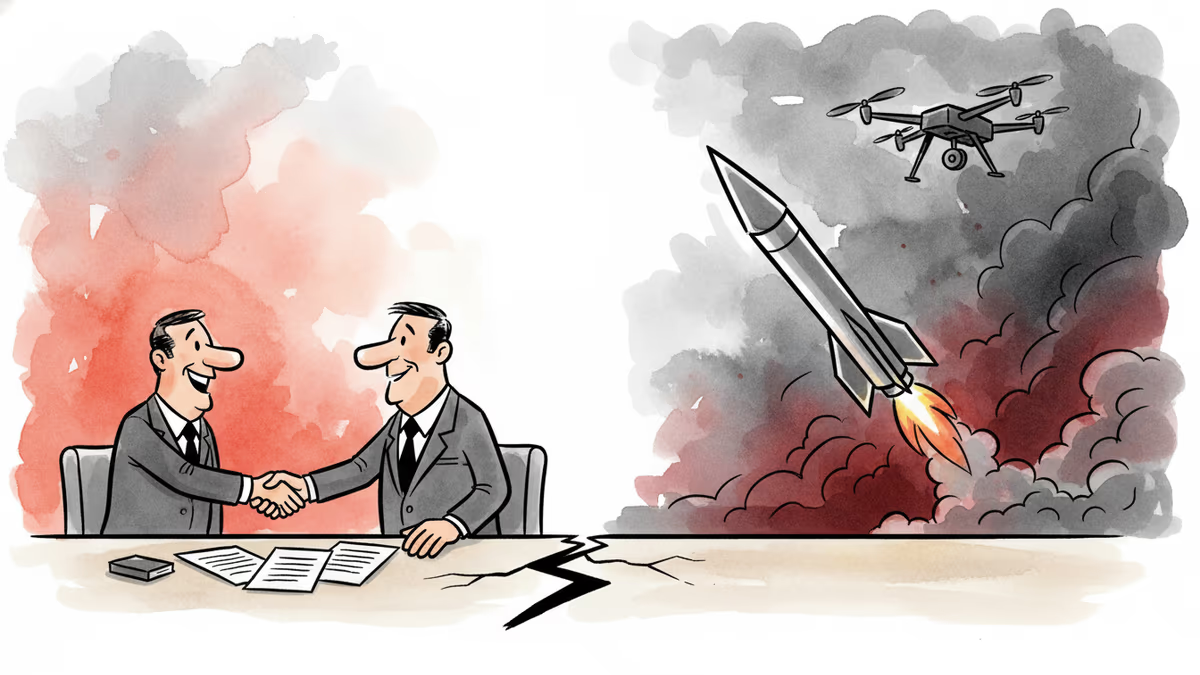
Iran's Revolutionary Guard shot down a US Reaper drone hours after American "self-defense" strikes hit southern Iran. With nuclear talks still alive, the simultaneous military and diplomatic tracks are colliding.

Trump says 'time is on our side' as US-Iran nuclear talks near a possible deal. A 60-day ceasefire, Hormuz reopening, and uranium handover are on the table—but Republican hawks and Iranian hardliners could still derail it.

Trump says a US-Iran nuclear deal is 'largely negotiated.' Iran calls it a 'Persian-style peace.' Both sides claim victory. Here's what's actually at stake.
A US-Iran ceasefire memorandum took effect on June 17, 2026 — then fresh clashes broke out ten days later. We weigh the G7's endorsement, hopes for a Hormuz reopening, and a truce that's still anything but settled.
Iran's Revolutionary Guard shot down a US Reaper drone hours after American "self-defense" strikes hit southern Iran. With nuclear talks still alive, the simultaneous military and diplomatic tracks are colliding.
Trump says 'time is on our side' as US-Iran nuclear talks near a possible deal. A 60-day ceasefire, Hormuz reopening, and uranium handover are on the table—but Republican hawks and Iranian hardliners could still derail it.
Trump says a US-Iran nuclear deal is 'largely negotiated.' Iran calls it a 'Persian-style peace.' Both sides claim victory. Here's what's actually at stake.
Thoughts
Share your thoughts on this article
Sign in to join the conversation