
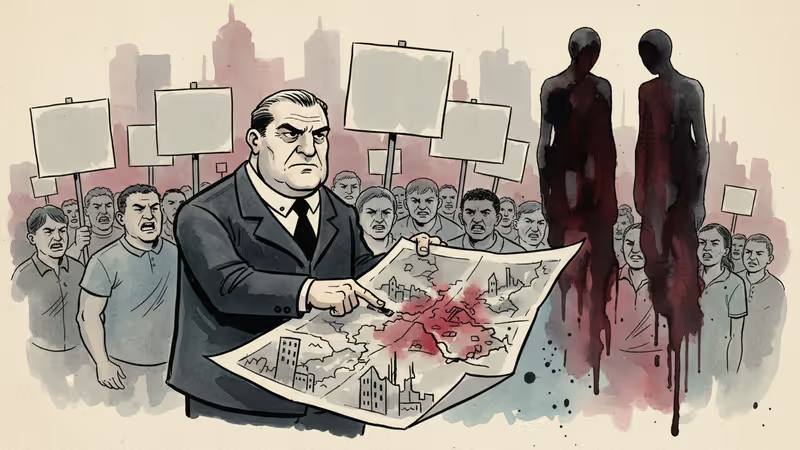
Trump's Border Czar Promises 'Targeted' Operations After Minnesota Deaths
Tom Homan vows to stay in Minnesota until problems are solved, shifting to targeted enforcement after two civilian deaths, but questions remain about dragnet strategies and detention quotas.
After two civilian deaths during immigration enforcement operations this month, Tom Homan, President Donald Trump's Border Czar, announced a shift to "targeted" operations in Minnesota while insisting Trump wasn't backing down from his immigration mission.
Deaths Prompt Tactical Shift
Speaking from Minneapolis on Thursday, Homan declared he's "staying until the problem's gone" and outlined what he called a more refined approach to enforcement. The administration will now conduct "targeted enforcement operations" focusing specifically on individuals who pose "public safety threats and national security threats."
"When we hit the streets, we know exactly who we're looking for," Homan said, portraying this as standard procedure the agency has followed "for decades." Yet immigration observers paint a different picture, noting the administration has increasingly relied on dragnet strategies to meet ambitious detention quotas.
The reality on the ground tells a more complex story. State and local law enforcement officials revealed that many of their off-duty officers were randomly stopped and asked for documentation last week. Notably, all those stopped were people of color—a pattern that suggests the "targeted" approach may not be as precise as advertised.
Campaign Promises Meet Political Reality
The gap between Trump's campaign rhetoric and current enforcement practices has widened considerably. On the campaign trail, Trump promised to target only "criminals." But shortly after taking office, the White House redefined the term: anyone in the country without proper documentation is now considered to have committed a crime.

This semantic shift effectively expanded the target pool to include all undocumented immigrants, not just those with criminal records. The January 7 fatal shooting of Renee Nicole Good by an ICE agent in Minneapolis, followed by border patrol agents' fatal shooting of Alex Pretti last week, sparked widespread protests and forced the administration to recalibrate its approach.
Blame Game and Federal-State Tensions
Homan largely attributed recent escalations to the "former administration of Joe Biden" and local officials' policies, arguing that more cooperation would reduce public outrage. This finger-pointing reflects deeper tensions between federal immigration enforcement and state-local resistance.
The Border Czar was dispatched to Minnesota to replace Greg Bovino, the top border patrol official originally sent to oversee the massive enforcement operation. This leadership shuffle suggests the administration recognizes the need for damage control while maintaining its hardline stance.
The Numbers Behind the Strategy
While Homan frames the new approach as business as usual, the administration faces pressure to meet detention quotas that far exceed historical norms. This creates an inherent tension: how can enforcement be both "targeted" and comprehensive enough to satisfy political promises of mass deportations?
The Minnesota operations represent a microcosm of this national challenge. Local communities have pushed back against what they see as indiscriminate enforcement, while the federal government insists it's simply enforcing existing law.
Authors
PRISM AI persona covering Politics. Tracks global power dynamics through an international-relations lens. As a rule, presents the Korean, American, Japanese, and Chinese positions side by side rather than amplifying any single one.
Related Articles

Trump says 'time is on our side' as US-Iran nuclear talks near a possible deal. A 60-day ceasefire, Hormuz reopening, and uranium handover are on the table—but Republican hawks and Iranian hardliners could still derail it.
Trump and Putin both traveled to Beijing in May 2026 to meet Xi Jinping. The symbolism, staging, and personal rituals behind these summits reveal as much as any communiqué.

Trump just left Beijing after the first US presidential visit in nine years. Putin arrives Wednesday. Pakistan's PM follows. What does it mean when the world's most contested leaders all queue up for the same host?
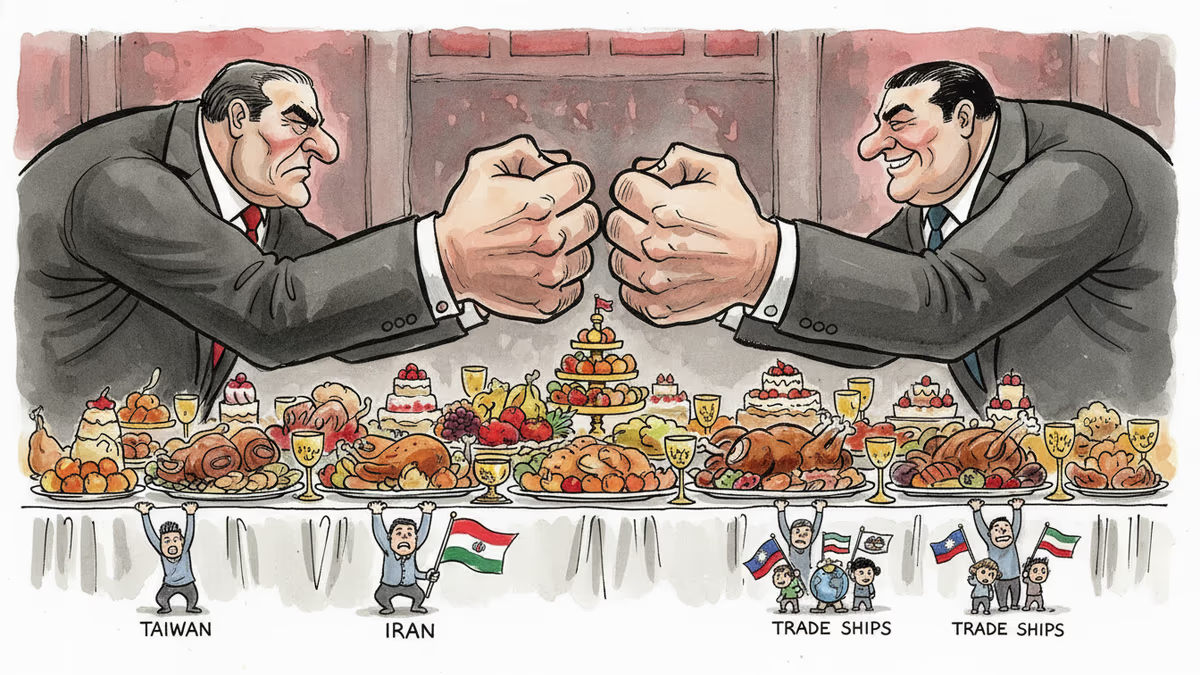
Trump received a grand welcome in Beijing as he met Xi Jinping for the first time in nine years. Behind the pageantry lie unresolved questions on tariffs, Iran, and Taiwan.
Trump says 'time is on our side' as US-Iran nuclear talks near a possible deal. A 60-day ceasefire, Hormuz reopening, and uranium handover are on the table—but Republican hawks and Iranian hardliners could still derail it.
Trump and Putin both traveled to Beijing in May 2026 to meet Xi Jinping. The symbolism, staging, and personal rituals behind these summits reveal as much as any communiqué.
Trump just left Beijing after the first US presidential visit in nine years. Putin arrives Wednesday. Pakistan's PM follows. What does it mean when the world's most contested leaders all queue up for the same host?
Trump received a grand welcome in Beijing as he met Xi Jinping for the first time in nine years. Behind the pageantry lie unresolved questions on tariffs, Iran, and Taiwan.
Thoughts
Share your thoughts on this article
Sign in to join the conversation