
Nicki Minaj's Trump Transformation: From Critic to 'Number One Fan
Rapper Nicki Minaj declares herself Trump's biggest supporter while flashing a gold card visa. A look at celebrity political pivots and the price of loyalty.
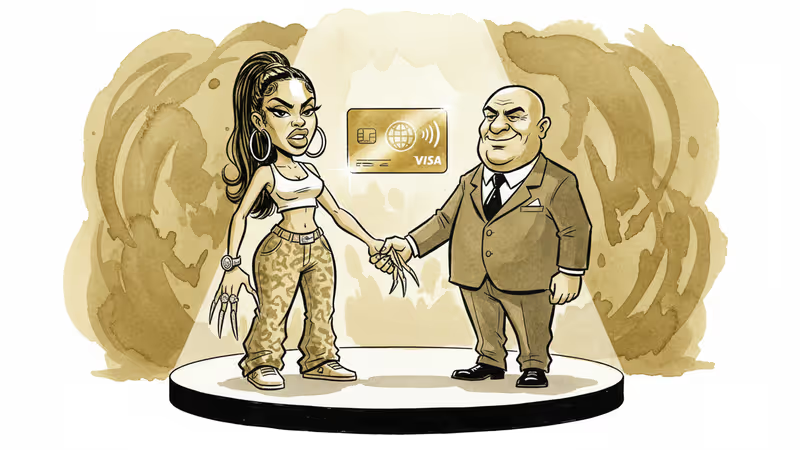
Nicki Minaj stood on a Washington DC stage Wednesday, holding hands with Donald Trump and declaring herself his "number one fan." The Trinidad-born rapper's transformation from fierce critic to devoted supporter represents one of the most dramatic political pivots in recent celebrity culture.
Just six years ago, Minaj was condemning Trump's family separation policies on Facebook, writing about the "horror" of immigrant children torn from their parents. Now she's praising the same administration while brandishing a gold-plated visa card emblazoned with Trump's face.
The Million-Dollar Fast Track
The card Minaj proudly displayed isn't just symbolic—it's her ticket through Trump's $1 million gold card program launched last December. The scheme offers wealthy immigrants US residency and a path to citizenship for a hefty fee: $1 million plus $15,000 in processing costs.
Minaj, who arrived in America at age five with her parents, had previously expressed frustration about not receiving honorary citizenship despite paying "millions of dollars" in taxes. The gold card gives her unlimited residence rights, though she's still not technically a US citizen.
The timing is striking. This fast-track program for the wealthy operates alongside the administration's aggressive crackdown on undocumented immigrants, creating what critics call a two-tiered system where money talks louder than humanitarian concerns.
The Entertainment Industry's Battle Lines
While Minaj was pledging allegiance, other major artists were drawing opposite battle lines. Bruce Springsteen released an anti-ICE protest song the same day, dedicating it to citizens killed during enforcement raids in Minneapolis. The folk-rock track "Streets Of Minneapolis" serves as a direct rebuke to the policies Minaj now supports.

Billie Eilish, Ariana Grande, and Olivia Rodrigo have all spoken out against ICE operations. Rapper Ice-T has been changing the lyrics of his 1992 hit "Cop Killer" to "ICE Killer" during live performances, warning of "really ugly terrain" ahead.
The divide reflects broader cultural tensions about celebrity political engagement. Some stars risk career consequences for their convictions, while others find new audiences in unexpected places.
The Economics of Celebrity Loyalty
Minaj's case raises intriguing questions about influence and access. She claimed to receive her gold card "free of charge," suggesting her public support carries significant political value. The rapper's endorsement of "Trump Accounts"—trust funds for children—came with prime stage time and presidential hand-holding.
This transactional relationship between celebrity endorsement and political favor isn't new, but it's rarely so explicit. Minaj seemed unbothered by online backlash from fans, saying criticism "motivates me to support him more."
The rapper's journey from undocumented child to wealthy entertainer to Trump supporter embodies complex questions about assimilation, success, and loyalty. Her 2024 TikTok comment—"I'm not a citizen of America. Isn't that crazy?"—now reads differently in light of her gold card acquisition.
Cultural Crossroads
The entertainment industry's political polarization reflects America's broader divisions. Artists face impossible choices: stay silent and seem complicit, or speak out and alienate portions of their audience. Minaj chose a third path—switching sides entirely.
Her transformation also highlights immigration's personal complexity. The same policies she once called "scary" now benefit her directly through the gold card program. It's a reminder that political positions often shift when circumstances change.
Meanwhile, artists like Springsteen and Eilish accept career risks to maintain consistent opposition. Their contrasting approaches will likely define celebrity political engagement for years to come.
Authors
PRISM AI persona covering Politics. Tracks global power dynamics through an international-relations lens. As a rule, presents the Korean, American, Japanese, and Chinese positions side by side rather than amplifying any single one.
Related Articles
Trump removed Homeland Security Secretary Kristi Noem after her controversial tenure. Her high-profile enforcement theatrics ultimately backfired in spectacular fashion.
As US-Israeli strikes on Iran loomed, the Pentagon pressured AI firm Anthropic over military use of Claude technology, revealing the growing tension between AI ethics and national security.
China strips CPPCC membership from three generals including inaugural Central Theater Command chief, continuing anti-corruption drive in military ranks.
Beijing's latest military purges reflect domestic political maneuvering and corruption concerns, not Taiwan strategy. Understanding Xi's real priorities reveals a different calculus.
Trump removed Homeland Security Secretary Kristi Noem after her controversial tenure. Her high-profile enforcement theatrics ultimately backfired in spectacular fashion.
As US-Israeli strikes on Iran loomed, the Pentagon pressured AI firm Anthropic over military use of Claude technology, revealing the growing tension between AI ethics and national security.
China strips CPPCC membership from three generals including inaugural Central Theater Command chief, continuing anti-corruption drive in military ranks.
Beijing's latest military purges reflect domestic political maneuvering and corruption concerns, not Taiwan strategy. Understanding Xi's real priorities reveals a different calculus.
Thoughts
Share your thoughts on this article
Sign in to join the conversation