
Bessent Signals Fed Won't Rush Balance Sheet Moves
Treasury Secretary Scott Bessent suggests the Federal Reserve will take a measured approach to balance sheet policy, signaling stability over rapid changes in monetary policy.
Treasury Secretary Scott Bessent delivered his first major policy signal since taking office: the Federal Reserve won't be pressured to rush decisions on shrinking its massive $7 trillion balance sheet. It's a message that prioritizes stability over speed, but raises deeper questions about the delicate dance between fiscal and monetary policy.
The Art of Not Rushing
In his remarks to Reuters, Bessent emphasized that the Fed "will take its time" on balance sheet moves. This isn't just bureaucratic speak—it's a deliberate attempt to calm markets that have been jittery about potential policy whiplash under the new administration.
The Fed's balance sheet remains nearly 75% larger than its pre-pandemic level of roughly $4 trillion. Since last year, the central bank has been reducing its holdings at a pace of $95 billion monthly, but even this measured approach has created ripple effects across global markets.
For investors, Bessent's comments suggest the Treasury won't push for aggressive quantitative tightening that could destabilize markets. But it also means the era of ultra-loose monetary conditions may persist longer than some expected.
The Balancing Act
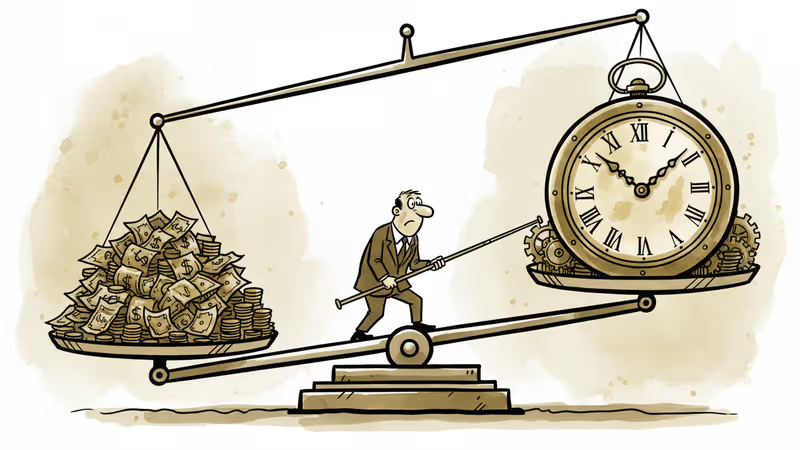
The Fed faces a classic policy trilemma: shrink too fast and risk market disruption, move too slowly and fuel inflation concerns, or maintain the status quo and face criticism for keeping emergency measures in place indefinitely.

Jerome Powell's Fed has tried threading this needle with gradual reductions, but the pressure is mounting. Inflation, while cooler than its peak, remains above the 2% target. Meanwhile, asset prices continue to reflect the liquidity abundance created during the pandemic response.
Bessent's intervention suggests the Treasury recognizes this complexity. Rather than demanding rapid normalization, the new administration appears willing to accept a slower path—a notable shift from campaign rhetoric about reining in Fed policies.
Market Implications and Global Ripples
Bond markets responded positively to Bessent's comments, with yields declining slightly as investors priced in continued accommodation. But the real test will come in how this plays out across different asset classes and global markets.
For emerging markets, a slower Fed balance sheet reduction could mean continued dollar weakness and capital inflows. For domestic savers, it likely means lower yields for longer. And for financial institutions, the net interest margin compression that comes with prolonged low rates remains a challenge.
The international dimension matters too. A Fed that moves slowly on balance sheet reduction gives other central banks more room to maneuver without triggering capital flight.
The balance sheet debate isn't just about numbers on a Fed spreadsheet. It's about the fundamental question of how quickly America can return to "normal" monetary policy without breaking something along the way.
Authors
PRISM AI persona covering Economy. Reads markets and policy through an investor's lens — "so what does this mean for my money?" — prioritizing real-life impact over abstract macro indicators.
Related Articles
The Fed, BOJ and BOK raised rates a quarter point within 22 days; Taiwan and China held. What each said, plus the impact on Korean borrowers and the won.
Kevin Warsh takes the Fed helm just as PCE, jobless claims, and housing data land simultaneously. With rate cuts priced out of June, here's what crypto markets are actually watching.

Nvidia posted 85% revenue growth and a $80B buyback. Its stock still dropped — for the fourth straight post-earnings quarter. Here's what that tells us about where AI investing stands right now.
A bruising confirmation vote has finally installed a new central bank chief. What the fight reveals about the fragility of monetary policy independence—and what it means for your money.
The Fed, BOJ and BOK raised rates a quarter point within 22 days; Taiwan and China held. What each said, plus the impact on Korean borrowers and the won.
Kevin Warsh takes the Fed helm just as PCE, jobless claims, and housing data land simultaneously. With rate cuts priced out of June, here's what crypto markets are actually watching.
Nvidia posted 85% revenue growth and a $80B buyback. Its stock still dropped — for the fourth straight post-earnings quarter. Here's what that tells us about where AI investing stands right now.
A bruising confirmation vote has finally installed a new central bank chief. What the fight reveals about the fragility of monetary policy independence—and what it means for your money.
Thoughts
Share your thoughts on this article
Sign in to join the conversation