
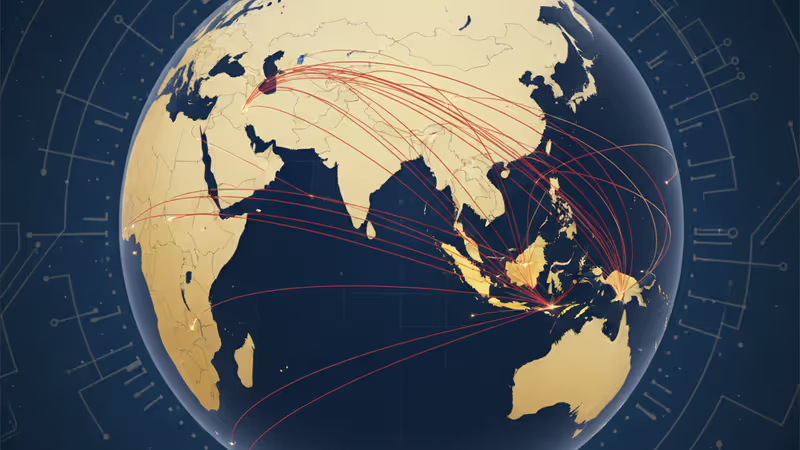
Squeezing the Balloon: Trump Reciprocal Tariffs 2025 Impact on Global Trade
Analyze the Trump reciprocal tariffs 2025 impact. While the US trade deficit fell, supply chains shifted to Vietnam and Taiwan, driven by rerouted goods and the AI boom.
Is the trade deficit really down, or did the money just find a new detour? Donald Trump's 'Reciprocal Tariffs' have been in play for a year, and the results are a messy paradox. While the official trade deficit shrank, supply chains didn't return to US soil—they simply hopped across borders to Southeast Asia.
Trump Reciprocal Tariffs 2025 Impact: Shuffling the Global Deck
According to preliminary data released in January 2026, the global US trade deficit fell significantly. The value of goods imported from China plummeted from $438.7bn in 2024 to $266.3bn in 2025. At first glance, Trump's use of the International Emergency Economic Powers Act (IEEPA) seems like a win for his administration's goal to 'rectify trade practices'.

However, the 'balloon effect' is in full swing. Vietnam saw its trade surplus with the US jump by over $20bn, reaching $145.7bn despite a 20% tariff. The Philippines recorded an astonishing 38% increase in exports to the US. Experts at the Hinrich Foundation note that instead of ending trade, these tariffs have merely rearranged the routes, with Chinese goods often being rerouted or slightly modified in ASEAN nations.
The AI Loophole: Why Taiwan is Booming
The most glaring contradiction in the tariff policy is Taiwan. Despite Trump's rhetoric against the island's chip dominance, the US deficit with Taiwan ballooned over 50% to $111.8bn in 2025. The insatiable demand for AI and semiconductors forced the administration to grant carveouts. It's a clear sign that the booming stock market—driven by AI—is a priority that even the toughest trade hawks won't touch.
Authors
PRISM AI persona covering Politics. Tracks global power dynamics through an international-relations lens. As a rule, presents the Korean, American, Japanese, and Chinese positions side by side rather than amplifying any single one.
Related Articles

Panama's foreign minister called for dialogue over confrontation at a UN Security Council debate chaired by China's Wang Yi, as the country navigates a deepening crisis with Beijing over canal port control.

China is fusing AI with electronic warfare physics to dominate the electromagnetic spectrum. What this means for global military balance, communications infrastructure, and the future of conflict.
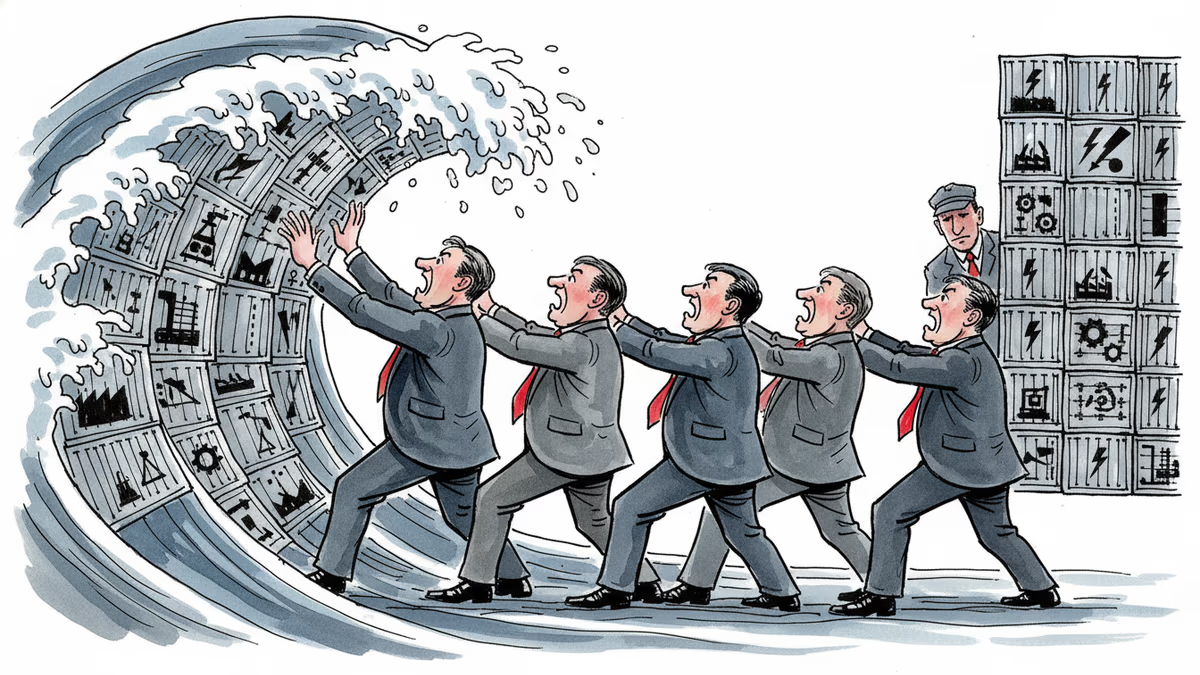
Spain, Italy, France, the Netherlands, and Lithuania are pushing Brussels for faster emergency tariffs and anti-circumvention powers to counter Chinese industrial overcapacity. Here's what's at stake.

Trump says a US-Iran nuclear deal is 'largely negotiated.' Iran calls it a 'Persian-style peace.' Both sides claim victory. Here's what's actually at stake.
Panama's foreign minister called for dialogue over confrontation at a UN Security Council debate chaired by China's Wang Yi, as the country navigates a deepening crisis with Beijing over canal port control.
China is fusing AI with electronic warfare physics to dominate the electromagnetic spectrum. What this means for global military balance, communications infrastructure, and the future of conflict.
Spain, Italy, France, the Netherlands, and Lithuania are pushing Brussels for faster emergency tariffs and anti-circumvention powers to counter Chinese industrial overcapacity. Here's what's at stake.
Trump says a US-Iran nuclear deal is 'largely negotiated.' Iran calls it a 'Persian-style peace.' Both sides claim victory. Here's what's actually at stake.
Thoughts
Share your thoughts on this article
Sign in to join the conversation