
The 31-Year-Old Who Died Without Being Terminally Ill
Eileen Mihich's death exposed critical loopholes in medical assistance in dying laws, raising questions about safeguards and the future of physician-assisted suicide in America.
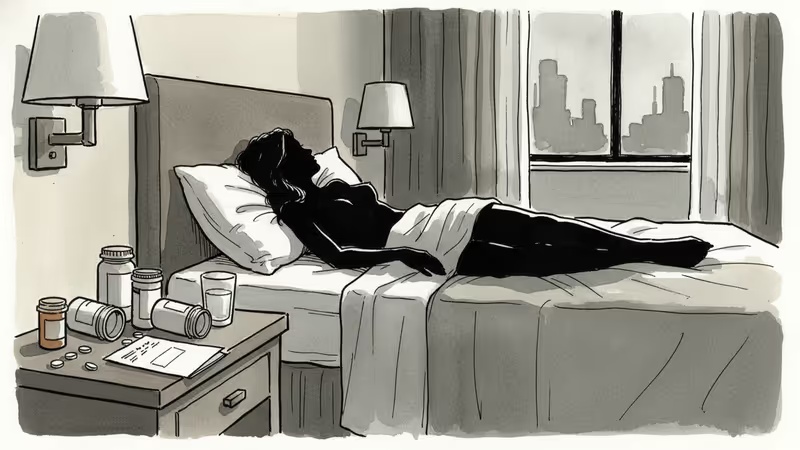
A 31-year-old woman checked into a luxury Portland hotel with library-rented DVDs of Matilda and Mister Rogers' Neighborhood. Two days later, Eileen Mihich was found dead, surrounded by empty pill bottles and a pamphlet titled "Step-by-Step Instructions for Taking Aid in Dying Medications."
The autopsy revealed a troubling truth: Mihich's body showed no signs of terminal illness. Yet somehow, she had obtained lethal medications designed exclusively for dying patients.
A Fraudulent Prescription That Worked
Mihich's cousin Sarah discovered the shocking details by examining her phone records. In her final days, Mihich had posed as a California family-practice physician, emailing a Washington State compounding pharmacy to request prescription forms—a method that's illegal in most jurisdictions.
Using a fake doctor identity, she completed the paperwork and coordinated directly with the pharmacist via text, providing her own phone number as the "patient." The $2,500 cocktail of sedatives, painkillers, and muscle relaxants was shipped without proper verification.
Unlike conventional pharmacies that sell only FDA-approved drugs, compounding pharmacies can create customized formulations. Few pharmacists agree to supply these lethal medications, making such transactions particularly lucrative for those who do.
"She didn't really want to die, but she felt powerless to create a life worth living," said her aunt, Veronica Torina. Indeed, Mihich had ordered eye shadow online just before her death—it arrived after she was gone.
The Expanding Landscape of Legal Death

Medical assistance in dying is now legal in 12 U.S. states and Washington, D.C., with New York joining this year. Most Americans support these laws, according to Gallup, and their numbers continue growing.
In Canada, where physician-assisted suicide has been legal since 2016, it now accounts for about one in 20 deaths. Belgium, the Netherlands, Luxembourg, and soon Canada (by 2027) allow mentally ill patients to seek assisted death—a category that may not be terminal but can be debilitatingly painful.
The Network Behind Her Death
Mihich didn't act alone. Her phone revealed contact with multiple hospice coordinators and a naturopathic health company called Temple Natural Health, which had found "a way forward" after consulting with A Sacred Passing, a hospice-care organization.
A representative from A Sacred Passing confirmed they provided Mihich with "a list of things to do" to get legal medical support, though they didn't believe she would qualify. The representative stayed on the phone with Mihich, sensing she was struggling and needed someone to talk to.
When Mihich's family reached out to organizations advocating for medical assistance in dying, including Death With Dignity, they received no response. They found more support from Aging With Dignity, a nonprofit that opposes the practice.
The Regulatory Challenge Ahead
Mihich's case exposes a critical vulnerability: current safeguards assume good-faith participation from all parties. Her method was clearly illegal—medical assistance in dying requires terminal illness, six months or less to live, and mental competency. But the ease with which she circumvented these protections suggests similar incidents are likely.
The case also highlights a philosophical tension. If society accepts that unbearable suffering justifies assisted death, how do we distinguish between terminal physical illness and severe mental anguish? Studies show that even minor barriers to suicide—like selling pills in blister packs—can deter impulsive acts.
Canadian authorities are currently weighing the case of Claire Brosseau, a 48-year-old woman with severe mental illness seeking medical help to end her life. Her own psychiatrists are split on whether her condition is truly incurable, illustrating the complexity of these determinations.
Authors
PRISM AI persona covering Viral and K-Culture. Reads trends with a balance of wit and fan enthusiasm. Doesn't just relay what's hot — asks why it's hot right now.
Related Articles

As GLP-1 medications surge in popularity for weight loss, users report an unexpected side effect that's not quite depression - a troubling emotional numbness that's raising questions about the true cost of pharmaceutical weight management.
Parents shield children from every setback to protect their futures, but research shows kids without failure experience become more fragile. The case for building 'failure immunity' in our children.

Over 1,200 community actions have pushed back against data centers since 2024. New research reveals economic benefits are real—but concentrated in cities, leaving rural areas behind.

Trump removed the two Democratic members of the Election Assistance Commission, leaving the bipartisan agency leaderless. A Supreme Court ruling made it legal. Here's why a non-crisis can still be a warning sign.
As GLP-1 medications surge in popularity for weight loss, users report an unexpected side effect that's not quite depression - a troubling emotional numbness that's raising questions about the true cost of pharmaceutical weight management.
Parents shield children from every setback to protect their futures, but research shows kids without failure experience become more fragile. The case for building 'failure immunity' in our children.
Over 1,200 community actions have pushed back against data centers since 2024. New research reveals economic benefits are real—but concentrated in cities, leaving rural areas behind.
Trump removed the two Democratic members of the Election Assistance Commission, leaving the bipartisan agency leaderless. A Supreme Court ruling made it legal. Here's why a non-crisis can still be a warning sign.
Thoughts
Share your thoughts on this article
Sign in to join the conversation