
TikTok's Awkward Awards Show Wasn't a Failure—It Was a Warning Shot to Old Media
The chaotic first U.S. TikTok Awards revealed a critical truth: The platform's algorithmic magic can't be replicated. An analysis of the future of media.
The Lede: Why The C-Suite Should Care
The first-ever U.S. TikTok Awards were a chaotic, glitch-filled spectacle that many dismissed as a failure to translate online magic to a live stage. They are missing the point. This wasn't a failed awards show; it was a powerful, unintentional demonstration of TikTok's core competitive advantage: the algorithmic moat. The event's awkwardness revealed that the platform's cultural dominance cannot be simply lifted, packaged, and broadcast through traditional media formats. For any leader in media, marketing, or tech, this 'failure' is a critical case study in the immutable gap between algorithmically-driven culture and linear, one-to-many entertainment.
Why It Matters: The Limits of Translation
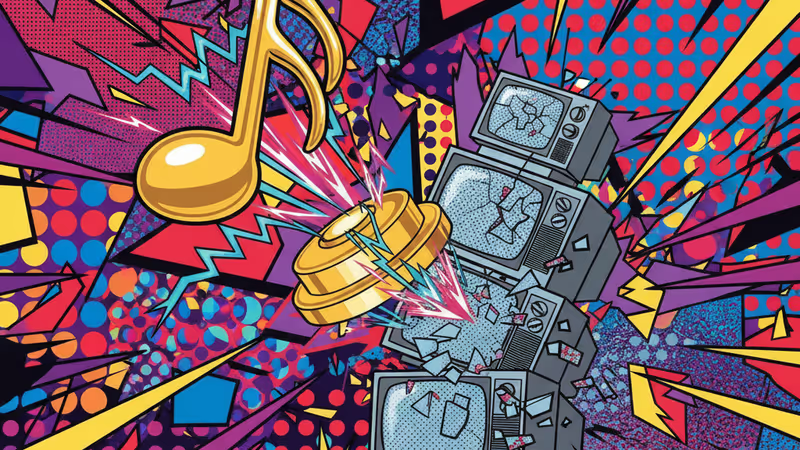
The inability to smoothly port the TikTok experience into a live broadcast has significant second-order effects. The on-stage broken screens and awkward pauses weren't just technical glitches; they were a metaphor for the broken translation of the platform's essence.
- For Marketers: It proves that 'going viral' is not a transferable asset. A trend's power is inextricably linked to the context of the For You Page—the sound, the adjacent videos, the user's specific mood. You cannot simply replicate a TikTok moment in a Super Bowl ad and expect the same impact. The medium is the message.
- For Media Companies: This is a stark warning. Simply hiring TikTok creators or optioning viral trends is a flawed strategy. The value is not in the individual pieces of content but in the network effect and the AI-driven curation that stitches them together into a personalized, addictive stream.
- For Competitors (Meta, YouTube): It underscores that feature-parity (e.g., Reels, Shorts) is not enough. The challenge isn't just replicating a short-form video feed, but reverse-engineering the cultural engine and serendipity that TikTok’s algorithm has perfected.
The Analysis: A Category Error in Entertainment
Legacy media has a long history of attempting to absorb and institutionalize internet culture, from MTV's early embrace of web videos to the Streamy Awards. These efforts aimed to legitimize digital creators by placing them within established formats. TikTok's attempt was different—it tried to replicate the format of its own feed, and in doing so, committed a category error.
A traditional awards show is a linear, curated narrative. The TikTok For You Page is an infinite, personalized, chaotic dialogue. Forcing the latter into the structure of the former is like trying to capture lightning in a bottle. The show's chaos—the abrupt shifts in tone, the technical mishaps, the moments of genuine connection (like Keith Lee's speech) punctuated by absurdity (plushie cannons)—was a perfect, if accidental, reflection of the FYP experience. But without the algorithm to smooth the transitions and personalize the flow for each individual viewer, it just felt disjointed and strange. The broadcast failed because it lacked the single most important character: the algorithm itself.
PRISM Insight: The Algorithmic Moat
The key takeaway for investors and strategists is the concept of the 'Algorithmic Moat'. TikTok’s defensibility isn't just its user base or its creators; it's the black box of its recommendation engine. This AI has been trained on billions of hours of user behavior to understand and even predict cultural micro-trends before they fully form.
The awards show proved this moat is deeper than we thought. You can take the creators off the platform, you can put the viral songs on a stage, but you cannot replicate the core product: a perfectly customized stream of cultural discovery. This implies that the true valuation of platforms like TikTok lies not in their content libraries, but in the predictive power and cultural attunement of their AI. Any M&A activity, like the recently signed deal for its U.S. operations, must be valued on the basis of acquiring this intelligence layer, not just a social media app.
PRISM's Take: Culture Isn't Broadcast Anymore
The 2025 TikTok Awards should not be remembered as a clumsy first attempt. It should be seen as the moment the new media order inadvertently flexed on the old one. By failing to fit into a traditional broadcast format, TikTok proved its own revolutionary nature. Culture is no longer a top-down broadcast delivered by a handful of gatekeepers on a Hollywood stage. It is a decentralized, algorithmically-mediated conversation happening on millions of screens simultaneously. The show's glitches and surreal vibe weren't a bug; they were a feature, broadcasting a clear message to the entire entertainment industry: You can't televise a revolution.
Related Articles
The TikTok Awards are more than a party; they're a strategic move to solidify the platform as a new cultural institution, challenging Hollywood and YouTube.
An analysis of how social media and the creator economy are turning historic castles into high-value digital assets, fueling a new 'Castle Economy'.
Disconnected news clips are more than just noise; they're rewiring our brains for superficial analysis. Discover the risks and opportunities of the micro-news age.
An artist's viral dog embroidery reveals key trends in the creator economy, pet humanization, and the future of authentic D2C commerce. Analysis for leaders.