

The Silicon Curtain: How US Sanctions Are Fueling China's AI Chip Rebellion
US sanctions, intended to curb China's tech rise, are fueling a boom in domestic AI chipmakers. This isn't just hype; it's the birth of a parallel hardware ecosystem.
The Lede: Beyond the IPO Hype
The staggering 700% IPO surge of Chinese AI chipmaker MetaX isn't just another speculative frenzy. It's a financial flare signal, illuminating a seismic shift in the global technology landscape. For busy executives and investors, this isn't about one hot stock; it's about the birth of a parallel, state-backed AI hardware ecosystem. US export controls, designed to hobble China's technological ambitions, are paradoxically acting as the ultimate market catalyst, creating a protected, trillion-dollar sandbox for a new breed of Nvidia rivals to flourish.
Why It Matters: The Great Bifurcation
The rise of homegrown Chinese GPU players like MetaX and Moore Threads signifies more than just new competition. It marks the hardening of a 'silicon curtain' that is bifurcating the global AI industry. The key implications are:
- A Fragmented Market: The world is splitting into two distinct AI hardware spheres: a US-led ecosystem built around platforms like Nvidia's CUDA, and a burgeoning Chinese ecosystem forced to develop its own hardware and software stacks from the ground up. Global companies will soon face complex choices about supply chain dependencies and software compatibility.
- Forced Innovation: Denied access to the best, China is forced to innovate differently. Instead of chasing Nvidia on single-chip performance—a losing battle for now—companies like Huawei are pioneering system-level solutions. This creates new architectural paradigms that could, in the long run, challenge Western design philosophies.
- The End of a Global Standard: For decades, tech evolved towards global standards. The AI chip war reverses this. Prepare for a future where AI models may not be easily portable between US and Chinese hardware, creating new moats and new headaches for multinational corporations.

The Analysis: Asymmetric Warfare in the AI Stack
Washington's strategy was straightforward: cut off the supply of cutting-edge GPUs to slow China's progress in large-scale AI model training. However, this has triggered a classic case of asymmetric response. While no single Chinese chip can match an Nvidia H100, that's no longer the only game in town.
Huawei's 'Ascend' cluster strategy is the prime example. By networking a larger number of their 'good enough' processors with high-speed interconnects, they can achieve competitive performance for massive AI training tasks at a system level. This is a brute-force solution born of necessity, but it works. They are not trying to out-engineer Nvidia's flagship chip; they are trying to out-system Nvidia's complete solution within a captive domestic market.
The real challenge for China remains the software moat. Nvidia's dominance isn't just its silicon; it's CUDA, the software platform that millions of developers are trained on. China's next great hurdle is building a compelling software and developer ecosystem to rival CUDA's decade-long head start. The immense capital flowing into these new companies is earmarked for precisely this challenge.
PRISM's Take: An Unintended Consequence
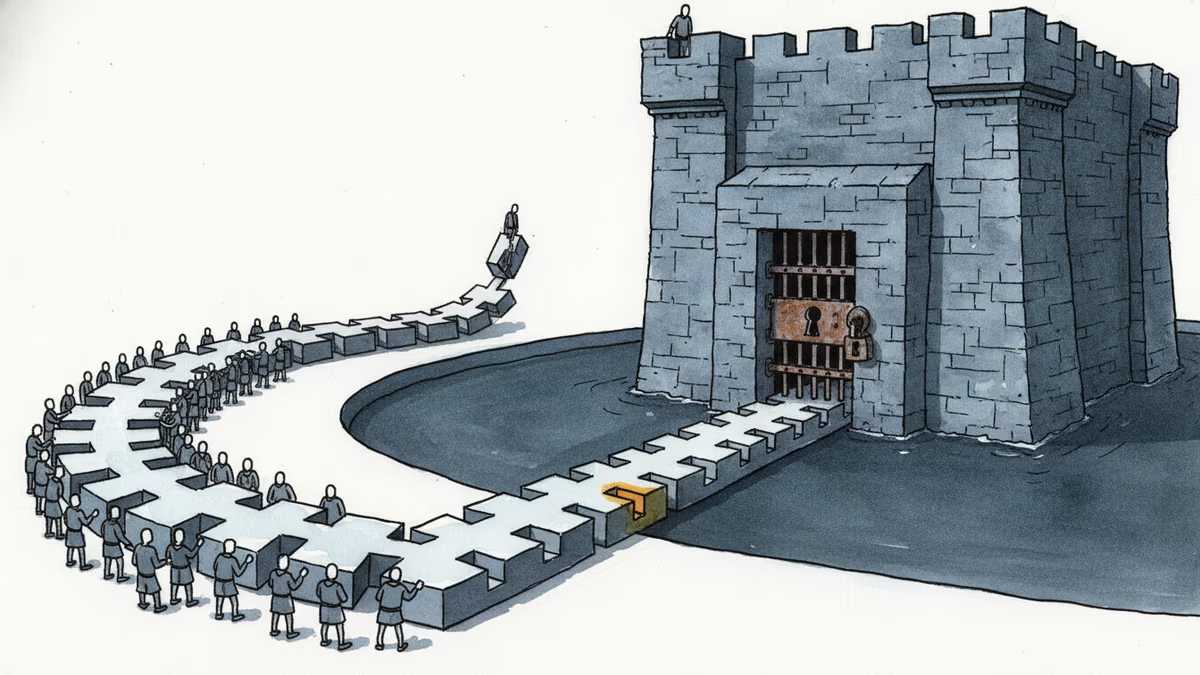
The US policy to contain China's AI capabilities has inadvertently created the perfect incubator for a resilient, self-sufficient, and battle-hardened competitor. By walling off its domestic market, China has eliminated the primary barrier to entry for its nascent chip firms: direct competition with Nvidia. The result will not be the crippling of China's AI industry, but the creation of a fundamentally different one. The Great Firewall is expanding from the internet to the silicon itself, and the world must now prepare to navigate a permanently divided technological landscape.
Authors
Related Articles

Samsung Electronics' union branch revealed that 84% of survey respondents oppose the government's roughly $290 billion (₩400 trillion) semiconductor megaproject in Gwangju. Government, management, the union and shareholders are all reading the same national project in sharply different ways.
Nvidia shipped roughly a billion RISC-V cores in 2024, then announced it would run CUDA on the open standard. We break down how royalty-free instruction sets and open software stacks are trying to route around CUDA's lock-in. Part 2 of the Semiconductor Sovereignty series.

US AI-chip export controls split into three layers in the first half of 2026 — January easing, a May crackdown on circumvention, and a pending bill. Nvidia erased China from its guidance and still posted a record $81.6 billion quarter. A look at the export policy that both shields and cages it.

AMD's MI325X matches or beats Nvidia on memory and bandwidth — yet Nvidia's 86-92% share holds. The real moat is CUDA, 20 years in the making. Part 1 of 4.
Samsung Electronics' union branch revealed that 84% of survey respondents oppose the government's roughly $290 billion (₩400 trillion) semiconductor megaproject in Gwangju. Government, management, the union and shareholders are all reading the same national project in sharply different ways.
Nvidia shipped roughly a billion RISC-V cores in 2024, then announced it would run CUDA on the open standard. We break down how royalty-free instruction sets and open software stacks are trying to route around CUDA's lock-in. Part 2 of the Semiconductor Sovereignty series.
US AI-chip export controls split into three layers in the first half of 2026 — January easing, a May crackdown on circumvention, and a pending bill. Nvidia erased China from its guidance and still posted a record $81.6 billion quarter. A look at the export policy that both shields and cages it.
AMD's MI325X matches or beats Nvidia on memory and bandwidth — yet Nvidia's 86-92% share holds. The real moat is CUDA, 20 years in the making. Part 1 of 4.
Thoughts
Share your thoughts on this article
Sign in to join the conversation