
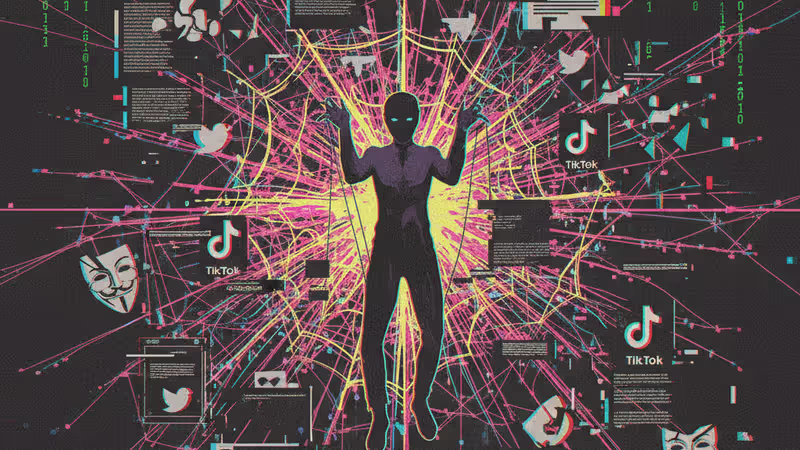
The Epstein Files: A Masterclass in Modern Information Warfare
The release of the Epstein files isn't just a political scandal. It's a playbook for modern information warfare, setting a dangerous precedent for the future.
The Lede: Beyond the Scandal
The release of new Jeffrey Epstein documents is not merely a political sideshow or a rehashing of a sordid past. For the C-suite, this is a live-fire demonstration of a critical 21st-century reality: information itself—archival, redacted, and decontextualized—has become a precision-guided weapon. The strategic deployment of decades-old photos by political operatives offers a stark playbook for how narrative battles will be fought, not just in politics, but in corporate, market, and geopolitical arenas.
Why It Matters: The Normalization of 'Archival Warfare'
The immediate political goal is obvious: tarnish a rival by association. But the second-order effects are far more significant. We are witnessing the weaponization of the public record, where legal discovery and document dumps are no longer just tools for justice, but raw material for real-time memetic warfare.
- Erosion of Evidentiary Value: When a redacted photo from an official government file is instantly framed as proof of a cover-up, the line between evidence and propaganda dissolves. This tactic exploits information gaps to sow maximum distrust in institutions, from the Department of Justice to the media.
- The Power of Visual Anchors: In a saturated information ecosystem, a single provocative image—like Bill Clinton in a pool—can hijack the entire narrative. The context, timeline, and relevance become secondary to the immediate emotional and political impact. This is a lesson in cognitive hijacking.
- The Playbook is Public: Competitors, activist investors, and nation-states are watching. The strategy is clear: force the release of sensitive data, selectively amplify the most damaging elements, and use the ambiguity of redactions to build a conspiracy.
The Analysis: A Calculated Reversal
The Trump administration's previous reluctance to release these same files, followed by their current aggressive promotion of them, is not a contradiction; it's a strategic evolution. The initial resistance maintained control. The eventual release, mandated by Congress, created an opportunity. By immediately seizing the narrative and focusing on a well-established political foil like Bill Clinton, they effectively preempted any potential damage to their own side from the bipartisan list of Epstein's associates.
This is a calculated move to reframe a potentially sprawling, multi-sided scandal into a simple, partisan attack. The very act of DOJ-affiliated spokespeople posting the images from personal accounts blurs the lines between official government communication and partisan campaign messaging, a hallmark of modern political information operations.
PRISM Insight: The Analog Precursor to an AI-Powered Future
What we are seeing with the Epstein files is the analog prototype for a far more chaotic future. Today, operatives are weaponizing grainy, decontextualized photos from official archives. Tomorrow, they will deploy photorealistic, AI-generated 'evidence' with fabricated provenance to achieve the same goal with greater speed and scale.
This event serves as a crucial benchmark. It establishes the public's appetite for and vulnerability to visually-driven, context-light narratives. The battle for truth is rapidly shifting from interpretation (what does this photo mean?) to authentication (is this photo even real?). Companies and governments are unprepared for a world where their 'Epstein files' moment can be synthesized on demand.
PRISM's Take: The Medium is the Attack
Ultimately, the specific content of these newly released photos is less important than the method of their deployment. The real story is the refinement of a devastatingly effective information warfare doctrine. It demonstrates that in the modern attention economy, you don't need a smoking gun; you just need a grainy photo, a powerful distribution network like X, and a pre-existing narrative to slot it into.
This isn't just about Jeffrey Epstein's ghost haunting the political elite. It's about that ghost being commandeered as a digital drone in a perpetual war for public perception. The key takeaway is not who was on the island, but who is now mastering the art of narrative island-hopping to secure political high ground.
Related Articles
The DOJ's Epstein file release is more than a scandal. It's a stress test for institutional transparency in an age of big data and weaponized information.

The DOJ's antitrust lawsuit against Apple is a tectonic shift. We analyze its impact on tech, finance, and the future of platform monopolies. This is not just a lawsuit, it's the end of an era.
The DOJ's botched release of the Epstein files is more than a scandal. It's a critical lesson in data transparency, digital trust, and information warfare.
The chaotic first U.S. TikTok Awards revealed a critical truth: The platform's algorithmic magic can't be replicated. An analysis of the future of media.