
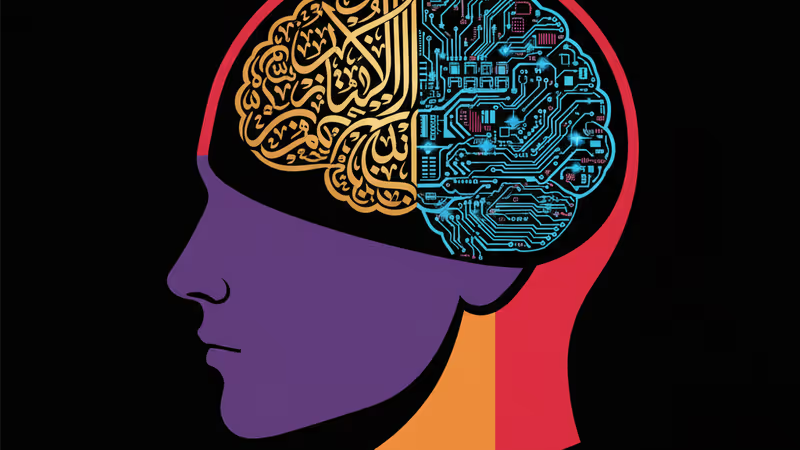
The Arabic Algorithm: How a 1,500-Year-Old Language Is Shaping the Future of AI
Uncover how the historical influence of the Arabic language offers a strategic roadmap for AI, tech investment, and unlocking the 400M-strong MENA market.
The Lede: Beyond 'Algebra' and 'Coffee'
While the world acknowledges the historical contribution of Arabic words to the English lexicon, a far more critical story is unfolding in real-time. For global executives and investors, the complex structure of the Arabic language is no longer a historical curiosity; it's a high-stakes technical challenge and a multi-billion dollar market opportunity. The companies that crack the Arabic code for AI and natural language processing (NLP) won't just sell more products—they will unlock the primary digital interface for over 400 million people in one of the world's fastest-growing economic blocs.
Why It Matters: The Dialect Dilemma is a Digital Moat
The core challenge isn't just translating Modern Standard Arabic (MSA), the formal language of news and government. The real value lies in understanding the 25+ major dialects spoken colloquially from Morocco to Iraq. This fragmentation, often seen as a barrier, is also a formidable competitive moat.
- Second-Order Effects: A voice assistant, chatbot, or recommendation engine that only understands MSA is functionally useless for everyday e-commerce or social media in Riyadh, Cairo, or Dubai. The failure to grasp local dialects leads to poor user experience, customer churn, and ceded market share to local or more agile competitors.
- Industry Impact: Big Tech's standard playbook of launching a single-language model and iterating has failed repeatedly in the Arabic-speaking world. This creates a rare opening for specialized startups and regional tech champions to build defensible businesses around hyper-local, dialect-specific AI models.
The Analysis: From Ancient Trade Routes to Digital Pipelines
Historically, Arabic words like 'algorithm' (from al-Khwarizmi), 'algebra' (al-jabr), and 'zenith' (samt al-ra's) entered other languages through centers of scholarship and trade. They were carriers of advanced concepts in mathematics, astronomy, and commerce. Today, the dynamic is reversed: the world's technology is trying to enter the Arabic linguistic sphere, and it's hitting a wall.
The language's non-concatenative morphology (where root letters are modified internally to change meaning) and right-to-left cursive script are trivial hurdles compared to the deep chasm between formal MSA and spoken dialects. An NLP model trained on Al Jazeera news (MSA) will be completely lost trying to parse a conversation on a Kuwaiti TikTok stream.
This isn't a simple localization task; it's a fundamental data and modeling problem. Western AI models, overwhelmingly trained on English and other European languages, lack the architectural nuance to handle this level of diglossia (the switching between two forms of a language). This technical gap represents the most significant strategic vulnerability for global tech platforms operating in the MENA region.
PRISM Insight: The Rise of 'Arab-Centric AI' is the Next Investment Frontier
The misconception that Arabic is simply 'too difficult' for technology is a flawed assumption that creates a powerful investment thesis. The real opportunity is not in 'solving' Arabic as a monolithic entity, but in building specialized models for its most commercially valuable dialects.
We are seeing the emergence of a new category: Arab-Centric AI. Watch for startups focused on creating foundational models for Gulf Arabic, Egyptian Arabic, or Levantine Arabic. These companies are building the essential infrastructure for the next generation of regional services:
- Conversational Commerce: AI that can understand a spoken order for groceries in a thick Saudi accent.
- Media & Content Analysis: Tools that can gauge public sentiment from social media across a dozen dialects simultaneously.
- Fintech & Regtech: Advanced identity verification and customer support that functions in the user's native tongue.
Investors should view the lack of high-quality, dialect-specific datasets not as a risk, but as the raw material for building a defensible data advantage. The first companies to build and commercialize these linguistic assets will become acquisition targets for global players or regional giants in their own right.
PRISM's Take: Linguistic Fluency is the New Market Access
The historical flow of Arabic words into English was a lagging indicator of a civilization's peak influence. Today, the ability of global technology to fluently integrate into the Arabic linguistic ecosystem is a leading indicator of future market dominance. For centuries, the world learned the language of commerce and science from Arabic speakers. Now, in the age of AI, the smartest technology must learn to speak Arabic—in all its rich, complex, and diverse forms. Ignoring this linguistic reality is not just a cultural oversight; it is a critical failure of strategic foresight.
Related Articles

The rise of affordable luxury honeymoons isn't about saving money. It's a strategic shift in consumer values, redefining the future of travel and hospitality.
Wordle is more than a game. It's a masterclass in user acquisition and the NYT's secret weapon in the attention economy. PRISM breaks down the strategy.
The NYT's new game, Strands, isn't just a puzzle. It's a strategic move to deepen user engagement and build an unbreakable subscription moat.

An analysis of the NYT Connections puzzle, not as a game, but as a strategic asset redefining media, user engagement, and data collection in the attention economy.