
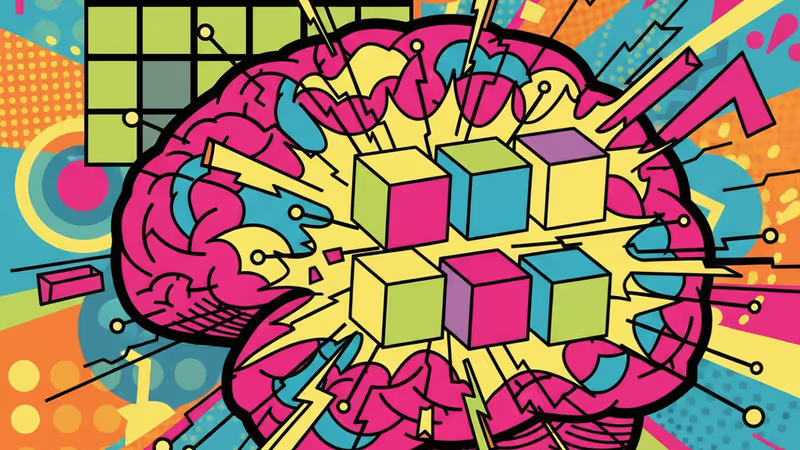
Beyond Wordle: How NYT's Connections Rewired the Media Playbook
An analysis of the NYT Connections puzzle, not as a game, but as a strategic asset redefining media, user engagement, and data collection in the attention economy.
The Lede: The Five-Minute Moat
Millions of professionals begin their day not with market reports, but with a 16-word grid. The New York Times' viral puzzle, Connections, is far more than a morning diversion; it's a masterclass in habit formation and a core pillar in the Times' formidable digital subscription empire. While today's puzzle may hinge on Hollywood trivia, the real story is how a simple word game became one of media's most powerful strategic assets.
Why It Matters: The New Rules of Engagement
In an era of rampant subscription fatigue and fractured attention, NYT Games has built an unbreachable competitive moat with a remarkably low-tech product. This isn't just about fun; it's a strategic playbook for any industry vying for consumer mindshare. The success of Connections demonstrates three critical principles:
- Ritual over Volume: A single, daily challenge creates scarcity and appointment-based engagement, trumping the infinite-scroll model of social media.
- Low-Stakes Success: The game provides a daily, achievable win—a valuable dopamine hit in a world of complex, often intractable problems.
- Bundling Stickiness: The Games offering makes the core news subscription exponentially 'stickier', drastically reducing churn by integrating the NYT brand into a daily habit beyond just reading the headlines.
The Analysis: Engineering a Cultural Touchstone
The New York Times didn't just buy a hit with Wordle; it acquired a formula. Connections, developed in-house, perfects that formula. Its genius lies in its carefully engineered constraints and its understanding of human cognition. The puzzle demands lateral thinking, forcing players to see non-obvious relationships between words—a skill high-performing executives prize.
The color-coded difficulty (Yellow to Purple) provides a structured cognitive journey, making the game accessible but challenging. Unlike a purely algorithmic competitor, the human touch of its editors, like Wyna Liu, lends the puzzles a quirky, relatable intelligence that AI has yet to replicate. This curation fosters a sense of community, a daily 'water cooler' moment where millions share a common, solvable challenge. This is not passive content consumption; it is active, focused engagement—the rarest commodity in the digital economy.
PRISM Insight: The Gamification of Cognitive Data
Beneath the surface of this simple game lies a vast and valuable data-gathering operation. Every tap, every incorrect guess, every successful grouping, and the time taken to solve the puzzle generates a rich dataset on human associative thinking. While the NYT uses this to refine its puzzles, the second-order implications are immense.
This 'cognitive exhaust' is a goldmine for understanding how humans categorize information and make creative leaps—a current weakness in even the most advanced Large Language Models (LLMs). We are witnessing the largest voluntary cognitive study in history, disguised as a word game. For AI developers, this data on non-linear human thought is priceless, offering a path to train more nuanced and context-aware models.
PRISM's Take: The Future of Media is a Daily Habit
The strategic brilliance of Connections is its proof that in the attention economy, depth beats width. Forget the metaverse for a moment; the most valuable digital real estate is the five minutes of focused, daily attention the NYT commands from its most valuable users. This isn't a game; it's a loyalty engine.
Connections proves that the future for media and consumer brands isn't just about delivering a product, but about embedding your brand into the daily rituals of your audience. The companies that shift their focus from passive consumption to active, habitual engagement will not only survive the next wave of digital disruption—they will define it.
Related Articles
Wordle is more than a game. It's a masterclass in user acquisition and the NYT's secret weapon in the attention economy. PRISM breaks down the strategy.
Viral comic artist Berkeley Mews isn't just funny—his work is a masterclass in the creator economy. We break down his formula for digital success.
New research shows swearing isn't just cathartic—it's a neurological hack that boosts strength and reduces pain. Discover the science behind this primal biohack.
Discover how the simple act of peeling a banana reveals the hidden cognitive friction and behavioral debt crippling your organization's productivity and innovation.