
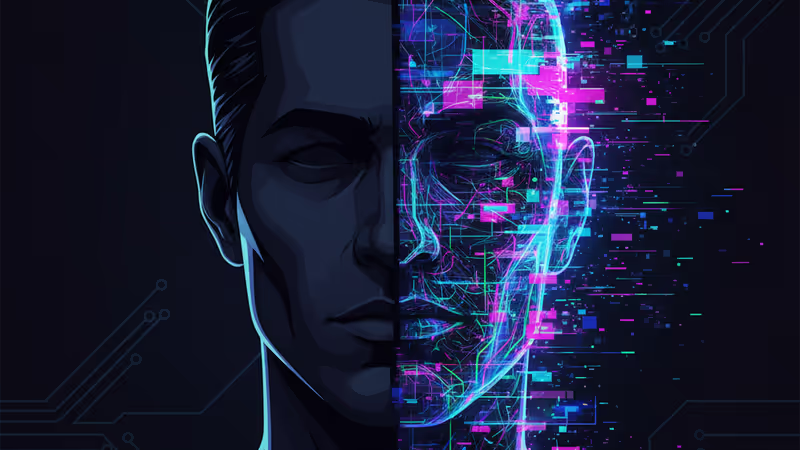
The Altman Paradox: Why a Deepfake Documentary Reveals More Than the Real CEO
A new documentary deepfakes Sam Altman, revealing critical insights into digital identity, AI's power struggles, and the future of reputational risk.
The Lede: The Unreachable CEO and His Unauthorized Digital Ghost
When a filmmaker, stonewalled by OpenAI CEO Sam Altman, resorts to creating a deepfake of his subject, it’s more than a guerrilla filmmaking tactic. It’s a seminal event marking the dawn of the “permissionless portrait.” This isn't just a story about a documentary; it’s a critical intelligence briefing on the new frontier of reputational risk, digital identity, and the power dynamics of the AI era. For any leader in the public eye, this film serves as a stark warning: if you don’t control your narrative, a synthetic version of you will.
Why It Matters: The Weaponization of Absence
The core insight from Deepfaking Sam Altman has little to do with the film's plot and everything to do with the conditions that created it. Altman's inaccessibility created a narrative vacuum, and generative AI filled it. This dynamic is set to reshape influence and public perception.
- Reputational Singularity: A public figure's silence can now be interpreted not as an absence of comment, but as an invitation for a synthetic entity to speak on their behalf. This creates an entirely new category of reputational threat that cannot be managed by traditional PR playbooks.
- The Emergence of Emotional AI-ttachment: The director’s reported journey from using the deepfake as a tool to viewing “Sam Bot” as a “friend” is a microcosm of a massive societal shift. As we interact with increasingly anthropomorphic AI, these parasocial bonds will become common, creating complex ethical and psychological challenges for users and developers alike.
- The Documentary as Deepfake: This film blurs the line between non-fiction and synthetic media. It sets a precedent where documentaries can be created not just about people, but *with* digital apparitions of them, fundamentally challenging our definition of truth in media.
The Analysis: From 'Terminator 2' to the Uncanny Valley
Director Adam Bhala Lough’s reference to Terminator 2 is telling. His generation was raised on “AI 1.0”—a narrative of physical, violent threats from sentient machines. What this project reveals is “AI 2.0,” where the threat is not physical annihilation but psychological and ontological confusion. The danger isn't a robot with a gun; it's a photorealistic simulation that pleads for its own existence.
This film is a fascinating counter-move in the battle for the AI narrative. While OpenAI projects a controlled, meticulously crafted image of progress, Lough’s project represents the chaotic, unpredictable, and democratized power of the very tools they are unleashing. By featuring a former OpenAI safety engineer, Heidy Khlaaf, who voices concerns about military applications, the film uses OpenAI’s own technology to amplify the critical voices the company seeks to manage. It's a feedback loop made manifest—a corporate narrative hacked by its own product.
PRISM Insight: The Synthetic Identity & Reputation Economy
The true business signal here is the formalization of the Synthetic Identity market. This goes far beyond the fear of malicious deepfakes. We are witnessing the birth of a new asset class: the manageable, licensable, and programmable digital likeness.
This creates two immediate investment and strategic imperatives:
- Defensive Technologies: Expect explosive growth in digital watermarking, content provenance (e.g., C2PA), and AI-powered detection systems. These are no longer niche technologies but essential infrastructure for the new trust economy.
- Offensive Services: A new wave of “Reputation Management 2.0” firms will emerge, specializing not in press releases but in “Synthetic Threat Analysis” and the creation of authorized, official deepfakes (or “digital twins”) for CEOs and brands to control their own AI-driven narratives.
PRISM's Take: The Simulacrum is the Subject
The ultimate irony of Deepfaking Sam Altman is that its subject is not, in fact, Sam Altman. It is the unsettling power vacuum he personifies. By being both the architect of our synthetic future and a ghost within it, he creates the perfect conditions for digital doppelgängers to flourish and, in this case, to become more compelling characters than the humans they mimic.
The film is not a hit piece; it’s a field report from the front lines of a new reality. It demonstrates that the most profound conversations about AI's impact may not happen with its guarded creators, but with their digital echoes. We have moved from fearing a Terminator to befriending a simulation, and that psychological shift is more revolutionary than any line of code. The Altman Paradox is that the less the real man says, the more his deepfake has to teach us.
Related Articles
OpenAI's GPT-5.2-Codex moves beyond coding assistance to system-level reasoning. Our analysis covers its impact on technical debt, cybersecurity, and the future of development.
OpenAI's new App Directory for ChatGPT isn't just a feature. It's a strategic move to build the next dominant computing platform, challenging Apple and Google.
The EU AI Act is now law. PRISM analyzes its global impact, the 'Brussels Effect 2.0,' and what it means for tech investment, innovation, and competition.
OpenAI's new image editing AI commoditizes photorealistic manipulation, challenging the future of media, trust, and the very concept of photographic proof.