
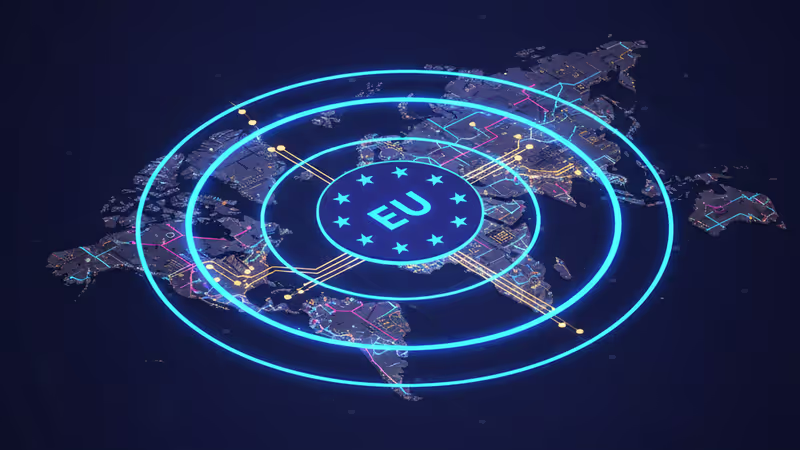
The Brussels Effect 2.0: EU's AI Act Is Now Law, Redrawing the Global Tech Map
The EU AI Act is now law. PRISM analyzes its global impact, the 'Brussels Effect 2.0,' and what it means for tech investment, innovation, and competition.
The Lede: The Starting Gun for Global AI Governance Has Fired
The European Union's landmark AI Act is now officially law. For the busy executive, investor, or policymaker, this is not just another piece of regional regulation. This is the first shot in the global race to govern artificial intelligence, establishing a comprehensive legal framework that will ripple across the globe, reshaping product roadmaps, investment theses, and the very definition of competitive advantage in the AI era. Ignore it at your peril; this is the new de facto global standard.
Why It Matters: The End of the AI Wild West
The AI Act's formal adoption moves the industry from an era of self-policing and ethical guidelines to one of legally-binding compliance. The second-order effects will be profound:
- The Compliance Moat: Just as GDPR created a massive industry around data privacy compliance, the AI Act will spawn a new ecosystem of AI auditors, certification bodies, and specialized legal consultants. For incumbents like Microsoft, Google, and Meta, this represents a significant competitive advantage. They have the legal firepower and engineering resources to absorb these costs, creating a formidable barrier to entry for smaller, resource-strapped startups.
- Product Roadmaps Rerouted: Features will now be assessed not just for market fit, but for their risk classification under EU law. Any company with users in the EU will need to bake risk assessments and transparency requirements into the core of their development lifecycle. This will inevitably slow down the “move fast and break things” ethos that has defined Big Tech.
- A Global Standard by Default: Known as the 'Brussels Effect,' the EU's high regulatory standards often become the global norm because it's simpler for multinational companies to adopt one strict standard for all markets rather than creating fragmented, region-specific products. Expect features mandated by the AI Act—like watermarking for deepfakes and transparency for chatbots—to be rolled out globally.
The Analysis: A Geopolitical Power Play in Code
This is more than just tech policy; it’s a defining moment in 21st-century geopolitics. The world's three major tech blocs are now pursuing divergent paths on AI governance:
- The United States: Pursuing a largely pro-innovation, market-driven approach with voluntary commitments from major players. The focus is on maintaining a competitive edge, particularly against China, with regulation seen as a potential brake on progress.
- China: Implementing a state-centric model where AI regulation is a tool for social control and advancing national strategic objectives. The rules are strict, but designed to bolster state power and national champions.
- The European Union: Planting its flag as the world's 'regulatory superpower.' By focusing on fundamental rights and a risk-based approach, the EU is exporting its values and forcing the global tech ecosystem to conform to its vision of “trustworthy AI.”
Unlike GDPR, which governed the relatively static domain of data storage and consent, the AI Act attempts to regulate dynamic, evolving systems. Its success will hinge on the agility of the newly formed EU AI Office to interpret and enforce rules against a technology that advances exponentially. The key battleground will be the definition and classification of “high-risk” systems, a category that will be subject to intense corporate lobbying.
PRISM Insight: The New Investment Thesis for AI
For investors, the AI Act fundamentally alters risk calculation. The era of funding purely based on model performance and potential market size is over. The new due diligence checklist must include:
- Compliance-Readiness: Can a startup's architecture support the rigorous documentation, transparency, and oversight requirements for high-risk systems? Startups that build this in from day one will command a premium.
- The Rise of 'Trust Tech': A new category of investment will surge. Think of companies specializing in AI model auditing, explainability-as-a-service (XAI), synthetic data for bias testing, and data provenance tracking. These are no longer niche academic fields; they are now mission-critical infrastructure.
- Re-evaluating the 'Platform' Play: Foundational model providers like OpenAI and Anthropic now face specific obligations regarding transparency and documentation for their general-purpose AI (GPAI) systems. This adds a significant, ongoing operational cost that could favor the hyperscale cloud providers who can bundle compliance tooling with their platforms.
PRISM's Take: Maturation, Not Strangulation
While alarmists will cry that the AI Act will stifle European innovation, we see it differently. This is a forced maturation of the AI industry. For two decades, software has “eaten the world” with minimal accountability. The AI Act signals that this period is over for the most powerful technology yet invented.
The real winners will not be European or American companies, but 'bilingual' organizations that can speak both the language of rapid, agile innovation and the language of rigorous, auditable compliance. This regulation doesn't kill the race; it just changes the rules of the track. The most adaptable, not just the fastest, will now win.
Related Articles
The FTC is investigating Instacart's AI pricing tool. PRISM analyzes why this signals a new era of regulatory scrutiny for all algorithmic commerce.

Adobe's AI lawsuit over pirated books highlights a systemic risk. Our analysis explores the 'original sin' of training data and why data provenance is critical.

An inside look at the White House's plan to ban state-level AI laws. PRISM analyzes the high-stakes power grab and what it means for tech investors and executives.

A high-stakes clash between Trump's powerful Chief of Staff, Susie Wiles, and Elon Musk signals a new era of political risk for the tech billionaire's empire.