
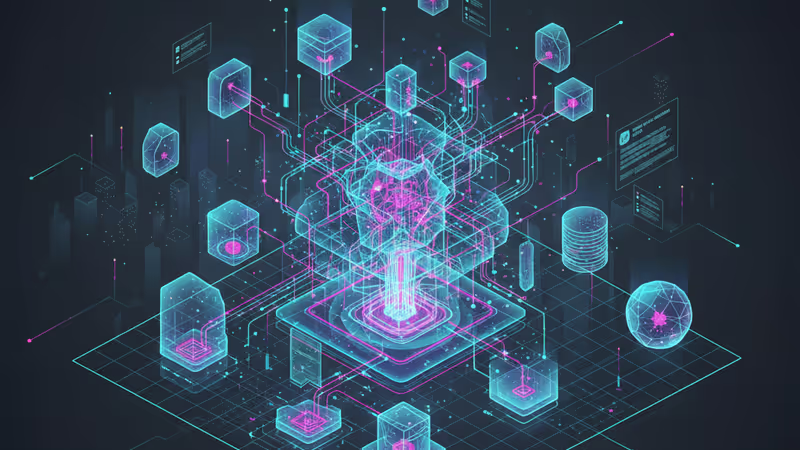
OpenAI's GPT-5.2-Codex: More Than a Coder, It's Your New System Architect
OpenAI's GPT-5.2-Codex moves beyond coding assistance to system-level reasoning. Our analysis covers its impact on technical debt, cybersecurity, and the future of development.
The Lede: Beyond Autocomplete
OpenAI’s new GPT-5.2-Codex is not another incremental update in the AI coding assistant race. It’s a categorical leap. Forget smarter code completion. This model is engineered for system-level reasoning, capable of executing complex, multi-file code transformations and acting as a sophisticated cybersecurity analyst. For CTOs and engineering leaders, this isn't a new tool for your developers; it's a new strategic capability for your entire organization.
Why It Matters: The End of an Era
The release of GPT-5.2-Codex signals a fundamental shift in software development and security. The implications are far-reaching, creating new efficiencies and new threats simultaneously.
- The Death of Technical Debt as a Constant: The model's ability to perform "large-scale code transformations" is a direct assault on technical debt. Imagine migrating a legacy enterprise application from Python 2 to 3, or refactoring a monolith into microservices, not in a quarter, but in a week. This moves a core, and costly, engineering problem from a manual slog to a machine-led process.
- The Democratization of Elite Hacking: "Enhanced cybersecurity capabilities" is a double-edged sword. For defenders (Blue Teams), it means a tireless digital expert that can proactively audit code for complex, multi-stage vulnerabilities. For attackers (Red Teams and threat actors), it dramatically lowers the barrier to entry for creating sophisticated, polymorphic malware and discovering zero-day exploits. The cybersecurity arms race just went exponential.
- The Developer Role Evolves: The value of a developer is no longer in writing boilerplate code or remembering API syntax. With a model capable of "long-horizon reasoning," the developer's role elevates to that of a system architect and AI director. Their core job becomes defining complex goals, validating the AI's architectural choices, and managing the overall system integrity.
The Analysis: From Copilot to Chief Architect
We've moved through distinct phases of AI in development. The first wave, epitomized by the original GitHub Copilot, was about suggestion—a smart assistant sitting on your shoulder. This second wave, driven by models like GPT-5.2-Codex, is about agency and abstraction.
Historically, developer productivity has been unlocked by raising the level of abstraction—from assembly to C, from C to Python. This model represents the next layer. The unit of work is no longer a function or a class; it's an entire feature, a refactor, or a security audit. This puts immense pressure on the competitive landscape. While Google’s Gemini models are formidable, OpenAI is framing the battleground not on token count or benchmarks, but on solving intractable, enterprise-scale problems like technical debt and security posture.
This also poses an existential threat to startups building "AI software engineer" agents. If the foundational model possesses this level of architectural reasoning out-of-the-box, the value proposition of a third-party agent diminishes unless it can provide extreme specialization or a flawless user experience that OpenAI cannot match within its ecosystem.
PRISM Insight: Invest in the Application Layer
The primary investment and innovation vector is no longer the foundational model itself, but the infrastructure and tooling built atop it. We anticipate a surge in three key areas:
- AI-Native Security Platforms: Tools that go beyond simple vulnerability scanning, using Codex-level models to provide continuous, autonomous code hardening and real-time threat modeling.
- Automated Modernization Services: Consultancies and product companies specializing in using models like this to execute massive, AI-led platform migrations for large enterprises.
- Next-Generation IDEs: Development environments will be redesigned away from text editing and towards architectural conversation, where developers specify outcomes and the AI handles implementation.
The macro trend is the shift from "Software-as-a-Service" (SaaS) to "Intelligence-as-a-Service" (IaaS), where the core product is not the software, but the autonomous agent that builds, maintains, and secures it.
PRISM's Take
GPT-5.2-Codex is a watershed moment. It signals that the most complex, abstract, and value-driven tasks in software engineering are now within the sights of AI. Leaders who view this merely as a productivity tool for their existing developers will be strategically outmaneuvered. The real winners will be those who reorganize their engineering cultures around a new hybrid intelligence—where senior human architects direct fleets of autonomous AI systems to build and defend the next generation of technology. The biggest risk is not failing to adopt this tool, but failing to understand the new paradigm it has just created.
Related Articles
Analysis of GPT-5's safety measures reveals a strategic shift towards autonomous AI agents, impacting enterprise adoption, cybersecurity, and future regulation.
Riot Games' discovery of a critical motherboard flaw shifts the anti-cheat battleground from software to silicon. An analysis of the new hardware security reality.

A new documentary deepfakes Sam Altman, revealing critical insights into digital identity, AI's power struggles, and the future of reputational risk.
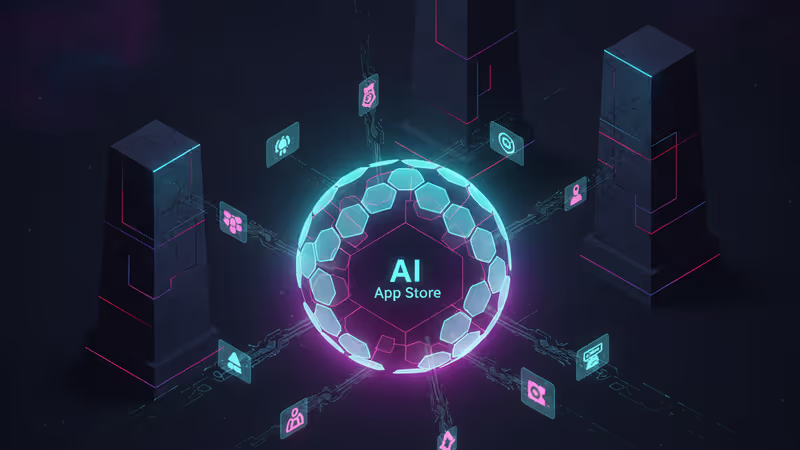
OpenAI's new App Directory for ChatGPT isn't just a feature. It's a strategic move to build the next dominant computing platform, challenging Apple and Google.