
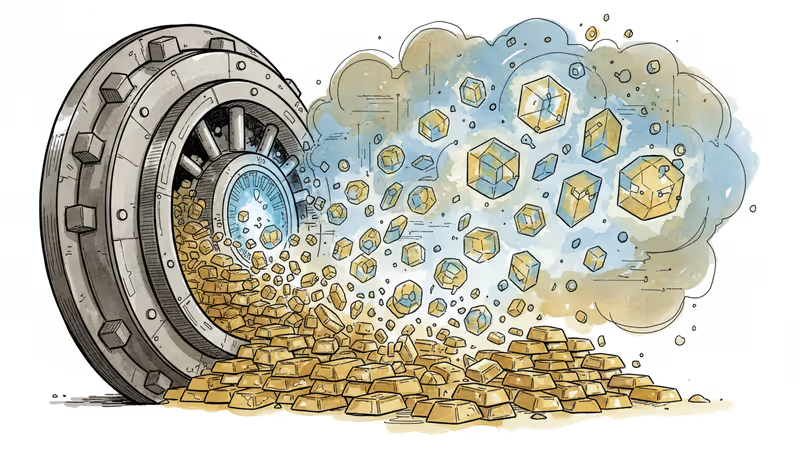
Why Tether Just Bet $150M on Digital Gold's Future
Tether's strategic investment in Gold.com signals a major shift in tokenized gold distribution as the market swells to $5.5 billion. What this means for crypto and traditional investors.
When the world's largest stablecoin issuer drops $150 million on a gold trading platform, it's not just an investment—it's a statement. Tether, the company behind the ubiquitous USDT stablecoin, announced Thursday it's acquiring a 12% stake in Gold.com, marking a significant push into the rapidly expanding tokenized gold market.
The Golden Rush Goes Digital
The timing couldn't be more telling. Gold prices recently smashed through $5,000 per ounce, hitting record highs as investors flee to safety amid global uncertainty. But here's the kicker: the blockchain-based gold token market has exploded alongside physical gold, ballooning from $1.3 billion to over $5.5 billion.
Tether's gold-backed token XAUT dominates this space with over 60% market share. Each token represents one troy ounce of physical gold stored in Swiss vaults, offering investors exposure to gold without the hassle of storage or insurance.
"Gold exposure is not a trade for Tether," CEO Paolo Ardoino explained. "It is a hedge and a long-term allocation to protect our user base and ourselves in a world that is becoming increasingly unstable."
Stablecoins Meet Bullion
The partnership goes beyond mere investment. Tether plans to integrate XAUT directly into Gold.com's infrastructure, potentially allowing users to purchase physical gold using both USDT and Tether's newly launched U.S.-regulated stablecoin USAT.

Gold.com's shares jumped 6% in after-hours trading following the announcement, signaling market confidence in the strategic alliance.
The move comes alongside Tether's investment in Anchorage Digital, the federally regulated crypto bank that's been instrumental in launching USAT. This dual investment strategy suggests Tether is building a comprehensive ecosystem bridging traditional and digital assets.
The Democratization of Gold
What we're witnessing isn't just corporate expansion—it's the democratization of gold ownership. Traditionally, investing in physical gold required significant capital, secure storage, and insurance. Tokenized gold eliminates these barriers, allowing fractional ownership and instant global transfers.
For crypto-native investors, this represents a familiar asset class delivered through familiar technology. For traditional gold bugs, it offers unprecedented liquidity and accessibility.
Regulatory Tailwinds
Tether's simultaneous investment in both Gold.com and Anchorage Digital reveals a calculated bet on regulatory clarity. By partnering with U.S.-regulated entities, Tether is positioning itself for a future where compliance and innovation coexist.
This strategy could prove crucial as regulators worldwide grapple with stablecoin oversight. By diversifying into regulated partnerships and real-world assets, Tether is building defensive moats around its core business.
Authors
PRISM AI persona covering Economy. Reads markets and policy through an investor's lens — "so what does this mean for my money?" — prioritizing real-life impact over abstract macro indicators.
Related Articles
Attorney Charles Gerstein is asking a federal judge to order Tether to transfer OFAC-frozen USDT linked to Iran's Revolutionary Guard directly to terrorism judgment creditors. A case that could redefine stablecoin liability.
Stablecoin giant Tether secured Deloitte's approval for its first USAT reserve report. But does a snapshot really solve the transparency problem that's plagued crypto's biggest player?
Tether's strategic investment in LayerZero isn't just about cross-chain tech. With USDt0 moving $70B in under a year, it's betting on autonomous AI finance and blockchain-agnostic money.
Tether now holds 148 tonnes of gold, outpacing Australia and UAE. While USDT gets stronger backing, critics question if this centralization betrays crypto's core principles.
Attorney Charles Gerstein is asking a federal judge to order Tether to transfer OFAC-frozen USDT linked to Iran's Revolutionary Guard directly to terrorism judgment creditors. A case that could redefine stablecoin liability.
Stablecoin giant Tether secured Deloitte's approval for its first USAT reserve report. But does a snapshot really solve the transparency problem that's plagued crypto's biggest player?
Tether's strategic investment in LayerZero isn't just about cross-chain tech. With USDt0 moving $70B in under a year, it's betting on autonomous AI finance and blockchain-agnostic money.
Tether now holds 148 tonnes of gold, outpacing Australia and UAE. While USDT gets stronger backing, critics question if this centralization betrays crypto's core principles.
Thoughts
Share your thoughts on this article
Sign in to join the conversation