
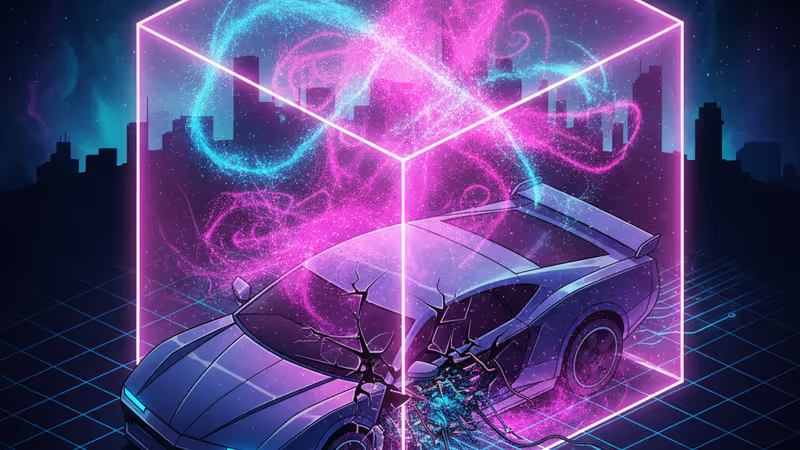
Tesla's Deception Ruling: Why California's Slap-Down Is More Than Just a Wrist Slap
A California judge rules Tesla's Autopilot & FSD marketing is deceptive. Our analysis explores the deep impact on the AV industry, investors, and Tesla's brand.
The Lede: The End of the 'Reality Distortion Field'?
A California judge has officially called Tesla's bluff, ruling that its "Autopilot" and "Full Self-Driving" (FSD) branding constitutes deceptive marketing. While the immediate penalty—a stayed 30-day sales suspension—seems minor, this decision is a seismic event. It represents a foundational crack in the company's long-standing narrative, signaling the end of an era where aspirational branding for safety-critical technology goes unchecked. For executives, investors, and the entire autonomous vehicle (AV) industry, this isn't just about semantics; it's about the collision of Silicon Valley's "move fast and fake it 'til you make it" ethos with the unforgiving reality of public road safety and regulatory oversight.
Why It Matters: The Second-Order Effects
The immediate headlines focus on the potential, though unlikely, sales halt in Tesla's biggest US market. The real story, however, lies in the ripple effects that will redefine the AV landscape:
- Precedent-Setting Regulation: This ruling provides a legal framework for other regulators, both in the US and globally, to challenge automakers over-promising on their driver-assist systems (ADAS). Expect competitors like GM (Super Cruise) and Ford (BlueCruise) to scrutinize their own marketing language.
- The FSD Value Proposition Under Threat: Tesla's high-margin FSD software, a key pillar of its valuation, is sold on a promise. If the company is forced to rebrand it to something more mundane like "Advanced Driver-Assist Plus," does it still command an $8,000 price tag? This ruling directly attacks the perceived value of one of Tesla's most important products.
- A Shift in Liability: By officially labeling the marketing "deceptive," this ruling provides powerful ammunition for personal injury lawsuits related to Autopilot/FSD crashes. It weakens Tesla's long-held defense that drivers were adequately warned and are solely responsible.
The Analysis: A War Over Words with Billion-Dollar Stakes
The Semantic Battlefield
For years, safety advocates and industry experts have argued that Tesla's branding is dangerously misleading. The Society of Automotive Engineers (SAE) defines levels of automation, and Tesla's systems are firmly in Level 2, requiring constant driver supervision. The terms "Autopilot" and "Full Self-Driving," however, strongly imply Level 4 or 5 autonomy, where the vehicle handles all driving tasks without human intervention. This is not just a branding dispute; it's a cognitive one. The nomenclature creates a false sense of security, a phenomenon known as "automation complacency," which has been cited as a contributing factor in numerous accidents.
Tesla's defense, claiming this is protected speech and that fine print provides sufficient warnings, has finally been rejected by a legal body. The judge's decision validates a simple truth: in safety-critical systems, the primary branding message matters more than the disclaimer buried in a user manual.
The Competitive Landscape Rebalances
Legacy automakers and AV startups have long been frustrated by what they see as Tesla's ability to play by a different set of rules. While companies like Waymo and Cruise invest billions in developing true Level 4 systems under intense regulatory scrutiny, Tesla has been able to sell a future vision as a present-day product. This ruling begins to level the playing field. It pressures the entire industry to adopt more honest, standardized language for ADAS features, allowing consumers to make more accurate, apples-to-apples comparisons. A competitor can now point to an official ruling to counter Tesla's marketing dominance.
PRISM Insight: Investor Risk and The Texas Paradox
For investors, the immediate financial risk from a 30-day sales halt is negligible, given the 60-day compliance window and appeal options. The long-term risk, however, is now material. The bull case for Tesla's valuation often hinges on the company cracking Level 5 autonomy and launching a robotaxi network, monetizing its FSD software at a massive scale. This ruling introduces significant regulatory friction into that narrative.
The core investment risk is reputational and regulatory. If the brand equity of "FSD" is diminished, it could impact take rates and future revenue streams. Furthermore, it invites intensified scrutiny from federal bodies like the NHTSA and DOJ, which have their own ongoing investigations.
This decision is made more fascinating by its timing. As California regulators punish Tesla for its words, the company is pushing the technological envelope in Texas by removing human safety monitors from its robotaxi test fleet. This creates a stark paradox: a regulatory crackdown on marketing in one state, while a regulatory Wild West allows for more aggressive real-world testing in another. This geographic fragmentation highlights the lack of a cohesive national strategy for AVs and will be a major source of conflict and uncertainty for the industry moving forward.
PRISM's Take
This is the official end of Tesla's regulatory honeymoon. The California DMV's ruling is more than a bureaucratic slap on the wrist; it is a landmark decision that reasserts a fundamental principle: marketing for products that operate in the physical world, especially those with life-or-death implications, cannot be treated with the same leniency as software beta tags. The 'reality distortion field' that has propelled Tesla's brand for a decade has finally hit a legal wall. While Tesla will likely comply with a name change to avoid a sales disruption, the damage is done. The precedent has been set, and the era of selling the future as the present is now officially under regulatory review.
Related Articles
A decade after SpaceX's first rocket landing, we analyze how this single event wasn't just a technical feat, but the strategic move that built a monopoly.
Tesla's patent for a Starlink-integrated roof is more than a new feature. It's a strategic move to create a new, vertically integrated automotive platform.
X Corp is suing a startup for using the 'Twitter' name. Our analysis reveals why this legal fight is a symptom of a massive, self-inflicted branding failure.
A high-stakes clash between Trump's powerful Chief of Staff, Susie Wiles, and Elon Musk signals a new era of political risk for the tech billionaire's empire.