
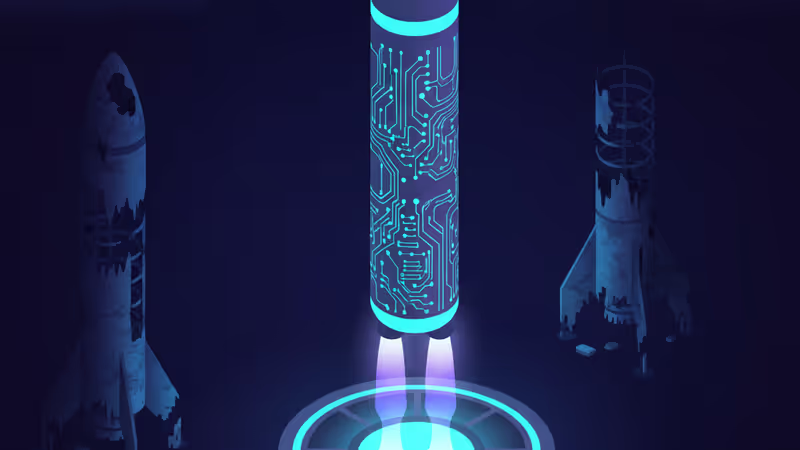
The Landing That Forged a Monopoly: How SpaceX’s 2015 Gamble Rewrote the Rules of Space
A decade after SpaceX's first rocket landing, we analyze how this single event wasn't just a technical feat, but the strategic move that built a monopoly.
The Lede: The Moment a Niche Player Became an Industry Titan
A decade ago, just before Christmas 2015, a SpaceX Falcon 9 booster descended from the heavens and landed upright, a fiery, balletic maneuver previously confined to science fiction. As Eric Berger’s new book Reentry recounts, this triumph was born from the ashes of a catastrophic failure just months prior. For the busy executive, this isn't a nostalgic space story. It's a masterclass in how a single, audacious technological bet can invalidate an entire industry's business model, creating a near-monopoly and redrawing the map of a half-trillion-dollar market.
Why It Matters: The Reusability Shockwave
The successful landing of booster B1019 wasn't just about recovering a piece of hardware; it was a fundamental paradigm shift with cascading effects that are still unfolding:
- The Death of Expendability: Before this moment, rockets were single-use, multi-million-dollar machines. The landing proved that the most expensive component could be flown again and again. This instantly rendered the cost structure of every other launch provider on Earth obsolete.
- Unlocking the LEO Economy: Megaconstellations like Starlink are only economically viable with an unprecedentedly high launch cadence and low cost-per-kilogram. The 2015 landing was the proof-of-concept that made Starlink—and SpaceX's subsequent vertical integration—possible.
- Setting a Pace No One Can Match: In the decade since, competitors like ULA (a Boeing-Lockheed Martin venture) and Arianespace have struggled to develop their own reusable systems. SpaceX used its head start not to relax, but to accelerate, creating a performance and cost gap that has become a chasm.
The Analysis: From 'Impossible' to Inevitable
The aerospace establishment had long dismissed orbital-class rocket reusability as a fool's errand—technically nightmarish and economically unproven. They pointed to the Space Shuttle's exorbitant refurbishment costs as a cautionary tale. What they failed to grasp was the difference between a government program designed by committee and a venture driven by first-principles physics and ruthless commercial focus.
As the excerpt from Reentry highlights, SpaceX’s path was forged through failure. The loss of the CRS-7 mission in June 2015 created immense pressure. A lesser company might have retreated, focusing solely on reliability. Instead, SpaceX doubled down, understanding that reliability at an unsustainable cost was a dead end. This culture—embracing rapid, iterative failure as a data-gathering tool—is the company's core competitive advantage. While legacy players spend a decade designing a new rocket on paper to avoid failure, SpaceX builds, flies, breaks, and fixes in a relentless cycle.
That 2015 landing was the moment the theoretical became tangible. It silenced the critics and, more importantly, demonstrated to the market and investors that Elon Musk's vision was not just possible, but the inevitable future of launch.
PRISM Insight: Vertical Integration as the Ultimate Moat
The true strategic genius of the Falcon 9 landing lies beyond the rocket itself. Reusability was not the product; it was the key that unlocked the factory. By drastically lowering the cost of access to space, SpaceX was able to become its own biggest customer with Starlink.
This vertical integration is a powerful flywheel:
- Launch Dominance provides cash flow and a high flight rate to perfect reusability.
- Low-Cost Launch enables the Starlink constellation, a new, massive revenue stream.
- Starlink Revenue funds the development of Starship, the next-generation system designed for interplanetary colonization.
This is a lesson for leaders in any deep-tech industry: owning the critical bottleneck in a value chain (in this case, launch) allows you to build new, dependent businesses on top of it, creating a nearly unassailable competitive moat.
PRISM's Take: A Bet on Physics, Not Precedent
Ten years on, the landing of B1019 stands as one of the most significant engineering achievements of the 21st century. But its business legacy is even more profound. It was the moment a hardware company proved it was actually a software and systems-integration powerhouse, capable of solving a dynamic control problem many thought impossible.
The ultimate lesson is that transformative innovation rarely comes from incremental improvements to existing models. It comes from challenging the fundamental assumptions an industry is built on. SpaceX didn't just build a better rocket; it invalidated the very concept of an expendable one. For every leader and investor, the question raised by that fiery descent a decade ago remains urgent: which core assumption in your industry is waiting to be overturned by a single, audacious bet?
Related Articles

Starlink's Direct to Cell service isn't just about ending dead zones. It's a strategic move to become a global telecom backbone, challenging incumbents.
Tesla's patent for a Starlink-integrated roof is more than a new feature. It's a strategic move to create a new, vertically integrated automotive platform.
Billionaire Jared Isaacman's confirmation as NASA chief isn't just a leadership change. It's the final victory for commercial space, reshaping the agency's future.
Jared Isaacman's confirmation as NASA chief isn't just a leadership change. It's the ultimate fusion of private space and public ambition. Here's why it matters.