
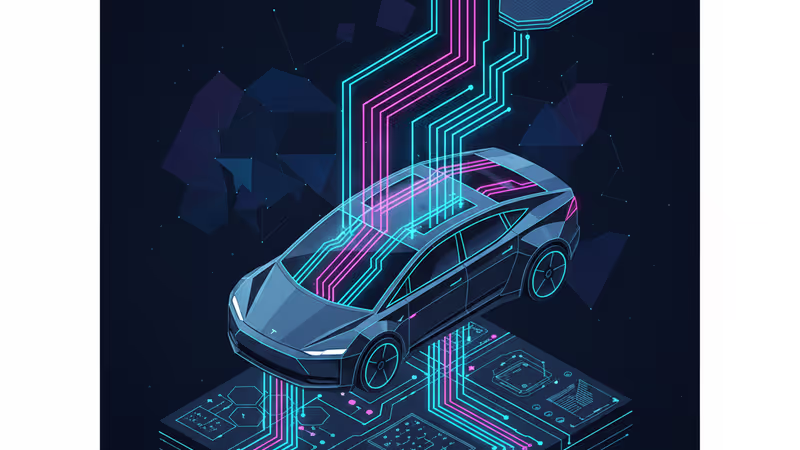
Tesla's 'Invisible Antenna' Patent: The Final Piece in Musk's Vertically Integrated Universe
Tesla's patent for a Starlink-integrated roof is more than a new feature. It's a strategic move to create a new, vertically integrated automotive platform.
The Lede: More Than Just a Sunroof
Tesla has filed a patent for a new vehicle roof assembly, but this isn't about improved glass or aerodynamics. It’s a declaration of strategic intent. For the busy executive, this development matters because it signals Tesla’s final move to vertically integrate its hardware with a proprietary, global communications network. By engineering a roof that is transparent to radio frequencies, Tesla is preparing to embed Starlink satellite antennas directly into its vehicles. This transforms the car from a product that consumes third-party data into a native node on a network Tesla owns and controls. This is the physical manifestation of the 'Musk Stack'—a seamless integration of ground transport, space-based communications, and data services that no other automaker can replicate.
Why It Matters: Escaping the Cellular Cage
The second-order effects of this patent are profound, creating a new competitive moat for Tesla and setting a new industry benchmark for the connected vehicle.
- For the User: This ends the tyranny of the cellular dead zone. Imagine uninterrupted, high-speed internet for everything from critical Full Self-Driving (FSD) data streams and over-the-air (OTA) updates to passenger streaming and gaming, anywhere on Earth. This moves connectivity from a convenience feature to a utility-grade reliability layer.
- For Tesla: It unlocks a massive, high-margin recurring revenue stream. Every Tesla sold becomes a potential Starlink subscriber, creating an 'Apple Services' style revenue model on top of hardware sales. More strategically, it grants Tesla total independence from telecom partners like AT&T, allowing it to control the entire data pipeline from its cars to its servers, a critical advantage for developing and deploying autonomous systems.
- For the Industry: Legacy automakers are just now solidifying their 5G strategies through partnerships. Tesla is leapfrogging them entirely. This move will force competitors into a frantic scramble to secure their own satellite connectivity partners (e.g., GM with satellite phone providers, others with OneWeb or Amazon's Kuiper), but they will forever be in a B2B relationship, lacking the deep, first-party integration and economic advantages Tesla will enjoy.
The Analysis: From Connected Car to Platform Play
The concept of the 'connected car' is not new. GM’s OnStar launched in 1996. For decades, however, vehicle connectivity has been a bolt-on feature, reliant on the patchy infrastructure of terrestrial cellular networks. Tesla itself pushed the industry forward by making OTA updates standard, but it still operated as a guest on these networks.
This patent for an RF-transparent roof with integrated antennas is the architectural key to change that dynamic. Current metal and glass roofs act as Faraday cages, significantly attenuating satellite signals and forcing aftermarket solutions like the bulky Starlink Mini dishes some owners are already using. By re-engineering the roof itself—a fundamental component of the vehicle—Tesla is designing for connectivity at the atomic level.
This is not an incremental improvement. It's a fundamental platform shift. It reflects a strategy where the vehicle is no longer the primary product, but rather a sophisticated mobile edge-computing device. Its purpose is to move people, yes, but also to collect and transmit vast quantities of data while providing a rich digital experience—all on a network controlled by the same parent company. This is a level of vertical integration that extends from the polymer in the roof panel to the satellite in Low Earth Orbit.
PRISM Insight: The 'Tesla-as-a-Service' Thesis Solidifies
For investors and strategists, this patent is a tangible piece of evidence supporting the 'Tesla-as-a-Service' (TaaS) valuation thesis. The market has long debated whether Tesla is a car manufacturer or a tech company. This development firmly anchors it in the latter category.
The ability to sell a recurring, high-margin Starlink subscription to a captive audience of millions of vehicle owners fundamentally alters Tesla's financial model. It adds a predictable, scalable revenue layer that is insulated from the cyclicality of auto manufacturing. This strengthens the argument that Tesla's Total Addressable Market (TAM) isn't just the automotive industry, but a significant slice of the global mobile data and connectivity market. This patent is the hardware enabler for that multi-trillion dollar software ambition.
PRISM's Take: Checkmate in the Connectivity Wars
While the patent filing is a technical document, its strategic message is crystal clear: Tesla is building a fortress. The future of mobility, especially autonomous mobility, will be defined not just by battery range or horsepower, but by the quality, reliability, and security of a vehicle's data connection. While competitors are focused on integrating third-party apps, Tesla is building the entire digital highway.
This integrated Starlink roof is not an optional feature; it is the logical endgame for a company that thinks in systems, not just products. It ensures that the critical data loop for FSD—collect, analyze, deploy—is never broken by a dropped cell signal. It is a brilliant, synergistic play that leverages a unique asset (Starlink) to create an unassailable advantage in another industry (automotive). This isn't just a smarter car; it's the foundation for a globally networked, autonomous fleet operating on its own private internet.
Related Articles
X Corp is suing a startup for using the 'Twitter' name. Our analysis reveals why this legal fight is a symptom of a massive, self-inflicted branding failure.
A California judge found Tesla's 'Full Self-Driving' marketing deceptive. PRISM analyzes why this ruling is a major red flag for investors and the entire EV industry.
A high-stakes clash between Trump's powerful Chief of Staff, Susie Wiles, and Elon Musk signals a new era of political risk for the tech billionaire's empire.
A California judge rules Tesla's Autopilot & FSD marketing is deceptive. Our analysis explores the deep impact on the AV industry, investors, and Tesla's brand.