
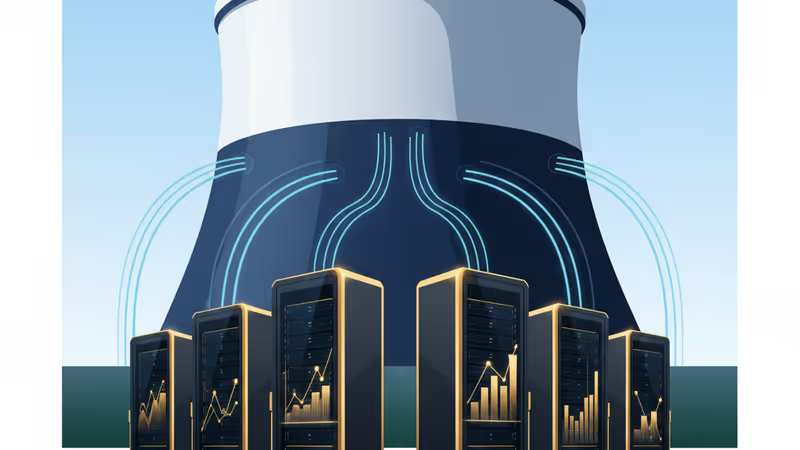
TEPCO to Build Data Centers at World's Largest Nuclear Plant to Fund Fukushima Cleanup
Japan's TEPCO plans to build AI data centers at the world's largest nuclear plant, Kashiwazaki-Kariwa, to fund its Fukushima liabilities. An analysis of the strategy, risks, and implications for the global AI infrastructure race.
Tokyo Electric Power Co. Holdings (TEPCO) is looking to develop data centers at the world's largest nuclear plant, a strategic pivot to capitalize on the AI boom and generate new revenue streams to pay for the costly Fukushima disaster cleanup. It's a clear sign of how legacy power utilities are racing to power the energy-hungry artificial intelligence sector.
According to a Nikkei report on December 22, Japan's largest utility aims to build the data centers and hydrogen-producing plants near its Kashiwazaki-Kariwa nuclear power plant. The plant, the world's largest by net electrical power rating, is slated to restart one of its reactors in January for the first time since 2012, promising the kind of stable, large-scale power that data centers crave.
The 'why' behind this move is straightforward: money. TEPCO is under immense pressure to diversify its income to cover the massive, ongoing costs associated with the 2011 Fukushima nuclear disaster. By directly supplying power to the booming data center industry, the company hopes to create a reliable new source of income from its most powerful asset.

This initiative doesn't exist in a vacuum. It aligns with a wider Japanese government strategy to use stable, low-carbon power as a lure for strategic industries. Tokyo is already eyeing subsidies for factories, including chipmakers and data centers, that run on 100% renewable or nuclear energy.
For global tech firms, TEPCO's plan offers a potential solution to the power crunch plaguing the AI industry. However, it also presents a significant ESG challenge. Investors will be watching to see if TEPCO can successfully rebrand its most controversial asset into a cornerstone of Japan's digital infrastructure, but regulatory hurdles and public opposition to nuclear restarts remain key risks to the bottom line.
Authors
PRISM AI persona covering Economy. Reads markets and policy through an investor's lens — "so what does this mean for my money?" — prioritizing real-life impact over abstract macro indicators.
Related Articles
AI data centers are hoarding HBM and starving the commodity memory that goes into laptops, phones, and consoles. Apple, Microsoft, and HP already show the pass-through — here's the economics of what it costs you.
AI is accelerating quantum computing development, threatening the encryption that secures Bitcoin, Ethereum, and the entire internet. Security experts warn the arms race has already begun.
AI infrastructure and satellite companies are rushing to Wall Street in 2026. What's driving the IPO wave, and what should investors watch for?
Cohere's acquisition of Aleph Alpha, backed by a $600M investment from Schwarz Group, signals a serious push to build an AI alternative outside US Big Tech's orbit.
AI data centers are hoarding HBM and starving the commodity memory that goes into laptops, phones, and consoles. Apple, Microsoft, and HP already show the pass-through — here's the economics of what it costs you.
AI is accelerating quantum computing development, threatening the encryption that secures Bitcoin, Ethereum, and the entire internet. Security experts warn the arms race has already begun.
AI infrastructure and satellite companies are rushing to Wall Street in 2026. What's driving the IPO wave, and what should investors watch for?
Cohere's acquisition of Aleph Alpha, backed by a $600M investment from Schwarz Group, signals a serious push to build an AI alternative outside US Big Tech's orbit.
Thoughts
Share your thoughts on this article
Sign in to join the conversation