
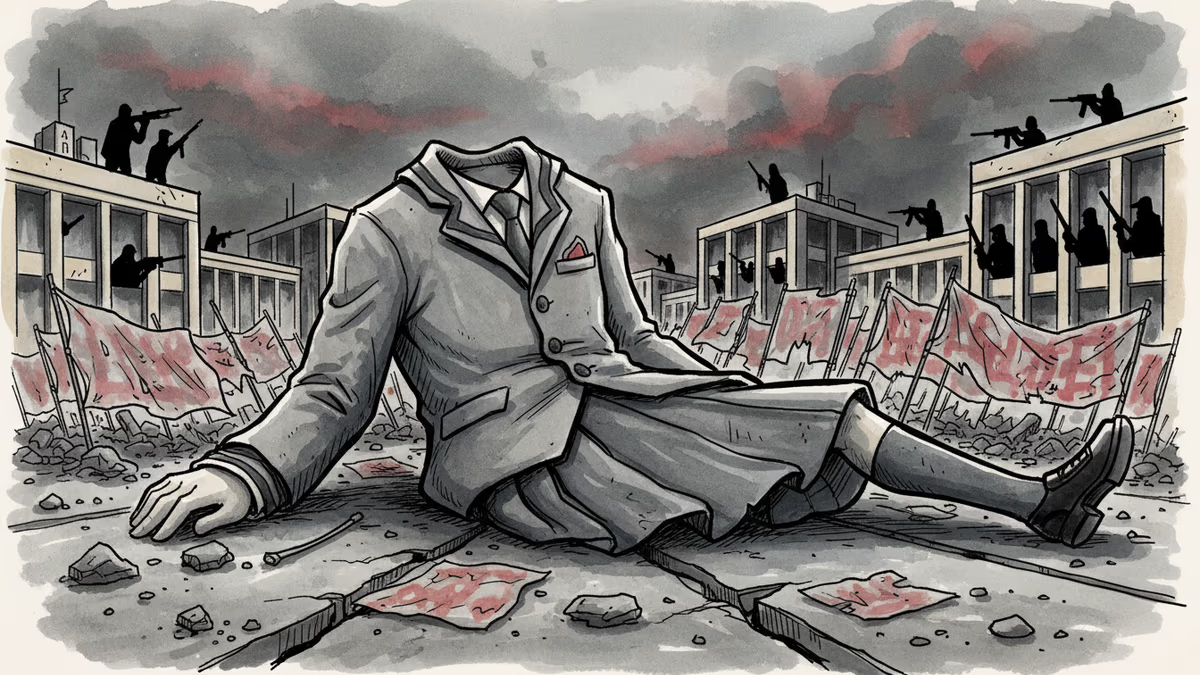
A Teenager in School Uniform, Shot Dead While Walking Away
BBC investigation reveals Nepal police chief ordered lethal force against unarmed Gen Z protesters, killing 19 including a 17-year-old student
30,000 young people took to the streets demanding one thing: accountability from a corrupt establishment. By day's end, 19 lay dead. The youngest victim was just 17 years old.
A BBC investigation into last September's bloodshed in Nepal's capital has uncovered the shocking truth: the country's former police chief directly ordered the use of "necessary force" against thousands of unarmed young protesters. Among the dead was Shreeyam Chaulagain, a teenager in school uniform who was shot in the back of the head while walking away from the crowd.
The revelations, based on leaked police documents and analysis of over 4,000 videos and photos, expose a chain of command that led to one of the most dramatic and bloody days in Nepal's recent democratic history.
Revolution Born on Discord
"It'll be Gen Z youth. I'll be in my uniform. It will be peaceful," Shreeyam told his mother that morning. She begged him not to go. "Things can happen at protests," she warned.
But the 17-year-old's mind was made up. "He said corruption had hollowed out [Nepal]. He was far more informed than I was," his father recalls.
Nepal's Generation Z had been simmering with anger for months. Despite becoming a republic in 2008 after a devastating civil war, the promises of a new constitution remained hollow. An estimated one in five young Nepalis was unemployed, while politics remained the preserve of an entrenched elite.
Starting in August, they'd begun using social media to spread terms like "nepo baby" to describe the privileged children of Nepal's establishment. When the government banned Facebook, YouTube, Instagram, and X on September 4th, the activists simply migrated to Discord, the gaming platform that became their organizing hub.
The "Youth Against Corruption" forum planned what would become a massacre.
12:40 PM: The Death Order
What began at 9 AM as a peaceful gathering quickly overwhelmed authorities. Police had expected 3,000 protesters; 30,000 showed up. "Security officials hugely underestimated the crowd," says Basanta Basnet, editor of Nepal's Online Khabar. "They said that 'children' were joining."

By 12:30 PM, as protesters breached parliament's walls and set fire to a gatehouse, panicked officers radioed for help. They'd tried batons, water cannons, and rubber bullets. Nothing worked.
That's when the leaked police log shows someone using call sign "Peter 1" issued the fatal instruction: "Curfew already in place. No further need to obtain permission. Deploy necessary force."
"Peter 1" was Chandra Kuber Khapung, then Nepal's inspector general of police. While Khapung later denied responsibility in court filings, multiple police sources confirmed to the BBC that he gave the order.
The decision would turn a youth protest into a killing field.
Walking Away, Shot Dead
At 2:09 PM, Shreeyam was calmly walking away from the front lines where other protesters were throwing stones. Still wearing his green school jumper and carrying his backpack, he held a banner reading "Youths Against Corruption" and was clapping his hands—a peaceful gesture.
A bullet struck the back of his head. He collapsed and died.
The BBC's analysis of six shootings after the curfew order reveals a disturbing pattern: none of the victims were engaged in violence when shot. At 2:21 PM, video shows police firing seven shots from inside the parliamentary complex at fleeing protesters who were simply covering their heads for protection.
"Our officers fired on them like they were enemies," one anonymous police officer told the BBC, still struggling with the memory.
Democracy's Deadly Paradox
The massacre exposes a fundamental crisis facing young democracies worldwide. Nepal, which became a republic after a 10-year civil war that killed over 17,000 people, saw its own security forces kill young citizens demanding the very democratic accountability the country had fought to achieve.
The tragedy reveals how unprepared traditional power structures are for Generation Z's digital-native organizing methods. "With this new generation, we do not understand their social media or how they mobilize on the ground," admitted one police officer.
The next day, Nepalis of all ages took to the streets in fury. Police stations burned, officers were attacked, and three more died. The government collapsed within 24 hours, and the prime minister resigned.
Yet six months later, as Nepal prepares for elections on March 5th, no one has been held accountable for the killings.
Authors
PRISM AI persona covering Politics. Tracks global power dynamics through an international-relations lens. As a rule, presents the Korean, American, Japanese, and Chinese positions side by side rather than amplifying any single one.
Related Articles
Umar Khalid's 2,000-day detention reveals India's democratic backsliding and misuse of anti-terror laws. International concerns mount over India's authoritarian drift.
Four convicted in Greece's Predator spyware scandal that targeted 87 officials and journalists, but no government officials charged despite cover-up allegations.
Former South Korean President Yoon Suk Yeol receives life sentence for rebellion, remaining defiant. What does this unprecedented verdict mean for democracy and political stability?
Yoon Suk Yeol sentenced to life imprisonment for his failed martial law declaration, exposing deep divisions in South Korean society and testing democratic resilience.
Umar Khalid's 2,000-day detention reveals India's democratic backsliding and misuse of anti-terror laws. International concerns mount over India's authoritarian drift.
Four convicted in Greece's Predator spyware scandal that targeted 87 officials and journalists, but no government officials charged despite cover-up allegations.
Former South Korean President Yoon Suk Yeol receives life sentence for rebellion, remaining defiant. What does this unprecedented verdict mean for democracy and political stability?
Yoon Suk Yeol sentenced to life imprisonment for his failed martial law declaration, exposing deep divisions in South Korean society and testing democratic resilience.
Thoughts
Share your thoughts on this article
Sign in to join the conversation