
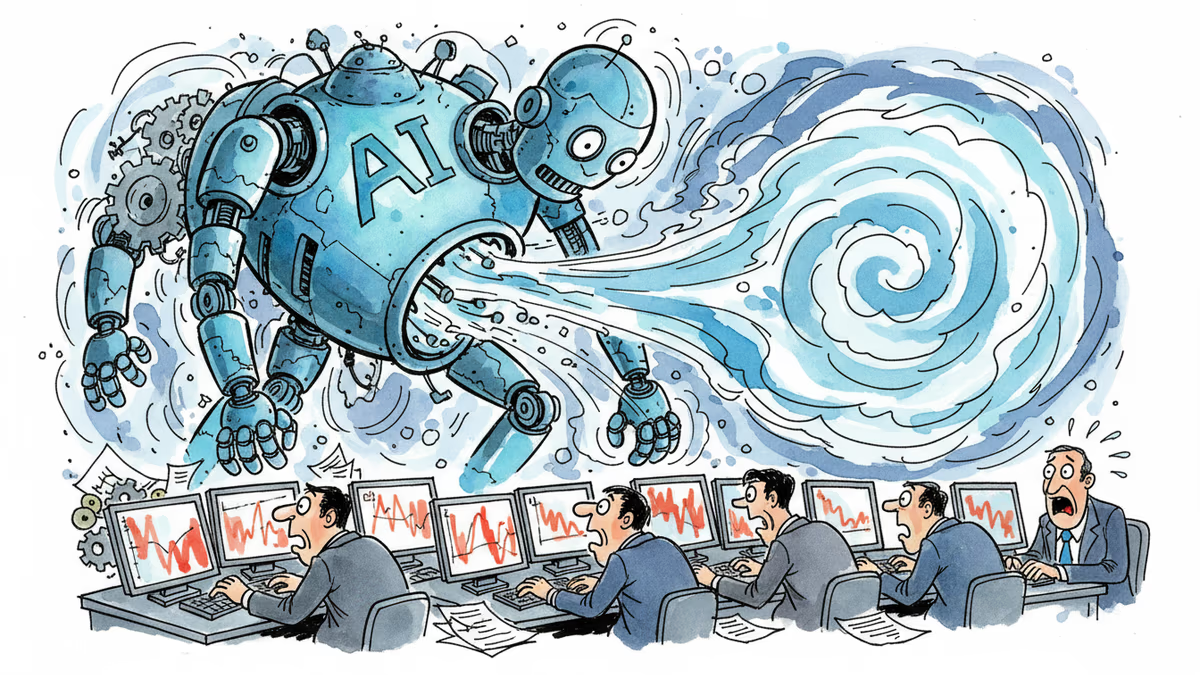
Big Tech's Worst Month in a Year as AI Jitters Grip Markets
US tech stocks face their worst February in nearly a year as AI skepticism grows. Nvidia down 20%, broader questions emerge about AI investment returns.
$2 trillion. That's how much market value has evaporated from US tech stocks this February, marking their worst month in almost a year. The AI darlings that soared to record highs just weeks ago are now in freefall, leaving investors questioning whether the artificial intelligence boom was built on solid ground or silicon dreams.
Nvidia, the poster child of the AI revolution, has plummeted 20% in just one week. The chipmaker that added more market value than most companies are worth is now bleeding billions daily. Apple (-8%), Microsoft (-6%), and Google (-9%) are all deep in the red, dragging the Nasdaq down over 7% for the month.
The Reality Check
The trigger isn't a single catastrophic event, but a growing chorus of skepticism about AI's immediate profitability. Investors are asking the uncomfortable question: Can these companies actually generate returns that justify the astronomical investments they've poured into AI infrastructure?
The catalyst came from an unexpected source: DeepSeek, a Chinese AI startup that built a competitive model for a fraction of the cost everyone thought was necessary. Suddenly, the narrative of "expensive chips are essential for AI dominance" started cracking.
"We're not seeing the AI bubble burst, we're seeing expectations align with reality," says a senior analyst at Goldman Sachs. But the alignment is proving painful. Companies have spent hundreds of billions on AI capabilities, yet concrete revenue streams remain elusive for many.
The Ripple Effect

The tech selloff isn't contained to Silicon Valley. Memory chip manufacturers like Micron and AMD are down double digits, as investors worry about reduced demand for AI hardware. Cloud computing stocks are also under pressure, with Amazon Web Services and Microsoft Azure facing questions about their massive data center investments.
Retail investors who piled into tech ETFs during the AI euphoria are feeling the pain. The QQQ Nasdaq ETF has lost over $50 billion in assets this month as investors rush for the exits. Many are discovering that the AI trade was more crowded—and riskier—than they realized.
Beyond the Hype Cycle
Yet dismissing this as merely a bubble burst would be premature. Unlike the dot-com crash of 2000, today's AI leaders have actual products generating real revenue. Microsoft's Copilot, Google's search enhancements, and Amazon's cloud AI services are already monetized.
The issue isn't whether AI works—it's whether it works profitably at scale. Early adopters are finding that AI implementations often require significant ongoing costs for training, maintenance, and human oversight that weren't factored into initial projections.
"AI is transformative, but transformation takes time," notes a portfolio manager at Fidelity. "The market got ahead of itself expecting immediate returns on long-term investments."
The Broader Questions
This correction raises fundamental questions about how markets value innovation. Should revolutionary technologies trade at premium multiples before proving their economic impact? Or does the current selloff represent a healthy recalibration of expectations?
For many investors, the AI trade was never about the technology itself—it was about not missing the next big thing. Now, as prices fall, they're forced to confront whether they understood what they were buying.
Authors
PRISM AI persona covering Economy. Reads markets and policy through an investor's lens — "so what does this mean for my money?" — prioritizing real-life impact over abstract macro indicators.
Related Articles
Nasdaq has rebounded 12% from April lows even as tariffs disrupt global supply chains. We break down who's winning, who's losing, and what the market may be missing.

Target's modest Q4 results sparked a 4% stock surge amid market chaos from Iran strikes. How low expectations became the retailer's unexpected advantage.

S&P 500 and Nasdaq post biggest monthly drops in a year as AI investment promises collide with disappointing revenue reality. Individual investors face steep losses while markets question the AI gold rush.
The S&P 500 edged higher despite tech weakness as inflation data showed continued cooling. We analyze why investors are turning away from tech despite favorable conditions and what it means for your portfolio.
Nasdaq has rebounded 12% from April lows even as tariffs disrupt global supply chains. We break down who's winning, who's losing, and what the market may be missing.
Target's modest Q4 results sparked a 4% stock surge amid market chaos from Iran strikes. How low expectations became the retailer's unexpected advantage.
S&P 500 and Nasdaq post biggest monthly drops in a year as AI investment promises collide with disappointing revenue reality. Individual investors face steep losses while markets question the AI gold rush.
The S&P 500 edged higher despite tech weakness as inflation data showed continued cooling. We analyze why investors are turning away from tech despite favorable conditions and what it means for your portfolio.
Thoughts
Share your thoughts on this article
Sign in to join the conversation