
The $100,000 Question: How Trump's H-1B Changes Are Reshaping Tech Hiring
Companies face tough choices as new H-1B fees and stricter scrutiny transform America's most coveted work visa. Immigration lawyers reveal the behind-the-scenes impact on talent acquisition strategies.
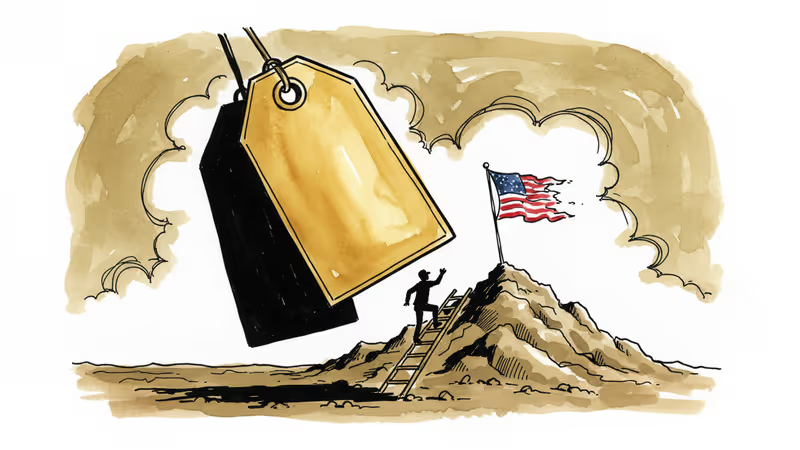
$100,000. That's what it now costs to bring a single foreign worker to America through the H-1B visa program. What was once considered a golden ticket to the American dream has become a corporate dilemma wrapped in red tape and hefty price tags.
The New Math of American Dreams
Every year, the H-1B program receives over 400,000 applications for just 85,000 spots—a lottery system where dreams are crushed by statistics. But 2026 feels different. Since September, President Trump has rolled out changes that have immigration lawyers and tech companies scrambling to recalculate their strategies.
The most jarring change? That $100,000 fee for companies hiring workers from abroad. Poorvi Chothani, an immigration attorney with 23 years of H-1B experience, tells a story of uncertainty: "Even our main clients haven't given us any numbers this time. Usually by now, we'd have their lists."
The scrutiny has intensified beyond paperwork. Visa officers now conduct social media vetting and can deny applications based on health conditions. "If a candidate is obese or has asthma, the officer can refuse their visa because they will use U.S. resources for their health," Chothani explains. It's a far cry from the merit-based system many thought they were entering.
Corporate Strategy Meets Reality
Companies are adapting in predictable ways. The path of least resistance? Hire talent already in America. F-1 visa holders (international students) and existing H-1B workers switching jobs don't trigger the $100,000 fee. This has created an internal talent war where companies are "scared of poaching" but also becoming victims of it.
"Our clients are encouraging their business heads to identify foreign students who're graduating from university," Chothani notes. But there's a catch—the new lottery system gives these candidates very low selection odds.
Some companies are exploring alternative visa categories like O-1 or L-1 visas, but Chothani warns against this strategy: "It's like fitting a square peg into a round hole. Whatever we do now is coming back to bite us. Overuse of the H-1B has come back to bite us. If we overuse the O-1 or L-1 categories, authorities are going to clamp down on those, too."

The Misinformation Economy
A troubling trend has emerged alongside policy changes: the rise of immigration influencers. Instagram personalities are promising shortcuts to American visas, often promoting fraudulent enhancement of profiles for EB-1 or O-1 applications.
"If you falsely enhance your profile and get an EB-1 approved, you're going to get tripped up with misrepresentation and fraud," Chothani warns. "Influencers, consultants, and agents are bypassing real lawyers with real knowledge."
This digital gold rush reflects deeper desperation among visa seekers, but it's creating long-term problems that could affect legitimate applicants for years to come.
The Indian Factor
Indians comprise three-quarters of the H-1B applicant pool, and despite the new hurdles, demand remains strong. "India has so many people who are qualified, and I don't think we have the ecosystem to absorb all of them," Chothani observes. "There is still a glitter and a glamour about America and American life. For every one person that doesn't want to go, there are nine people who are still seeing the American Dream."
This persistent demand suggests that while the process has become more expensive and uncertain, the fundamental appeal of American opportunities hasn't diminished—at least not yet.
Global Talent Wars Heat Up
America's H-1B restrictions aren't happening in a vacuum. Countries like Canada, Australia, and emerging tech hubs in Europe and Asia are positioning themselves as alternatives. The $100,000 fee and increased scrutiny could accelerate brain drain to these competitors.
For multinational companies, this creates new strategic questions: Is it worth paying premium prices for U.S. talent when other markets offer skilled workers with fewer barriers? The calculus becomes especially complex for companies with global operations who can potentially relocate entire teams.
Authors
Related Articles

Citizens across the US are destroying Flock surveillance cameras amid immigration enforcement concerns. A grassroots resistance movement is challenging the $7.5B surveillance startup.

DHS's Mobile Fortify app, used 100,000 times since launch, scans faces of immigrants, citizens, and protesters despite inability to confirm identities. Privacy concerns mount over biometric data collection.

Federal immigration agents' deadly shootings spark unprecedented online backlash across non-political communities, revealing how digital spaces now serve as organizing platforms for real-world resistance.

A deep dive into the Arizona semiconductor talent pipeline 2025, exploring how Intel and TSMC are tackling labor shortages and H-1B visa hurdles.
Citizens across the US are destroying Flock surveillance cameras amid immigration enforcement concerns. A grassroots resistance movement is challenging the $7.5B surveillance startup.
DHS's Mobile Fortify app, used 100,000 times since launch, scans faces of immigrants, citizens, and protesters despite inability to confirm identities. Privacy concerns mount over biometric data collection.
Federal immigration agents' deadly shootings spark unprecedented online backlash across non-political communities, revealing how digital spaces now serve as organizing platforms for real-world resistance.
A deep dive into the Arizona semiconductor talent pipeline 2025, exploring how Intel and TSMC are tackling labor shortages and H-1B visa hurdles.
Thoughts
Share your thoughts on this article
Sign in to join the conversation