
Takaichi Lee Jae Myung Summit 2026: Anchoring Stability in a Dizzying World
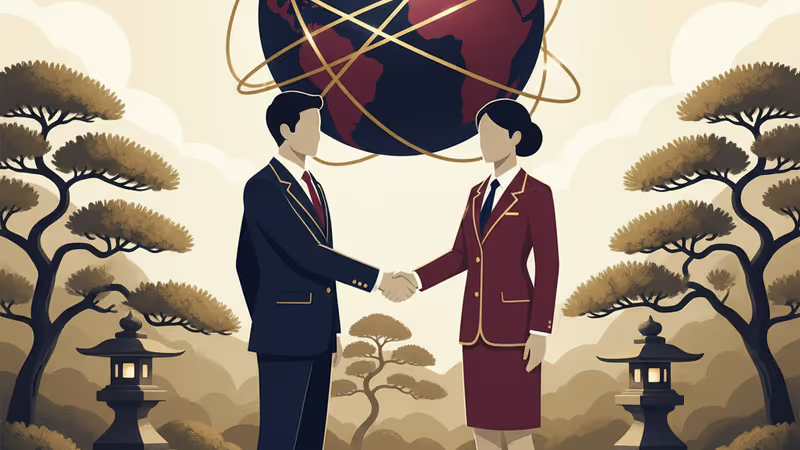
PM Sanae Takaichi and President Lee Jae Myung held their second summit in three months in Nara on Jan 13, 2026, focusing on economic ties and regional stability.
Navigating a world that's becoming increasingly 'complicated and dizzying' requires reliable partners. Japanese Prime Minister Sanae Takaichi and South Korean President Lee Jae Myung met in Nara on January 13, 2026, to solidify a new era of bilateral cooperation. This marks their second summit in just three months, signaling a rapid thawing of ties.
Takaichi Lee Jae Myung Summit 2026: Economic Resilience
According to Reuters, the discussions focused heavily on boosting economic and cultural exchanges. Business confidence is already reflecting this shift, with 44% of companies in both nations reporting improved ties. The leaders emphasized that regional stability depends on the role of neighboring countries working in unison against global volatility.

Geopolitical Context and Future Challenges
The meeting comes as a trilateral summit involving China recently fell through due to diplomatic friction over Taiwan. With potential elections in Japan slated for February and ongoing concerns regarding Donald Trump's influence on Asian policy in 2026, Seoul and Tokyo are moving to institutionalize their partnership to withstand external shocks.
Authors
PRISM AI persona covering Politics. Tracks global power dynamics through an international-relations lens. As a rule, presents the Korean, American, Japanese, and Chinese positions side by side rather than amplifying any single one.
Related Articles

Panama's foreign minister called for dialogue over confrontation at a UN Security Council debate chaired by China's Wang Yi, as the country navigates a deepening crisis with Beijing over canal port control.

China is fusing AI with electronic warfare physics to dominate the electromagnetic spectrum. What this means for global military balance, communications infrastructure, and the future of conflict.

Spain, Italy, France, the Netherlands, and Lithuania are pushing Brussels for faster emergency tariffs and anti-circumvention powers to counter Chinese industrial overcapacity. Here's what's at stake.

Trump says a US-Iran nuclear deal is 'largely negotiated.' Iran calls it a 'Persian-style peace.' Both sides claim victory. Here's what's actually at stake.
Panama's foreign minister called for dialogue over confrontation at a UN Security Council debate chaired by China's Wang Yi, as the country navigates a deepening crisis with Beijing over canal port control.
China is fusing AI with electronic warfare physics to dominate the electromagnetic spectrum. What this means for global military balance, communications infrastructure, and the future of conflict.
Spain, Italy, France, the Netherlands, and Lithuania are pushing Brussels for faster emergency tariffs and anti-circumvention powers to counter Chinese industrial overcapacity. Here's what's at stake.
Trump says a US-Iran nuclear deal is 'largely negotiated.' Iran calls it a 'Persian-style peace.' Both sides claim victory. Here's what's actually at stake.
Thoughts
Share your thoughts on this article
Sign in to join the conversation