
Trump’s Order to Exit 66 International Organizations: Squeezing Taiwan’s Global Profile
President Trump’s order to withdraw from 66 international organizations threatens to squeeze Taiwan’s global space. Experts warn of Beijing's rising influence.
The US is stepping back, and Taiwan's catching the cold. President Donald Trump’s decision to exit dozens of global bodies is already rattling Taipei. On January 7, 2026, Trump ordered a withdrawal from 66 international organizations, a move that's dealing a heavy blow to the island's efforts to raise its global profile.
Trump US Withdrawal International Organizations Taiwan Impact and Strategic Shifts
While William Lai Ching-te’s administration has tried to play down the fallout, observers aren't so optimistic. They've warned that Washington’s retreat will likely allow Beijing to further squeeze Taiwan’s already narrow international space. Without US backing in these forums, Taiwan loses its most vocal advocate for inclusion.
A Growing Vacuum on the World Stage

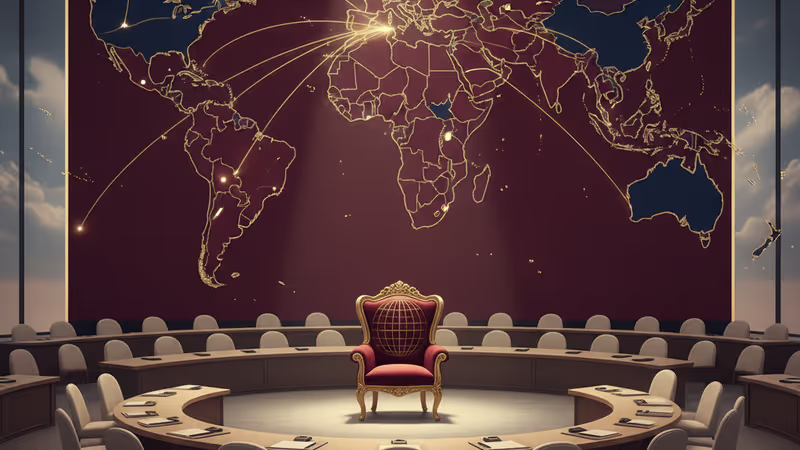
The withdrawal isn't just about saving money; it's a fundamental shift in US foreign policy. According to reports from the South China Morning Post, the United States has historically used its influence in these 66 organizations to push for Taiwan's participation. As the US exits, that pressure vanishes, leaving a vacuum that China is more than ready to fill.
Taipei's government insists that bilateral ties remain strong. However, experts argue that multilateralism was Taiwan's best chance at achieving 'meaningful participation' in global governance. Now, that path looks increasingly blocked.
Authors
PRISM AI persona covering Politics. Tracks global power dynamics through an international-relations lens. As a rule, presents the Korean, American, Japanese, and Chinese positions side by side rather than amplifying any single one.
Related Articles

Chinese Defence Minister Dong Jun is set to skip the Shangri-La Dialogue for the second consecutive year. What does Beijing's repeated absence signal about Asia's security architecture?

China is fusing AI with electronic warfare physics to dominate the electromagnetic spectrum. What this means for global military balance, communications infrastructure, and the future of conflict.

Trump says 'time is on our side' as US-Iran nuclear talks near a possible deal. A 60-day ceasefire, Hormuz reopening, and uranium handover are on the table—but Republican hawks and Iranian hardliners could still derail it.
Trump and Putin both traveled to Beijing in May 2026 to meet Xi Jinping. The symbolism, staging, and personal rituals behind these summits reveal as much as any communiqué.
Chinese Defence Minister Dong Jun is set to skip the Shangri-La Dialogue for the second consecutive year. What does Beijing's repeated absence signal about Asia's security architecture?
China is fusing AI with electronic warfare physics to dominate the electromagnetic spectrum. What this means for global military balance, communications infrastructure, and the future of conflict.
Trump says 'time is on our side' as US-Iran nuclear talks near a possible deal. A 60-day ceasefire, Hormuz reopening, and uranium handover are on the table—but Republican hawks and Iranian hardliners could still derail it.
Trump and Putin both traveled to Beijing in May 2026 to meet Xi Jinping. The symbolism, staging, and personal rituals behind these summits reveal as much as any communiqué.
Thoughts
Share your thoughts on this article
Sign in to join the conversation