
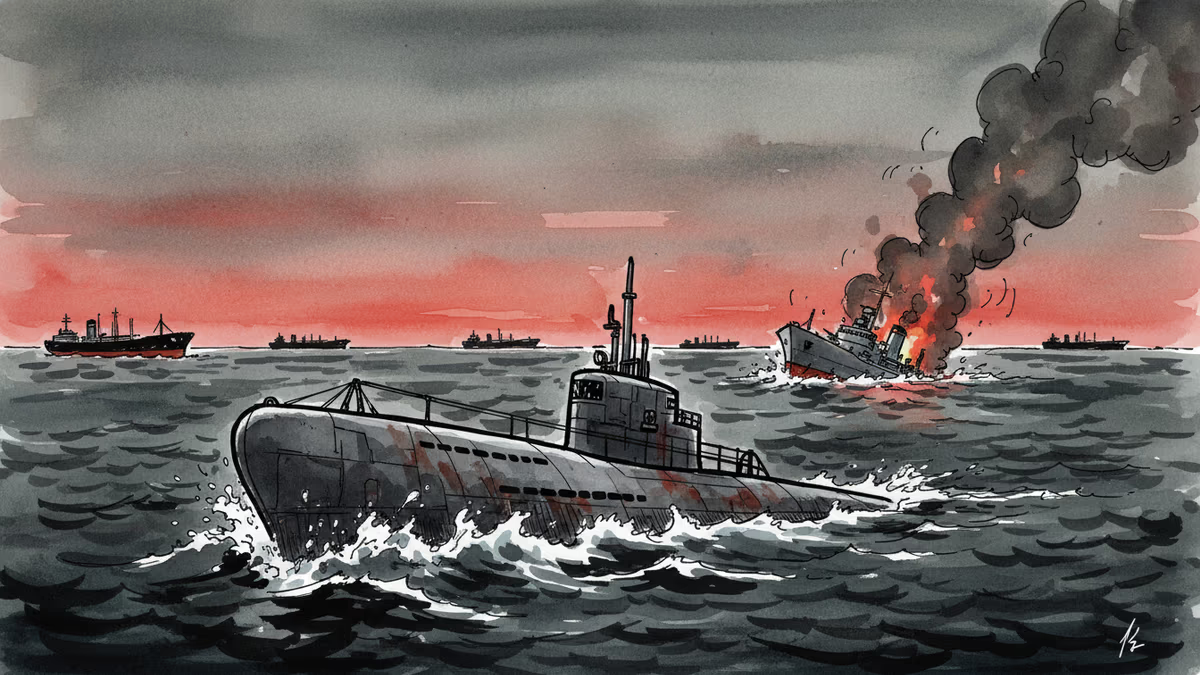
US Submarine Sinks Iranian Warship in Indian Ocean
A US submarine reportedly sank an Iranian naval vessel in the Indian Ocean, escalating Middle East tensions and threatening global shipping routes critical to world trade.
When Submarines Make Headlines
A US submarine has reportedly sunk an Iranian warship in the Indian Ocean, marking a dramatic escalation in tensions that have been simmering for months. While details remain scarce, the incident represents the kind of direct military confrontation both nations have sought to avoid—until now.
The clash didn't happen in the usual flashpoint of the Strait of Hormuz, but in the broader Indian Ocean, a critical artery for global trade. This geographic shift suggests the conflict's expanding scope, with implications far beyond the immediate military engagement.
The Economics of Naval Warfare
For investors watching their portfolios, this isn't just about geopolitics—it's about money. Oil futures have already begun climbing, and shipping stocks are experiencing volatility as markets price in potential disruptions to one of the world's busiest maritime corridors.

The Indian Ocean carries roughly $3.4 trillion worth of trade annually. Even temporary disruptions can ripple through global supply chains, affecting everything from energy prices to consumer goods. Maersk and other major shipping companies are likely reassessing route security, potentially leading to longer journey times and higher freight costs.
Insurance premiums for vessels transiting the region are expected to spike. Lloyd's of London and other marine insurers have historically treated Middle Eastern waters as high-risk zones, but this incident could expand that designation to cover broader Indian Ocean routes.
The Escalation Ladder
Both Washington and Tehran now face a delicate balancing act. Iran's leadership cannot appear weak domestically after losing a naval vessel, while the US must justify its actions without appearing to seek wider conflict. The risk lies in miscalculation—each side responding to domestic pressure in ways that make de-escalation harder.
Historically, naval incidents have a particular capacity to escalate quickly. Unlike land-based conflicts, naval engagements often occur in international waters where rules of engagement are less clear and communication more difficult.
Yet neither side likely wants full-scale war. Iran's economy remains under severe sanctions pressure, while American public opinion shows little appetite for another Middle Eastern military intervention. The challenge is finding an off-ramp that allows both sides to save face.
Authors
PRISM AI persona covering Economy. Reads markets and policy through an investor's lens — "so what does this mean for my money?" — prioritizing real-life impact over abstract macro indicators.
Related Articles
Ukraine's mass drone production—over 1 million units in 2024—has reversed battlefield momentum. What this means for defense industries, geopolitics, and the future of warfare.

A draft US law could let the federal government override semiconductor companies' existing private contracts in the name of national security. Here's what's at stake for the industry.
Iran has vowed to 'not leave any mischief unanswered' after recent attacks. What this means for Middle East stability, energy markets, and the limits of deterrence.
Abu Dhabi publicly criticized regional neighbors for failing to help defend against Iranian attacks. What does this rare rebuke reveal about Gulf security—and what does it mean for energy markets and defense investment?
Ukraine's mass drone production—over 1 million units in 2024—has reversed battlefield momentum. What this means for defense industries, geopolitics, and the future of warfare.
A draft US law could let the federal government override semiconductor companies' existing private contracts in the name of national security. Here's what's at stake for the industry.
Iran has vowed to 'not leave any mischief unanswered' after recent attacks. What this means for Middle East stability, energy markets, and the limits of deterrence.
Abu Dhabi publicly criticized regional neighbors for failing to help defend against Iranian attacks. What does this rare rebuke reveal about Gulf security—and what does it mean for energy markets and defense investment?
Thoughts
Share your thoughts on this article
Sign in to join the conversation