

Strava's Paywall Gambit: Why Monetizing 'Year in Sport' Signals The End of an Era for Free Apps
Strava paywalled its popular 'Year in Sport' feature. Our analysis breaks down why this isn't a feature update, but a major signal for the app economy.
The Rundown
Strava, the de facto social network for athletes, just made a high-stakes move: it placed its popular, viral “Year in Sport” recap behind its subscription paywall. While seemingly a minor feature change, this is a C-suite-level decision that serves as a critical bellwether for the entire app economy. This isn't about an animated summary of your runs; it's a calculated bet that the platform's network effect is strong enough to withstand a user revolt as it shifts aggressively from growth-at-all-costs to mandated profitability.
Why It Matters
This decision is a canary in the coal mine for the freemium model that built the modern app landscape. For years, free users were considered a marketing engine and a data source—their engagement and shareable content created the viral loops that attracted paying subscribers. Strava’s move reclassifies them as a cost center to be converted or sidelined. This has significant second-order effects:
- Precedent Setting: If Strava's revenue gamble pays off, expect other mature freemium apps to follow suit, systematically walling off beloved community features to force conversions. The era of generous free tiers is closing.
- Subscription Fatigue Test: This move directly tests the limits of consumer subscription tolerance. Is a personal data summary worth $80/year on top of Netflix, Spotify, and a dozen other recurring charges? The answer will dictate monetization strategies for years to come.
- Community as a Service (CaaS): The core value of Strava's free tier was social connection and motivation. By paywalling a key community-building feature, Strava is implicitly stating that community itself is now a premium product.

The Analysis: A Tale of Two Wraps
To understand the gravity of Strava's decision, you must contrast it with the undisputed champion of the year-in-review format: Spotify Wrapped. Spotify leverages Wrapped as its single most powerful, free marketing tool. It’s a cultural event that generates billions of impressions and reinforces brand loyalty at zero marginal cost. It’s designed for maximum shareability, converting users into evangelists.
Strava has chosen the opposite path. Instead of using its wrap-up as a viral acquisition tool to celebrate its entire user base and attract new members, it's using it as a cudgel to drive upgrades. This reflects a fundamental shift in strategy, likely driven by intense investor pressure for a clearer path to an IPO or profitable acquisition. The company, founded in 2009, is no longer a growth-stage startup; it's a mature business facing a reckoning with its balance sheet.
PRISM's Take: Monetizing the Moat, or Draining It?
Strava is making a dangerous, short-sighted gamble. It is trading its most effective viral marketing asset and a massive amount of community goodwill for a predictable, but likely modest, short-term revenue lift. The company’s primary defensible asset—its “moat”—is not its GPS-tracking technology, but its network effect. The millions of free users provide the audience, the data, and the social proof that makes a subscription valuable in the first place. The user who “begged” for the feature understands this better than Strava’s board seems to: the “plebs” are the foundation of the kingdom.
By alienating its foundational user base, Strava risks fostering resentment that could open the door for a competitor—perhaps one integrated with hardware like Garmin or Apple—to build a more user-centric community. This isn't just gating a feature; it's a potential breach of the social contract that may, in the long run, cost far more than it earns.
Authors
Related Articles

Google's Pixel Watch 4 just hit an all-time low of $289.99. But as wearable prices drop and AI integration deepens, the real question isn't about the hardware.
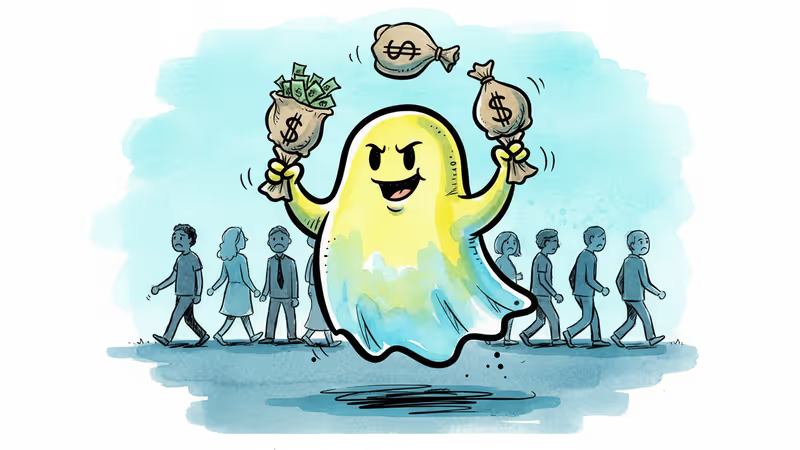
Snap reports 71% growth in paid subscribers while losing daily active users, highlighting the platform's struggle to diversify beyond advertising revenue.

Peloton's latest layoffs target engineers as the company pivots to AI-powered hardware amid declining post-pandemic demand. What's next for fitness tech?

Strava and Komoot bring offline maps to Apple Watch, ending iPhone dependency for runners and cyclists. A glimpse into the future of independent wearables or just catching up?
Google's Pixel Watch 4 just hit an all-time low of $289.99. But as wearable prices drop and AI integration deepens, the real question isn't about the hardware.
Snap reports 71% growth in paid subscribers while losing daily active users, highlighting the platform's struggle to diversify beyond advertising revenue.
Peloton's latest layoffs target engineers as the company pivots to AI-powered hardware amid declining post-pandemic demand. What's next for fitness tech?
Strava and Komoot bring offline maps to Apple Watch, ending iPhone dependency for runners and cyclists. A glimpse into the future of independent wearables or just catching up?
Thoughts
Share your thoughts on this article
Sign in to join the conversation