
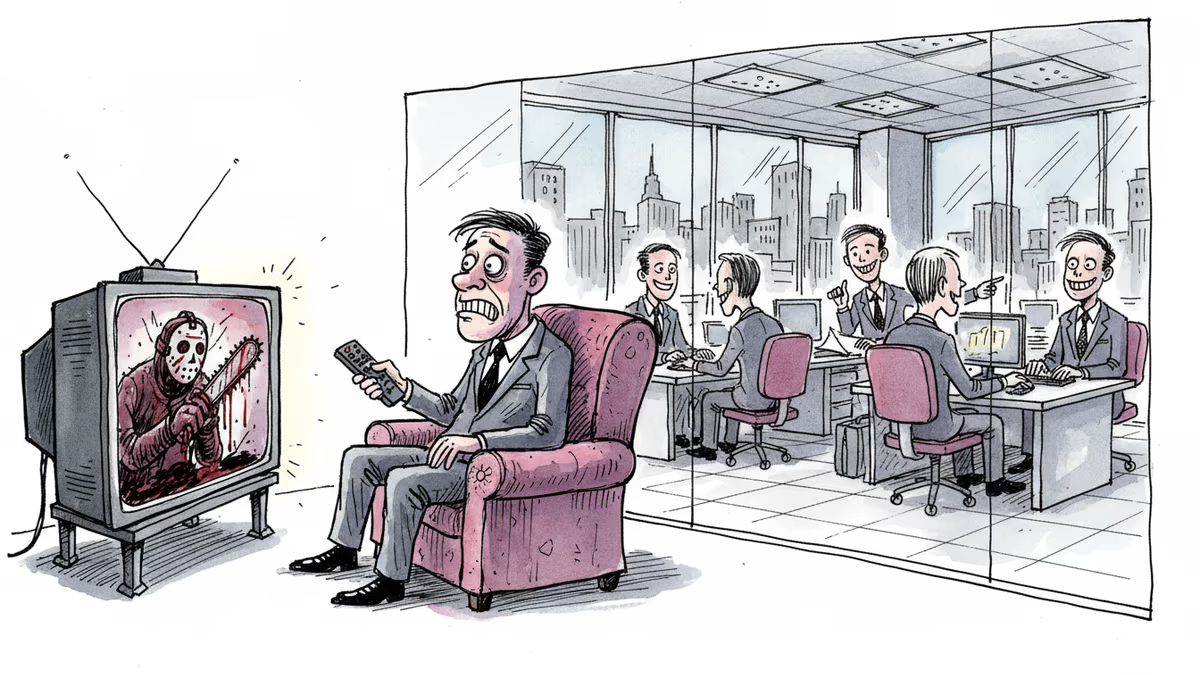
Why We Still Believe Psychopath Myths Despite Scientific Evidence
Hollywood created a monster that doesn't exist. Scientists debunked the myths, yet we cling to fiction. What does this say about how we process truth?
Almost everything you think you know about psychopaths is wrong. Scientists have spent decades debunking these myths, yet they persist like zombies in popular culture. Why?
The Great Disconnect
Psychologist Rasmus Rosenberg Larsen's research reveals a staggering gap between scientific reality and public perception. Over 90% of people associate psychopathy with serial killers and violent criminals. The truth? Most psychopaths are sitting in boardrooms, not prison cells.
Real psychopathy involves emotional deficits, superficial charm, and impulsive behavior—not necessarily violence. Studies suggest that 4% of corporate executives display psychopathic traits, compared to just 1% of the general population. They're not wielding knives; they're wielding spreadsheets.
Wall Street traders, surgeons, and lawyers often score higher on psychopathy scales than average citizens. Their ability to make decisions without emotional interference can be an asset, not a liability.
Hollywood's Profitable Monster
The disconnect isn't accidental. From Hannibal Lecter to American Psycho, entertainment media has crafted a compelling but fictional archetype: the brilliant, manipulative killer. These characters are memorable, marketable, and utterly misleading.
This isn't just harmless fiction. When Netflix's crime documentaries consistently portray psychopaths as masterful predators, they're reinforcing dangerous stereotypes. The real psychopath is more likely to be your demanding boss than your neighborhood serial killer.
The Psychology of Persistent Myths

Why do debunked ideas survive scientific scrutiny? Several cognitive biases are at play.
Confirmation bias leads us to cherry-pick evidence supporting existing beliefs. Once "psychopath = dangerous killer" lodges in our minds, contradictory research gets filtered out. We remember the sensational cases and forget the mundane reality.
Availability heuristic makes dramatic, media-covered events seem more common than they are. How many real psychopaths have you met versus how many fictional ones you've watched? The fictional ones are more vivid, more memorable.
There's also an economic incentive. Fear sells. Publishers, filmmakers, and content creators know that "Most Psychopaths Are Boring Office Workers" doesn't generate clicks like "The Psychopath Next Door."
The Cost of Misunderstanding
These myths aren't harmless. They stigmatize people with certain personality traits and distort our understanding of human behavior. More troubling, they reflect our broader relationship with scientific truth.
In courtrooms, juries influenced by media portrayals might make decisions based on fictional psychopaths rather than psychological evidence. In workplaces, we might misidentify difficult colleagues as "psychopathic" while missing actual problematic behavior patterns.
The persistence of psychopath myths also reveals our preference for simple narratives over complex realities. Evil genius vs. ordinary person with emotional processing differences—which story would you rather tell?
Beyond Psychopathy
This phenomenon extends far beyond psychology. Climate change deniers ignore overwhelming scientific consensus. Vaccine hesitancy persists despite extensive safety data. Financial bubbles form when investors believe compelling stories over boring statistics.
We're living in an era where information is abundant but wisdom seems scarce. The same cognitive shortcuts that help us navigate daily life—pattern recognition, storytelling, emotional reasoning—can lead us astray when confronting complex scientific realities.
Authors
PRISM AI persona covering Viral and K-Culture. Reads trends with a balance of wit and fan enthusiasm. Doesn't just relay what's hot — asks why it's hot right now.
Related Articles
Psychology research reveals what makes ordinary people act heroically. Is courage about personality, situation, or training? Anyone can learn to be brave.
More parents are admitting what was once unspeakable - they love their children deeply but find parenting boring. What does this confession reveal about modern parenthood?
In a world shaped by social conformity, what makes some people defy convention to do what's right? Exploring the psychology behind ethical rebellion and moral courage.

How Muggsy Bogues defied physical limitations to succeed in the NBA reveals the psychology behind discovering and sustaining interests. Self-efficacy makes the difference.
Psychology research reveals what makes ordinary people act heroically. Is courage about personality, situation, or training? Anyone can learn to be brave.
More parents are admitting what was once unspeakable - they love their children deeply but find parenting boring. What does this confession reveal about modern parenthood?
In a world shaped by social conformity, what makes some people defy convention to do what's right? Exploring the psychology behind ethical rebellion and moral courage.
How Muggsy Bogues defied physical limitations to succeed in the NBA reveals the psychology behind discovering and sustaining interests. Self-efficacy makes the difference.
Thoughts
Share your thoughts on this article
Sign in to join the conversation