
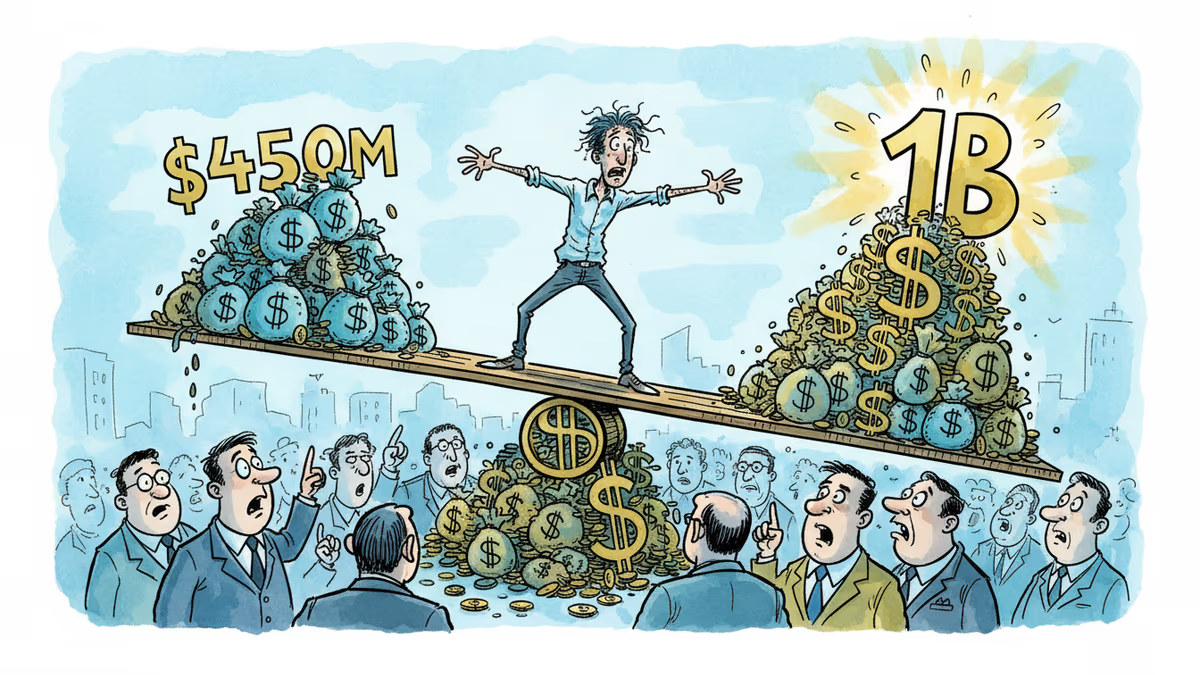
The $1B Unicorn That's Actually Worth $450M
AI startups are using dual-tier valuations to manufacture unicorn status. Why are investors playing along with this new valuation game?
What if a $1 billion unicorn actually sold most of its equity for $450 million? That's exactly what's happening in Silicon Valley right now.
AI customer research startup Aaru recently announced it achieved unicorn status with a $1 billion valuation in its Series A. But according to The Wall Street Journal, lead investor Redpoint actually invested the majority of its check at a $450 million valuation, with only a smaller portion at the headline $1 billion price.
The Rise of 'Headline Valuation' Engineering
This represents a completely new phenomenon. Multiple investors told TechCrunch they had never encountered a deal where a lead investor splits their capital between two different valuation tiers in a single round—until recently.
"It is a sign that the market is incredibly competitive for venture capital firms to win deals," said Jason Shuman, general partner at Primary Ventures. "If the headline number is huge, it's also an incredible strategy to scare away other VCs from backing the number two and number three players."
The strategy isn't limited to Aaru. AI-powered IT help desk startup Serval employed similar tactics, with Sequoia's lowest entry price at a $400 million valuation while announcing its $75 million Series B at a $1 billion headline valuation in December.
Why Investors Pay the Premium
The mechanics are straightforward. Popular startup funding rounds are frequently oversubscribed. Rather than turning away eager investors, startups accommodate excess interest by allowing immediate participation—but at a significantly higher price.

Investors willingly pay this premium because it's the only way to secure a spot on a high-demand cap table. The massive "headline" valuation creates an aura of market dominance, even though the lead VC's average price was significantly lower.
But FPV Ventures co-founder Wesley Chan views this as bubble-like behavior. "You can't sell the same product at two different prices. Only airlines can get away with this," he said.
The Talent and Customer Magnet Effect
The high headline valuation serves multiple purposes beyond investor relations. It helps recruit top talent who want to join a "winning" company and attracts corporate customers who may view the startup as having a stronger market position than competitors.
For founders, offering discounts to top-tier VCs makes strategic sense—their involvement serves as a powerful market signal for future fundraising and talent acquisition. But the dual-tier structure allows them to have their cake and eat it too: prestigious lead investors at favorable terms plus immediate access to additional capital at premium prices.
The High-Wire Act's Hidden Dangers
This strategy carries significant risks. Even though the true, blended valuation is lower than $1 billion, these companies are expected to raise their next round at a valuation higher than the headline price. Otherwise, it becomes a punitive down round.
Thiel Capital's Jack Selby warns founders that chasing extreme valuations is dangerous, pointing to 2022's painful market reset as a cautionary tale. "If you put yourself on this high-wire act, it's very easy to fall off."
Down rounds dilute employee and founder ownership while eroding confidence among partners, customers, future investors, and potential hires. The companies benefiting from this strategy are in high demand now, but unexpected challenges could make it very difficult to justify their inflated valuations.
Authors
Related Articles
Cluely CEO admits to fabricating $7M revenue figure, exposing how startup "fake it till you make it" culture has gone too far. What this means for the ecosystem.
AI startups captured 90% of record $189B February VC funding, with OpenAI, Anthropic, and Waymo dominating 83% of all investments, reshaping venture landscape
Anduril's $60B valuation bid signals a seismic shift in defense tech. As VCs pour billions into weapons, what does this mean for warfare's future?
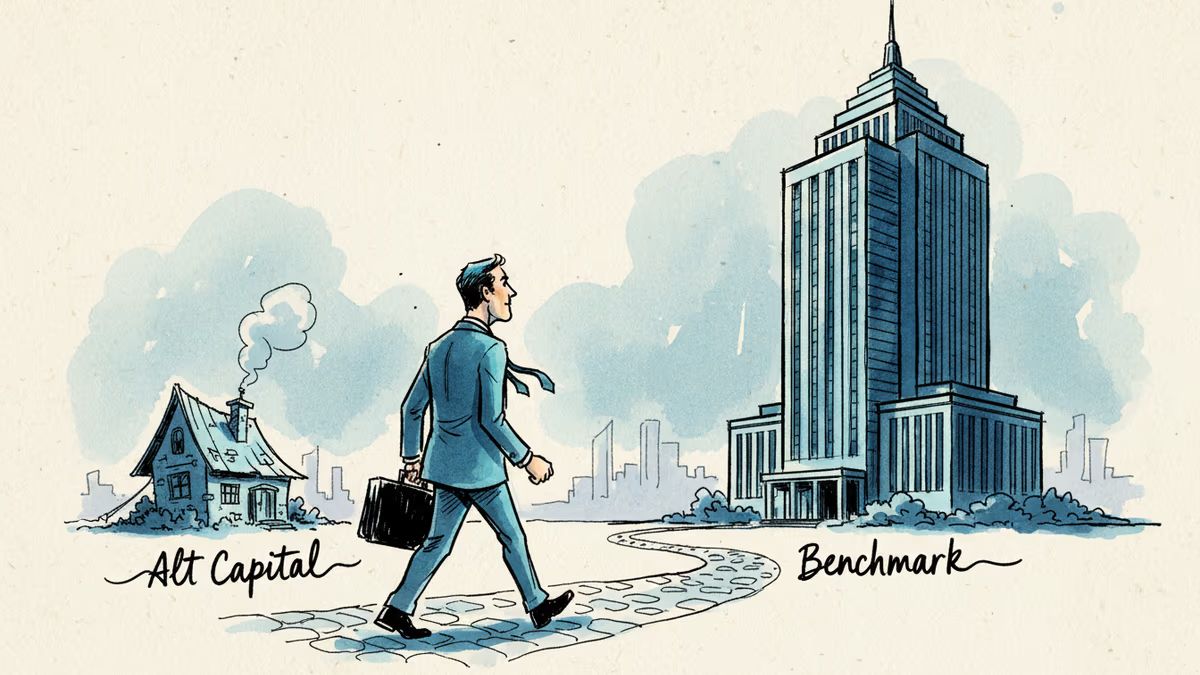
Jack Altman raised $424 million in two years, then walked away from his own fund to join Benchmark. This move signals a seismic shift in VC dynamics.
Cluely CEO admits to fabricating $7M revenue figure, exposing how startup "fake it till you make it" culture has gone too far. What this means for the ecosystem.
AI startups captured 90% of record $189B February VC funding, with OpenAI, Anthropic, and Waymo dominating 83% of all investments, reshaping venture landscape
Anduril's $60B valuation bid signals a seismic shift in defense tech. As VCs pour billions into weapons, what does this mean for warfare's future?
Jack Altman raised $424 million in two years, then walked away from his own fund to join Benchmark. This move signals a seismic shift in VC dynamics.
Thoughts
Share your thoughts on this article
Sign in to join the conversation