
The AI Startup Survival Guide Just Got Rewritten
Google Cloud's global startup chief warns against two once-hot AI business models. Why LLM wrappers and AI aggregators are hitting turbulence, and what separates the survivors from the casualties.
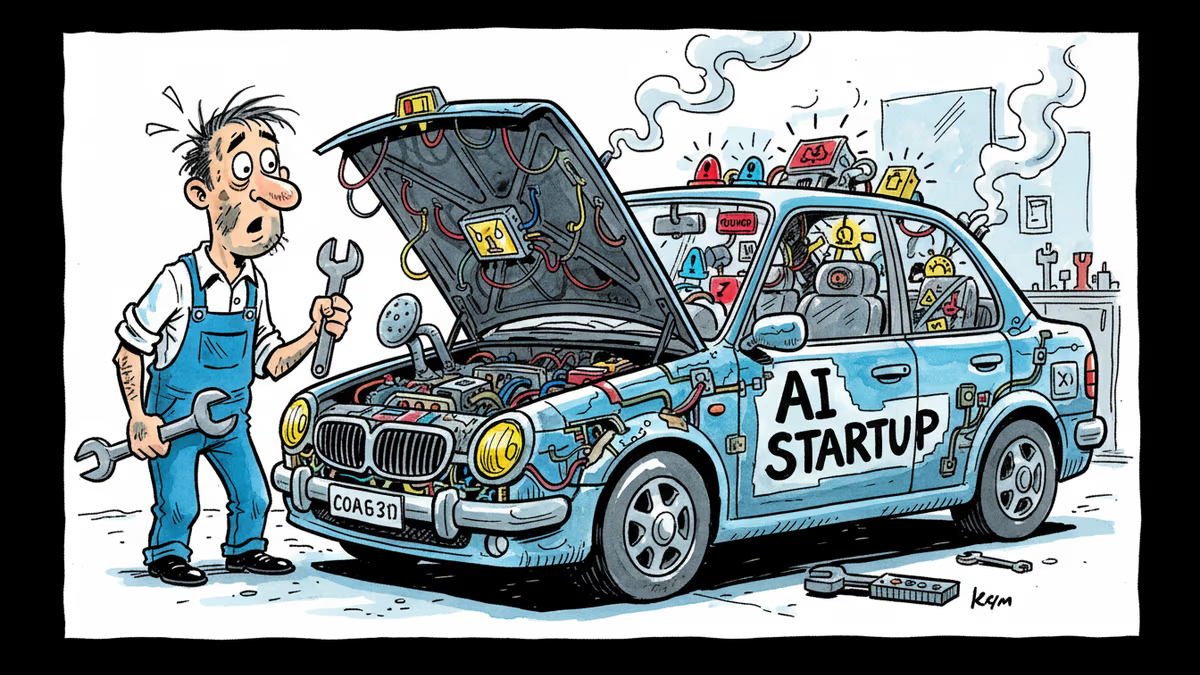
One startup a minute. That's how fast the generative AI boom minted new companies for nearly four years. But the gold rush is over, and the hangover is real. Darren Mowry, who leads Google's global startup organization, just delivered a sobering reality check: two once-hot business models now have their "check engine light" on.
The Thin Wrapper Problem
LLM wrappers sound technical, but the concept is simple: take an existing AI model like GPT or Claude, slap a user interface on top, and call it a solution. Think AI study buddies, translation tools, or summary generators that essentially repackage someone else's intelligence.
"If you're really just counting on the back end model to do all the work and you're almost white-labeling that model, the industry doesn't have a lot of patience for that anymore," Mowry said. The problem isn't the approach itself—it's the lack of differentiation. Wrapping "very thin intellectual property wrapped around Gemini or GPT-5" signals you're not building something unique.
But there are exceptions. Cursor, the GPT-powered coding assistant, and Harvey AI, a legal AI platform, have managed to thrive. What sets them apart? They've built "deep, wide moats" in specific verticals, becoming indispensable to their users rather than easily replaceable.
The Aggregator Squeeze
The second warning sign targets AI aggregators—platforms that bundle multiple AI models into one interface. Companies like Perplexity or OpenRouter promise access to various models through a single API, often adding monitoring and governance tools.
"Stay out of the aggregator business," Mowry's advice is blunt. Users don't just want access to multiple models; they want intelligent routing that directs queries to the right model based on their specific needs, not backend constraints or cost optimization.
This mirrors the late 2000s cloud computing playbook almost perfectly. When AWS was taking off, dozens of startups emerged as resellers, marketing themselves as easier entry points with billing consolidation and support. But when Amazon built enterprise tools and customers learned to manage cloud services directly, most of those middlemen vanished. Only those offering real services—security, migration, DevOps consulting—survived.

What's Actually Working
So where are the smart money and genuine traction going? Mowry highlights three areas seeing real momentum:
Developer platforms are having a moment. Replit, Lovable, and Cursor attracted major investment in 2025's record-breaking year because they're not just using AI—they're reimagining how developers work entirely.
Direct-to-consumer tech is another bright spot. Think Google's AI video generator Veo enabling film students to bring stories to life, or AI tools that put professional-grade capabilities directly in consumers' hands without requiring technical expertise.
Beyond AI, biotech and climate tech are surging, powered by access to "incredible amounts of data" that enable value creation "in ways we would never have been able to before."
The Margin Pressure Reality
The aggregator squeeze isn't just about user preferences—it's about economics. As model providers like OpenAI, Anthropic, and Google expand into enterprise features themselves, they're cutting out middlemen who add limited value. The margin pressure is real, and it's only getting worse.
This creates a brutal selection pressure: either add substantial value that justifies your cut, or get disintermediated. The companies surviving this transition are those building genuine intellectual property, not just prettier interfaces.
The Enterprise Awakening
There's another factor at play: enterprise customers are getting smarter. In 2024, many companies were happy to pay premiums for simplified AI access. By 2026, they've learned to evaluate models directly, understand pricing structures, and build internal capabilities. The "AI is magic" phase is over; now it's about ROI and practical implementation.
This sophistication shift means startups can't rely on information asymmetries or complexity arbitrage. They need to solve real problems that customers can't easily address themselves.
Authors
Related Articles

All 11 of xAI's original co-founders have now left Elon Musk's AI startup. With the company absorbed into SpaceX and declared 'rebuilt from foundations,' what does this mean for Grok—and for Musk's AI ambitions?
Stripe's 2025 report reveals AI startups are hitting $10M ARR twice as fast, with 20% charging customers within 30 days of launch. The startup playbook is being rewritten in real-time.
xAI co-founder Tony Wu abruptly resigned, citing the power of small AI teams. His departure adds to a string of senior executive exits from Elon Musk's AI company.

Google's parent company hits historic revenue milestone with cloud business reaching $70B run rate and YouTube surpassing $60B annually. What this means for the tech landscape.
All 11 of xAI's original co-founders have now left Elon Musk's AI startup. With the company absorbed into SpaceX and declared 'rebuilt from foundations,' what does this mean for Grok—and for Musk's AI ambitions?
Stripe's 2025 report reveals AI startups are hitting $10M ARR twice as fast, with 20% charging customers within 30 days of launch. The startup playbook is being rewritten in real-time.
xAI co-founder Tony Wu abruptly resigned, citing the power of small AI teams. His departure adds to a string of senior executive exits from Elon Musk's AI company.
Google's parent company hits historic revenue milestone with cloud business reaching $70B run rate and YouTube surpassing $60B annually. What this means for the tech landscape.
Thoughts
Share your thoughts on this article
Sign in to join the conversation