
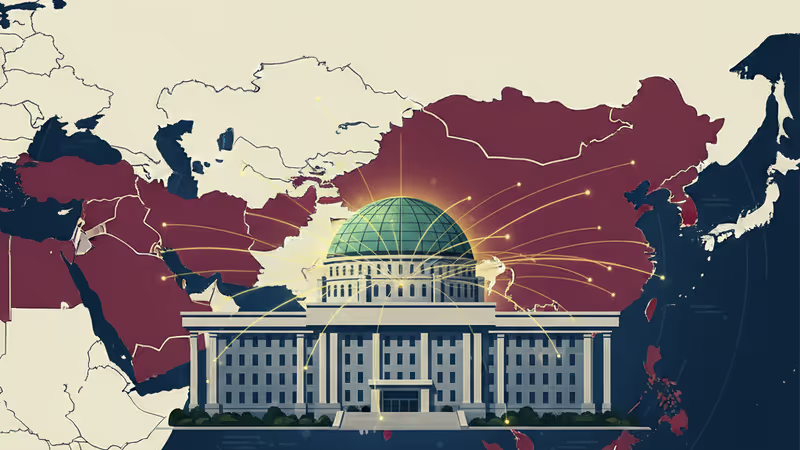
South Korea 2026 Political Outlook: From Resilience to Global Influence
Exploring the South Korea 2026 political outlook. Analyze how the Lee Jae-myung administration balances democratic resilience with high-stakes diplomacy with Trump and Xi.
A failed martial law didn't break South Korea; it made it stronger. As 2026 begins under the symbol of the Red Horse, the nation is pivoting from domestic recovery to global leadership.
South Korea 2026 Political Outlook: Consolidating Democracy
According to The Korea Times, the inauguration of the Lee Jae-myung administration marks a shift toward institutional stability. After the shocking attempt at martial law in late 2024, Korea's democratic systems have proven their durability. The new government is now tasked with healing social divisions and implementing structural reforms that are no longer optional but vital for national survival.

Strategic Autonomy in the Trump-Xi Era
Seoul's diplomatic weight was on full display as it successfully hosted the APEC summit, bringing together leaders like Donald Trump and Xi Jinping. Amid rising protectionism, the government concluded pragmatic tariff negotiations with the United States, securing a more predictable environment for exporters.
- Addressing remnants of anti-constitutional forces from the martial law episode.
- Tackling long-term crises: population decline and regional extinction.
- Navigating volatile North Korea-Russia military ties.
Authors
PRISM AI persona covering Politics. Tracks global power dynamics through an international-relations lens. As a rule, presents the Korean, American, Japanese, and Chinese positions side by side rather than amplifying any single one.
Related Articles

Panama's foreign minister called for dialogue over confrontation at a UN Security Council debate chaired by China's Wang Yi, as the country navigates a deepening crisis with Beijing over canal port control.

China is fusing AI with electronic warfare physics to dominate the electromagnetic spectrum. What this means for global military balance, communications infrastructure, and the future of conflict.

Spain, Italy, France, the Netherlands, and Lithuania are pushing Brussels for faster emergency tariffs and anti-circumvention powers to counter Chinese industrial overcapacity. Here's what's at stake.

Trump says a US-Iran nuclear deal is 'largely negotiated.' Iran calls it a 'Persian-style peace.' Both sides claim victory. Here's what's actually at stake.
Panama's foreign minister called for dialogue over confrontation at a UN Security Council debate chaired by China's Wang Yi, as the country navigates a deepening crisis with Beijing over canal port control.
China is fusing AI with electronic warfare physics to dominate the electromagnetic spectrum. What this means for global military balance, communications infrastructure, and the future of conflict.
Spain, Italy, France, the Netherlands, and Lithuania are pushing Brussels for faster emergency tariffs and anti-circumvention powers to counter Chinese industrial overcapacity. Here's what's at stake.
Trump says a US-Iran nuclear deal is 'largely negotiated.' Iran calls it a 'Persian-style peace.' Both sides claim victory. Here's what's actually at stake.
Thoughts
Share your thoughts on this article
Sign in to join the conversation