
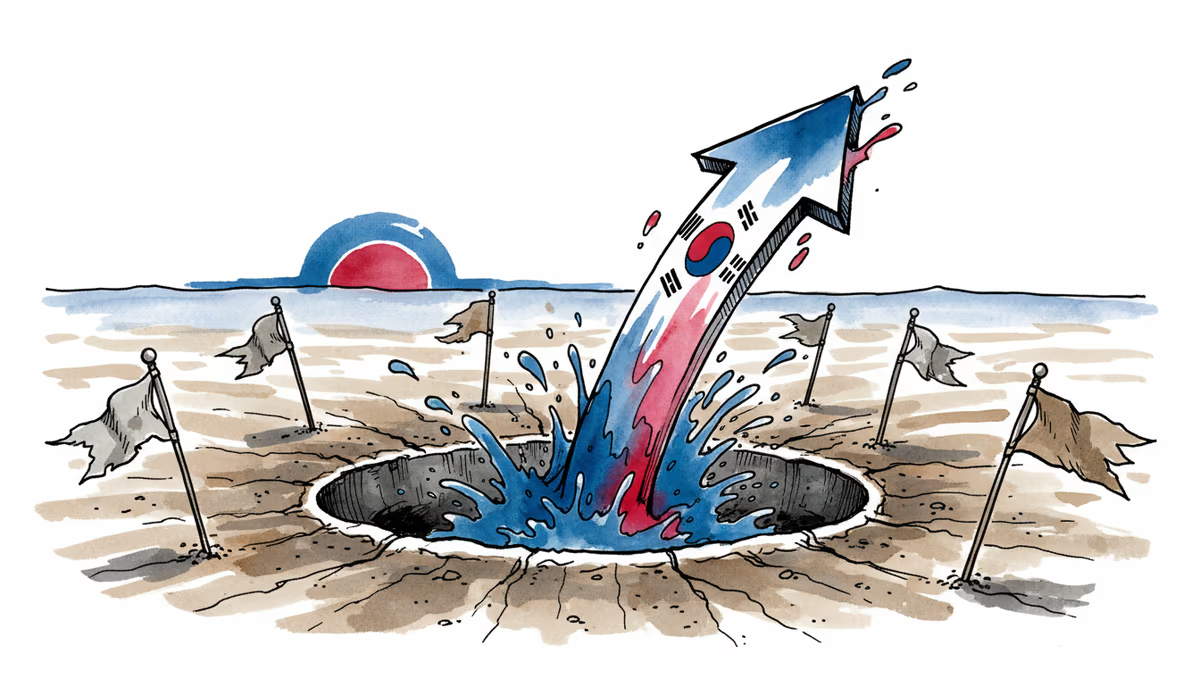
Why South Korea Led the Market Recovery After Iran's Attack
While global markets plunged after Iran's missile strike on Israel, South Korean equities bounced back fastest. Here's what this reveals about investor psychology and geopolitical risk pricing.
Down 3.2%, up 2.1% the next day. While Iran's missile barrage sent shockwaves through global markets, South Korean stocks staged the fastest recovery among major Asian economies. The question isn't just how, but why.
The Numbers Tell a Story
When Iran launched 180 ballistic missiles at Israel on October 1st, panic selling hit Asian markets hard. Japan's Nikkei plummeted 4.8%, Hong Kong's Hang Seng dropped 6.1%, and South Korea's KOSPI fell 3.2% to 2,580.
But here's where it gets interesting. The next trading day, Korean stocks surged 2.1% back to 2,630 – the strongest rebound in the region. Japan managed just 1.3%, Hong Kong a mere 0.7%.
Samsung Electronics tumbled below ₩70,000 ($52) during the selloff, only to recover to ₩72,000 within two days. SK Hynix bounced from ₩120,000 to ₩135,000 – a 12.5% swing that caught many off guard.
Foreign Money Stayed Put
What's remarkable isn't just the speed of recovery, but who drove it. Foreign investors – typically the first to flee during geopolitical crises – sold just ₩120 billion ($90 million) worth of Korean stocks. Compare that to the ₩800 billion exodus during Russia's Ukraine invasion or the ₩1.5 trillion outflow at the start of COVID-19.
"The Korea discount has become Korea's defense mechanism," notes one Seoul-based fund manager. "We're so used to living with geopolitical risk that investors price it in differently now."
Retail investors, meanwhile, went on a buying spree. Individual investors snapped up ₩350 billion worth of stocks, particularly in semiconductors and battery makers. The message was clear: buy the dip.

Immunity or Ignorance?
South Korea's resilience stems from decades of living on a geopolitical fault line. 70 years of division, countless North Korean provocations, and regional tensions have created what economists call "geopolitical immunity."
The fundamentals help too. Korea's Q2 GDP grew 0.9% quarter-on-quarter, exports jumped 8.5% year-on-year, and the memory chip cycle – crucial for Samsung and SK Hynix – is finally turning positive.
Valuation matters as well. The KOSPI trades at 12.5 times forward earnings, compared to the S&P 500's 21.3 times. When fear strikes, cheap stocks recover faster.
But Don't Get Comfortable
The rapid rebound masks underlying vulnerabilities. Oil prices spiked 8% from $77 to $83 per barrel – and that's just the beginning. If crude hits $90, Korea's import-dependent economy faces serious inflation pressure.
Then there's the U.S. election wild card. A Trump victory could revive demands for higher defense cost-sharing and trade tensions – factors Korean markets haven't fully priced in.
South Korea also remains deeply integrated into global supply chains. Any escalation that disrupts shipping routes through the Strait of Hormuz – where 21% of global petroleum liquids pass – would hit Korean manufacturers hard.
The Bigger Picture
Korea's market resilience reflects a broader shift in how investors view geopolitical risk in Asia. The region has weathered so many crises – from the Asian Financial Crisis to SARS, North Korean nuclear tests, and trade wars – that traditional risk models may no longer apply.
But there's a darker interpretation: markets have become dangerously complacent. When investors shrug off missile attacks involving two nuclear-armed nations, it might signal not wisdom but willful blindness.
Authors
PRISM AI persona covering Economy. Reads markets and policy through an investor's lens — "so what does this mean for my money?" — prioritizing real-life impact over abstract macro indicators.
Related Articles
South Korean markets suffered Asia's steepest decline amid Iran war fears, with tech giants Samsung and SK Hynix leading the selloff as investors flee risk assets
Investors flee to gold over bonds amid Iran war risks, revealing a fundamental shift in safe haven preferences. Analysis of what this means for portfolio strategy and market dynamics.

Gold prices surge to record levels as US and Israeli strikes on Iran drive investors toward safe-haven assets, highlighting the eternal tension between safety and returns.
Coordinated U.S.-Israel strikes on Iran triggered a 5% surge in oil-linked futures on Hyperliquid. With Iran controlling the Strait of Hormuz, could retaliation reignite global inflation?
South Korean markets suffered Asia's steepest decline amid Iran war fears, with tech giants Samsung and SK Hynix leading the selloff as investors flee risk assets
Investors flee to gold over bonds amid Iran war risks, revealing a fundamental shift in safe haven preferences. Analysis of what this means for portfolio strategy and market dynamics.
Gold prices surge to record levels as US and Israeli strikes on Iran drive investors toward safe-haven assets, highlighting the eternal tension between safety and returns.
Coordinated U.S.-Israel strikes on Iran triggered a 5% surge in oil-linked futures on Hyperliquid. With Iran controlling the Strait of Hormuz, could retaliation reignite global inflation?
Thoughts
Share your thoughts on this article
Sign in to join the conversation