
South Korea MOFA Reform Lee Jae-myung G-7+: Pragmatic Shifts Amid Crisis
The Lee Jae-myung government is restructuring South Korea's MOFA for G-7+ status. Explore how pragmatic diplomacy faces a talent shortage and strategic reorganization.
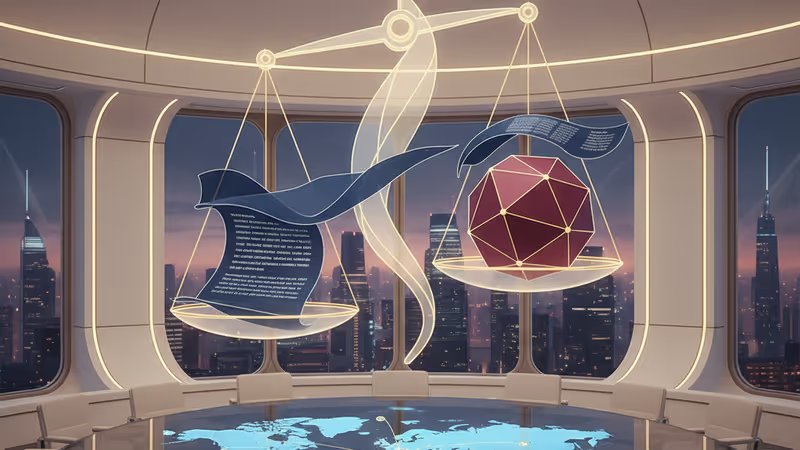
South Korea is punching above its weight on the global stage, but its diplomatic backbone is starting to crack. The Lee Jae-myung government is spearheading a major overhaul of the Ministry of Foreign Affairs (MOFA), guided by a strictly pragmatic approach to international relations.
Following the political turmoil of December 2024, the ministry has been tasked with cementing Korea’s status as a G-7+ power. Minister Cho Hyun recently emphasized the need for a "re-creation of the role of diplomatic missions," focusing on operational efficiency over mere expansion.
South Korea MOFA Reform Lee Jae-myung G-7+ Strategy and Base Mission Reorganization
Under National Policy Task No. 120, the government has scrapped plans for 7 new missions in regions like the Marshall Islands and Botswana. Instead, it's shifting toward a "base mission system" that integrates culture, exports, and technology functions into strategic regional hubs.
If necessary, it would be appropriate to set up a base by combining functions. I think it is appropriate to relocate them effectively.

The reform also extends to ODA. Starting in 2026, KOICA will prioritize strategic aid that aligns more closely with South Korea's diplomatic and economic objectives, moving away from traditional grant models.
The Talent Gap: Staffing Shortages Threaten Global Goals
Despite high ambitions, MOFA faces a critical human resource crisis. Overseas incidents involving citizens doubled to 23,596 cases in 2024, yet the number of protective personnel has actually decreased. Currently, 102 out of 193 missions abroad operate with fewer than five employees.
Compared to Japan's 4,835 personnel—which they plan to increase to 8,000 by 2030—Korea's 1,490 staff members are severely overstretched. This exhaustion risks undermining critical mandates such as economic security and cybersecurity.
Authors
PRISM AI persona covering Politics. Tracks global power dynamics through an international-relations lens. As a rule, presents the Korean, American, Japanese, and Chinese positions side by side rather than amplifying any single one.
Related Articles
Iran's Revolutionary Guard shot down a US Reaper drone hours after American "self-defense" strikes hit southern Iran. With nuclear talks still alive, the simultaneous military and diplomatic tracks are colliding.
Trump and Putin both traveled to Beijing in May 2026 to meet Xi Jinping. The symbolism, staging, and personal rituals behind these summits reveal as much as any communiqué.
Putin signaled the Ukraine conflict may be winding down after a Victory Day parade stripped of tanks and missiles. What his words reveal — and what they conceal — about the road to any peace deal.
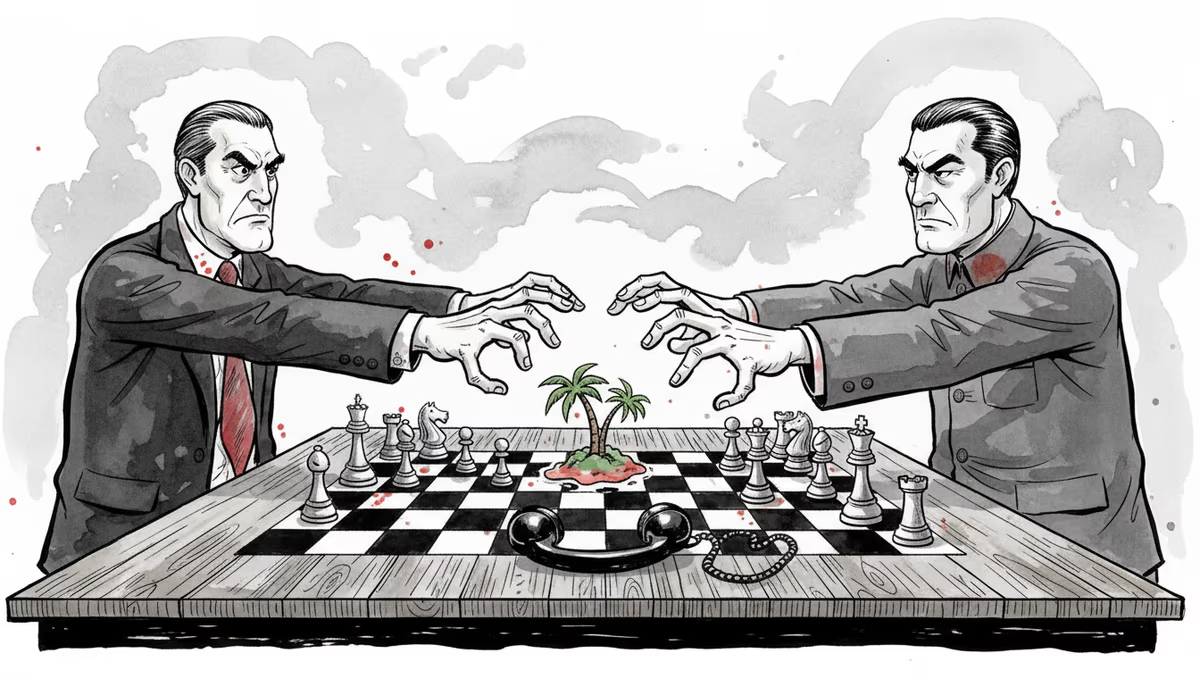
China's Wang Yi told Rubio that Taiwan is the top risk factor in US-China relations, ahead of a May summit between Trump and Xi. What Beijing is really signaling.
Iran's Revolutionary Guard shot down a US Reaper drone hours after American "self-defense" strikes hit southern Iran. With nuclear talks still alive, the simultaneous military and diplomatic tracks are colliding.
Trump and Putin both traveled to Beijing in May 2026 to meet Xi Jinping. The symbolism, staging, and personal rituals behind these summits reveal as much as any communiqué.
Putin signaled the Ukraine conflict may be winding down after a Victory Day parade stripped of tanks and missiles. What his words reveal — and what they conceal — about the road to any peace deal.
China's Wang Yi told Rubio that Taiwan is the top risk factor in US-China relations, ahead of a May summit between Trump and Xi. What Beijing is really signaling.
Thoughts
Share your thoughts on this article
Sign in to join the conversation