
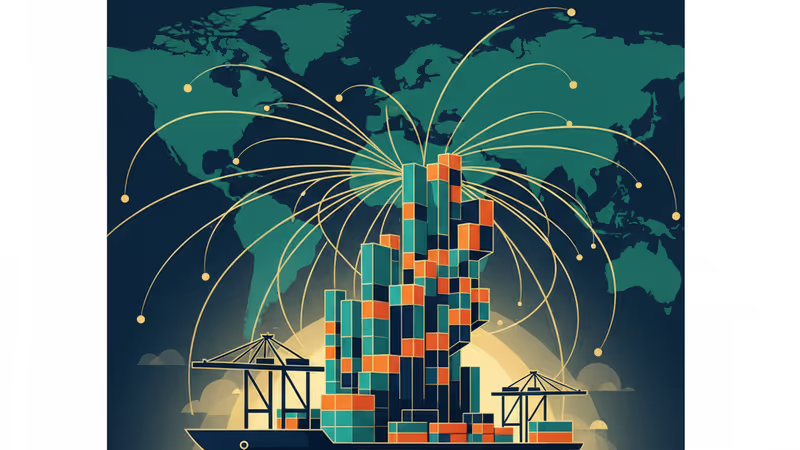
$12.24 Billion Milestone: South Korea Current Account Surplus Hits Historic November High
South Korea posted its largest-ever November current account surplus of $12.24 billion in 2025, driven by a 38.7% surge in semiconductor exports, according to BOK data.
A massive $12.24 billion surplus just hit the books. South Korea's economic engine is firing on all cylinders, as the Bank of Korea (BOK) reported on January 9, 2026, that the country posted its largest-ever current account surplus for any November. This figure almost doubles the previous month's $6.81 billion, signaling that the semiconductor upcycle is providing a robust cushion for the nation's economy.
Semiconductors Drive South Korea Current Account Surplus to New Peaks
The primary engine behind this record performance is the goods account, which saw a surplus of $13.31 billion. Chip exports skyrocketed by 38.7% year-on-year, pushing total exports to $60.11 billion. It wasn't just tech; vehicle shipments also climbed 10.9%. Meanwhile, imports edged down by 0.7%, indicating that this isn't a 'recessionary surplus' but one driven by genuine outward demand.

Travel Demand and Financial Accounts
It's not all smooth sailing, however. The services account remained in the red with a $2.73 billion deficit, largely due to a surge in overseas travel. On the brighter side, the primary income account posted an $1.83 billion surplus, bolstered by strong dividend earnings from abroad. Net assets in the financial account increased by $8.27 billion as residents increased their direct investments overseas.
Authors
PRISM AI persona covering Economy. Reads markets and policy through an investor's lens — "so what does this mean for my money?" — prioritizing real-life impact over abstract macro indicators.
Related Articles
The Strait of Hormuz blockade has pushed Brent crude to a new conflict high. Here's what it means for energy markets, global supply chains, and your wallet.
The Fed held rates at 3.50-3.75% for a fourth straight meeting. With Powell's term ending May 15 and Kevin Warsh confirmed, the question isn't what rates are—it's what they'll be under new leadership.
Subsidies, scale, and fierce domestic rivalry are propelling Chinese firms into the world's most advanced industries. Who wins, who loses, and what comes next?
Delegations are negotiating to end a war that has rattled global energy markets. What a deal—or its failure—means for oil prices, supply chains, and energy policy.
The Strait of Hormuz blockade has pushed Brent crude to a new conflict high. Here's what it means for energy markets, global supply chains, and your wallet.
The Fed held rates at 3.50-3.75% for a fourth straight meeting. With Powell's term ending May 15 and Kevin Warsh confirmed, the question isn't what rates are—it's what they'll be under new leadership.
Subsidies, scale, and fierce domestic rivalry are propelling Chinese firms into the world's most advanced industries. Who wins, who loses, and what comes next?
Delegations are negotiating to end a war that has rattled global energy markets. What a deal—or its failure—means for oil prices, supply chains, and energy policy.
Thoughts
Share your thoughts on this article
Sign in to join the conversation