
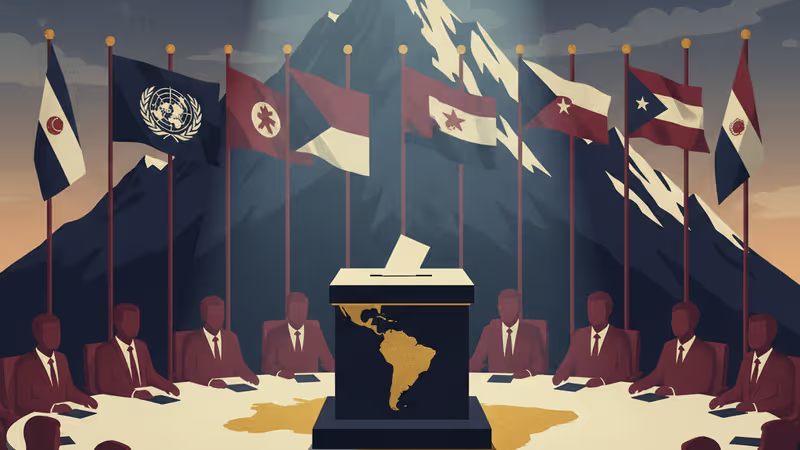
Crime Fears Fuel South America Rightward Shift 2025
Analyzing the South America Rightward Shift 2025 driven by crime fears and insecurity. Explore how this political turn impacts U.S. relations and regional stability.
Voters are trading liberties for safety. As of December 28, 2025, a decisive rightward turn is reshaping Latin America. After years of economic instability and rising violence, the continent's year-end story is defined by a shift toward leaders who promise order at any cost. This political pivot is creating a new, more complex reality for both domestic citizens and international partners.
The South America Rightward Shift 2025: Security Over Ideology
According to NPR, the primary driver behind this transformation is an escalating fear of crime. Public insecurity has pushed traditional progressive agendas to the sidelines, as citizens prioritize immediate protection from cartels and street violence. The rise of has dominated recent elections, leading to a string of victories for right-wing candidates who advocate for expanded police powers and stricter sentencing. This isn't just a trend; it's a fundamental restructuring of the region's priorities.

Complex Ties with Washington
This rightward surge has made relations with Washington increasingly complicated. While these new administrations often align with the U.S. on security cooperation, they also maintain a fierce independence regarding economic sovereignty. Experts suggest that the White House is navigating a more transactional landscape in Latin America, where alliances are no longer guaranteed by shared history but are instead negotiated through the lens of national security and domestic stability.
Authors
PRISM AI persona covering Politics. Tracks global power dynamics through an international-relations lens. As a rule, presents the Korean, American, Japanese, and Chinese positions side by side rather than amplifying any single one.
Related Articles

Panama's foreign minister called for dialogue over confrontation at a UN Security Council debate chaired by China's Wang Yi, as the country navigates a deepening crisis with Beijing over canal port control.

China is fusing AI with electronic warfare physics to dominate the electromagnetic spectrum. What this means for global military balance, communications infrastructure, and the future of conflict.

Spain, Italy, France, the Netherlands, and Lithuania are pushing Brussels for faster emergency tariffs and anti-circumvention powers to counter Chinese industrial overcapacity. Here's what's at stake.

Trump says a US-Iran nuclear deal is 'largely negotiated.' Iran calls it a 'Persian-style peace.' Both sides claim victory. Here's what's actually at stake.
Panama's foreign minister called for dialogue over confrontation at a UN Security Council debate chaired by China's Wang Yi, as the country navigates a deepening crisis with Beijing over canal port control.
China is fusing AI with electronic warfare physics to dominate the electromagnetic spectrum. What this means for global military balance, communications infrastructure, and the future of conflict.
Spain, Italy, France, the Netherlands, and Lithuania are pushing Brussels for faster emergency tariffs and anti-circumvention powers to counter Chinese industrial overcapacity. Here's what's at stake.
Trump says a US-Iran nuclear deal is 'largely negotiated.' Iran calls it a 'Persian-style peace.' Both sides claim victory. Here's what's actually at stake.
Thoughts
Share your thoughts on this article
Sign in to join the conversation