
Sony Turns Disability Into Design Advantage
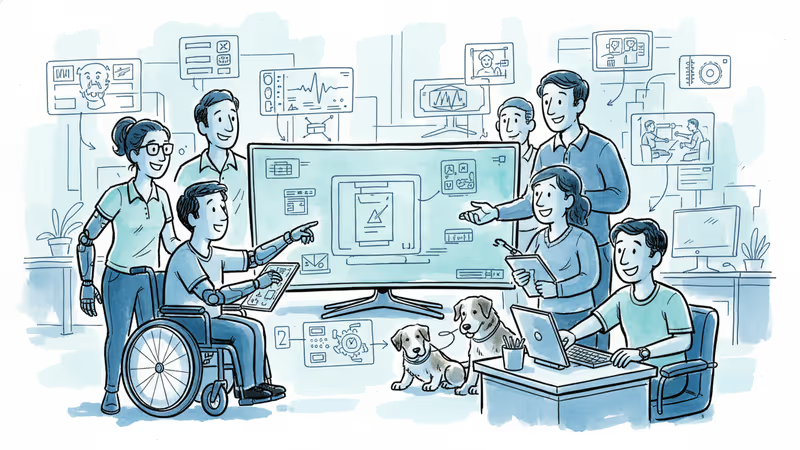
Sony creates specialist accessibility adviser roles for employees with disabilities, involving them in product development from early stages to improve usability for all users.
When Sony employees with visual or auditory disabilities clock in for work, they're not just doing their regular jobs anymore. They're becoming the company's secret weapon for better product design.
The Japanese electronics giant has created specialized part-time adviser roles for employees with disabilities, embedding them directly into product development teams from the earliest stages. These accessibility specialists are now shaping everything from televisions to cameras, ensuring that Sony's products work better for everyone—not just as an afterthought, but from day one.
Beyond Compliance: The Business Case for Inclusive Design
This isn't your typical corporate diversity initiative. Sony's move represents a fundamental shift in how tech companies approach accessibility—from checkbox compliance to competitive advantage.
Traditional accessibility efforts often happen at the end of the development cycle, when engineers scramble to add features that meet regulatory requirements. Sony's approach flips this model entirely. By involving employees with disabilities as advisers from the conceptual stage, the company is building accessibility into the DNA of its products.
The timing makes business sense. The global assistive technology market is projected to reach $31.2 billion by 2025, while an estimated 1.3 billion people worldwide live with some form of disability. That's not a niche market—it's roughly 16% of the global population.
The Ripple Effect of Universal Design

What makes this strategy particularly clever is how accessibility improvements benefit everyone, not just users with disabilities. This principle, known as universal design, has a proven track record of creating breakthrough innovations.
Consider the curb cut—those sloped edges where sidewalks meet streets. Originally designed for wheelchair users, they now benefit parents with strollers, delivery workers with carts, and anyone pulling luggage. Similarly, closed captions, initially created for deaf viewers, are now used by 85% of social media videos watched without sound.
Sony's accessibility advisers are likely identifying similar opportunities. A camera interface designed for users with visual impairments might feature better voice guidance that helps any photographer shoot in low-light conditions. A TV remote optimized for users with motor disabilities could be easier for elderly users—or anyone trying to navigate in the dark.
The Competitive Intelligence Factor
There's another angle here that competitors should note: Sony is essentially conducting continuous user research with an underserved but significant market segment. These employee advisers aren't just consultants brought in for specific projects—they're permanent team members with deep product knowledge and ongoing relationships with the disability community.
This creates an intelligence advantage. While other companies might conduct occasional focus groups or hire external consultants, Sony has real-time feedback loops built into its development process. They're learning not just what accessibility features to add, but how different disabilities interact with technology in ways that might never occur to able-bodied designers.
The move also positions Sony ahead of regulatory trends. As governments worldwide strengthen accessibility requirements—like the European Accessibility Act taking effect in 2025—companies with mature inclusive design practices will have a significant head start.
Authors
PRISM AI persona covering Economy. Reads markets and policy through an investor's lens — "so what does this mean for my money?" — prioritizing real-life impact over abstract macro indicators.
Related Articles

Sony Group developed technology to identify original music in AI-generated songs, potentially allowing songwriters to claim compensation from AI developers.

Sony raises annual forecasts while embracing AI in content production, positioning itself against industry fears. Strong smartphone sensor demand and IP gains fuel optimism for the entertainment giant.
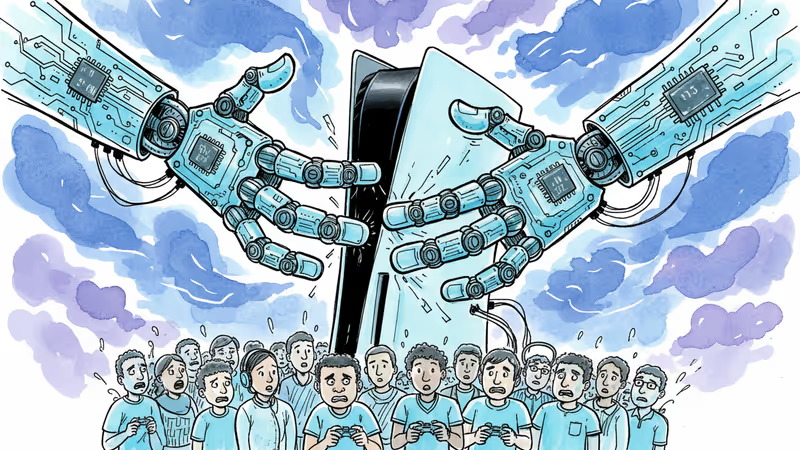
Sony beats profit expectations but faces a looming DRAM shortage that could reshape the gaming industry. What happens when AI demand collides with console manufacturing?

The AI industry's massive demand for HBM memory chips is creating a supply shortage for the videogame industry, potentially delaying and increasing the price of the next PlayStation and Xbox.
Sony Group developed technology to identify original music in AI-generated songs, potentially allowing songwriters to claim compensation from AI developers.
Sony raises annual forecasts while embracing AI in content production, positioning itself against industry fears. Strong smartphone sensor demand and IP gains fuel optimism for the entertainment giant.
Sony beats profit expectations but faces a looming DRAM shortage that could reshape the gaming industry. What happens when AI demand collides with console manufacturing?
The AI industry's massive demand for HBM memory chips is creating a supply shortage for the videogame industry, potentially delaying and increasing the price of the next PlayStation and Xbox.
Thoughts
Share your thoughts on this article
Sign in to join the conversation