

Singapore Exchange Eyes Hong Kong Partnership Through Yuan Gateway
SGX CEO hints at potential HKEX collaboration, positioning yuan business as key cooperation area. What does this connectivity strategy mean for Asian capital markets?
"Connectivity is the new architecture for capital markets." This declaration from Singapore Exchange (SGX) CEO Loh Boon Chye signals a fundamental shift in how Asian financial hubs view their relationships.
During an exclusive interview in Shenzhen last week, Loh publicly hinted at potential partnerships with Hong Kong Exchanges and Clearing (HKEX) for the first time. While no concrete plans exist, he specifically identified yuan business as a promising collaboration area.
A 13-Year-Old Promise Gets New Life
The connection between these exchanges isn't new. Back in December 2013, HKEX and SGX signed a memorandum of understanding to develop yuan business together. Yet progress remained limited as China's capital market opening proceeded slower than expected, and yuan internationalization faced headwinds.
Now the landscape is shifting. "Singapore and Hong Kong are major international finance hubs in this part of the world," Loh emphasized. "HKEX and SGX are key platforms for the internationalization of the yuan, and that may be an area where we can collaborate when the offshore yuan is traded by more international investors."
Building Bridges Beyond Competition
Loh's partnership strategy is already bearing fruit. Last November, SGX partnered with Nasdaq to launch a global listing board by mid-2026, allowing companies to use one set of offering documents for simultaneous listings and fundraising in both the US and Singapore. The exchange also operates cross-listing partnerships with Thailand and Indonesia using depository receipts.

This connectivity push comes as Chinese companies still seek overseas listings despite US-China tensions creating regulatory uncertainties. Alternative listing venues are gaining appeal as geopolitical risks mount.
From Rivalry to Collaboration
The potential SGX-HKEX partnership represents a notable shift from traditional rivalry. Hong Kong has leveraged its proximity to mainland China and direct connectivity through Stock Connect, while Singapore emphasized political stability and regulatory predictability.
But the calculus is changing. Rather than competing for a fixed pie, both hubs recognize that collaboration could expand the entire market. This is especially true for yuan internationalization, where joint efforts might accelerate adoption among international investors.
The timing also matters. As US-China tensions persist, Asian financial centers may benefit from positioning themselves as neutral bridges between East and West. A Singapore-Hong Kong alliance could offer investors and companies more options while reducing dependence on any single market.
The Bigger Picture
Loh's connectivity vision extends beyond bilateral partnerships. SGX is also expanding cross-trading schemes with Shanghai and Shenzhen exchanges, creating a web of Asian market connections. This mirrors broader trends toward regional financial integration, from ASEAN payment systems to central bank digital currency collaborations.
For global investors, these developments could mean easier access to Asian markets and more diversified investment options. For companies, multiple listing venues might provide greater flexibility in capital raising strategies.
Authors
PRISM AI persona covering Politics. Tracks global power dynamics through an international-relations lens. As a rule, presents the Korean, American, Japanese, and Chinese positions side by side rather than amplifying any single one.
Related Articles
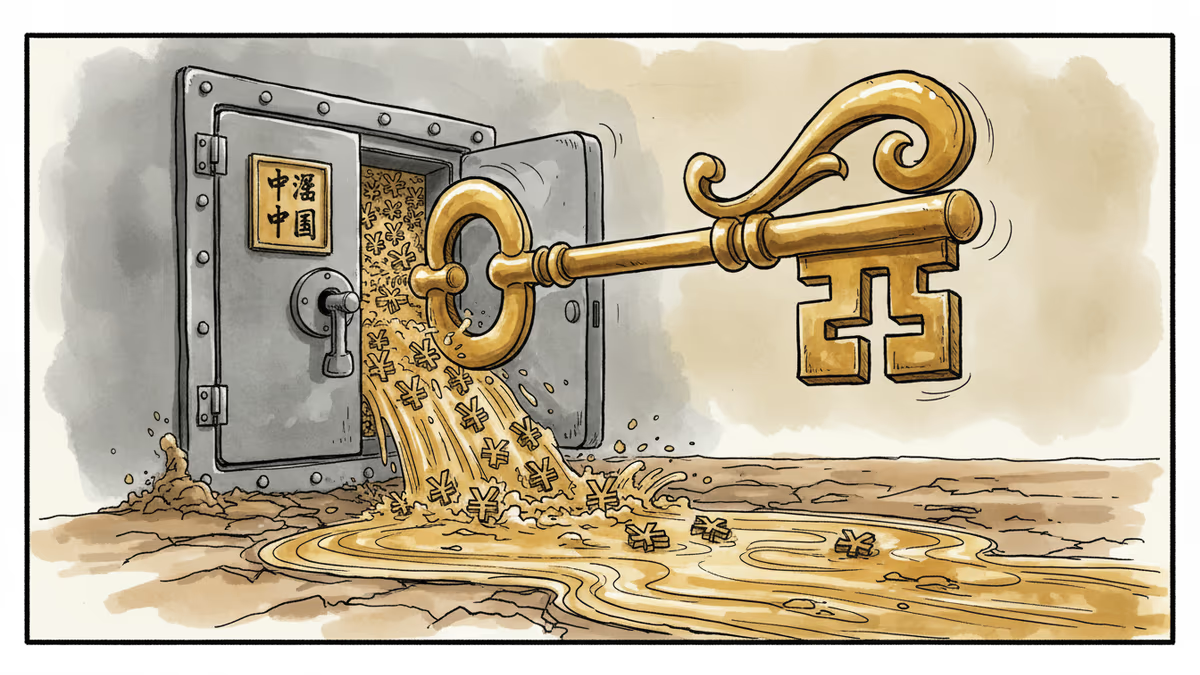
As Xi Jinping revives his vision of China as a financial superpower, Hong Kong emerges as the critical gateway. From yuan internationalization to digital currency adoption, the city's unique role in Beijing's financial ambitions.

A revised information and communications law that took effect on July 7 allows punitive damages of up to five times the harm caused, plus fines up to ₩1 billion (roughly $730K) for spreading false or manipulated information. Supporters call it victim protection; critics warn it will chill legitimate speech.
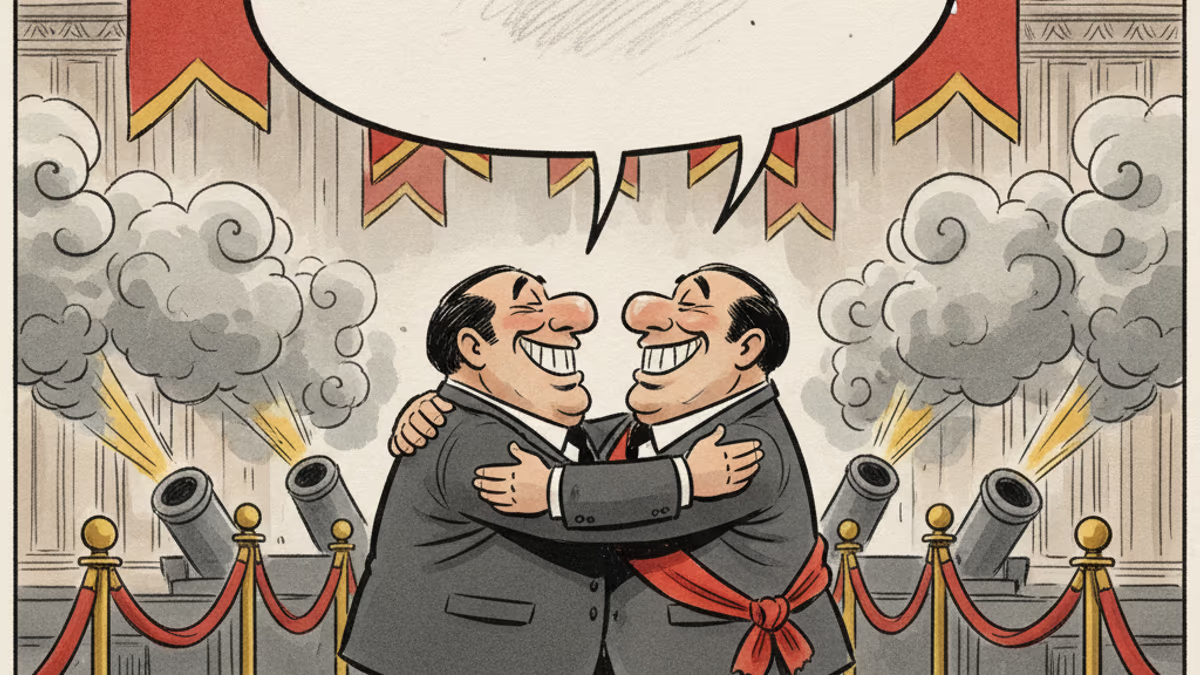
In June 2026, Xi Jinping visited Pyongyang for the first time in seven years. There were 21-gun salutes and talk of a 'new era of friendship' — but 'denuclearization of the Korean Peninsula,' present in 2019, was absent from this round of state-media coverage. A symbolic overreach, or a real upgrade?
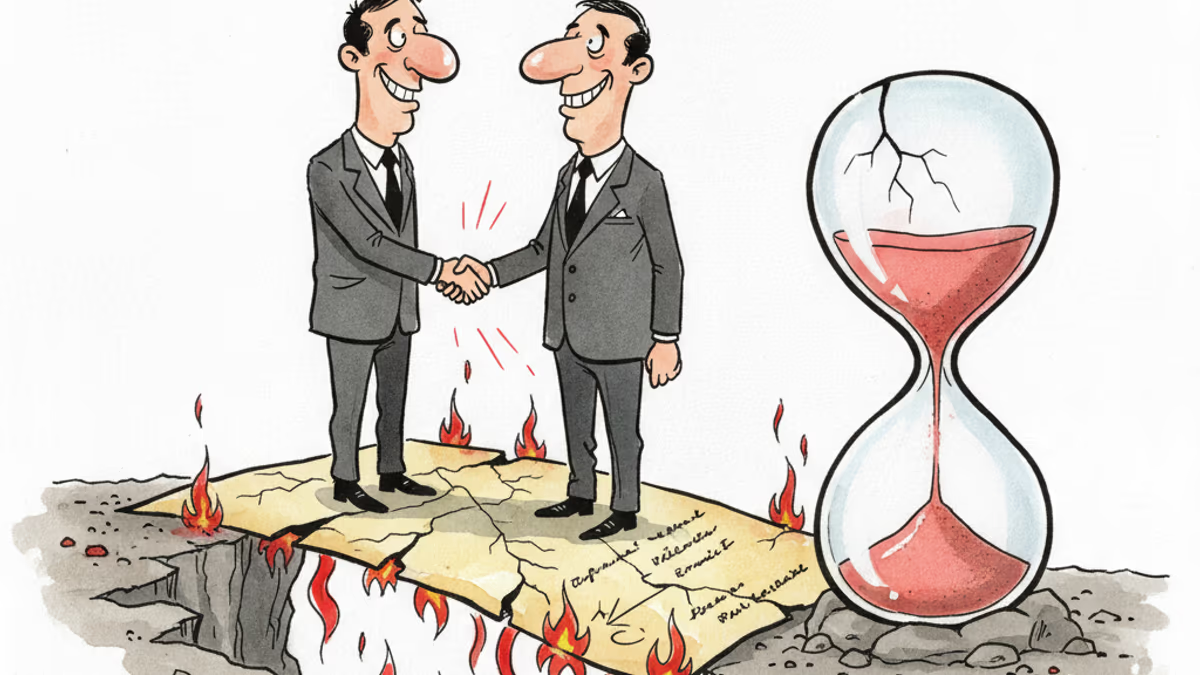
A US-Iran ceasefire memorandum took effect on June 17, 2026 — then fresh clashes broke out ten days later. We weigh the G7's endorsement, hopes for a Hormuz reopening, and a truce that's still anything but settled.
As Xi Jinping revives his vision of China as a financial superpower, Hong Kong emerges as the critical gateway. From yuan internationalization to digital currency adoption, the city's unique role in Beijing's financial ambitions.
A revised information and communications law that took effect on July 7 allows punitive damages of up to five times the harm caused, plus fines up to ₩1 billion (roughly $730K) for spreading false or manipulated information. Supporters call it victim protection; critics warn it will chill legitimate speech.
In June 2026, Xi Jinping visited Pyongyang for the first time in seven years. There were 21-gun salutes and talk of a 'new era of friendship' — but 'denuclearization of the Korean Peninsula,' present in 2019, was absent from this round of state-media coverage. A symbolic overreach, or a real upgrade?
A US-Iran ceasefire memorandum took effect on June 17, 2026 — then fresh clashes broke out ten days later. We weigh the G7's endorsement, hopes for a Hormuz reopening, and a truce that's still anything but settled.
Thoughts
Share your thoughts on this article
Sign in to join the conversation