
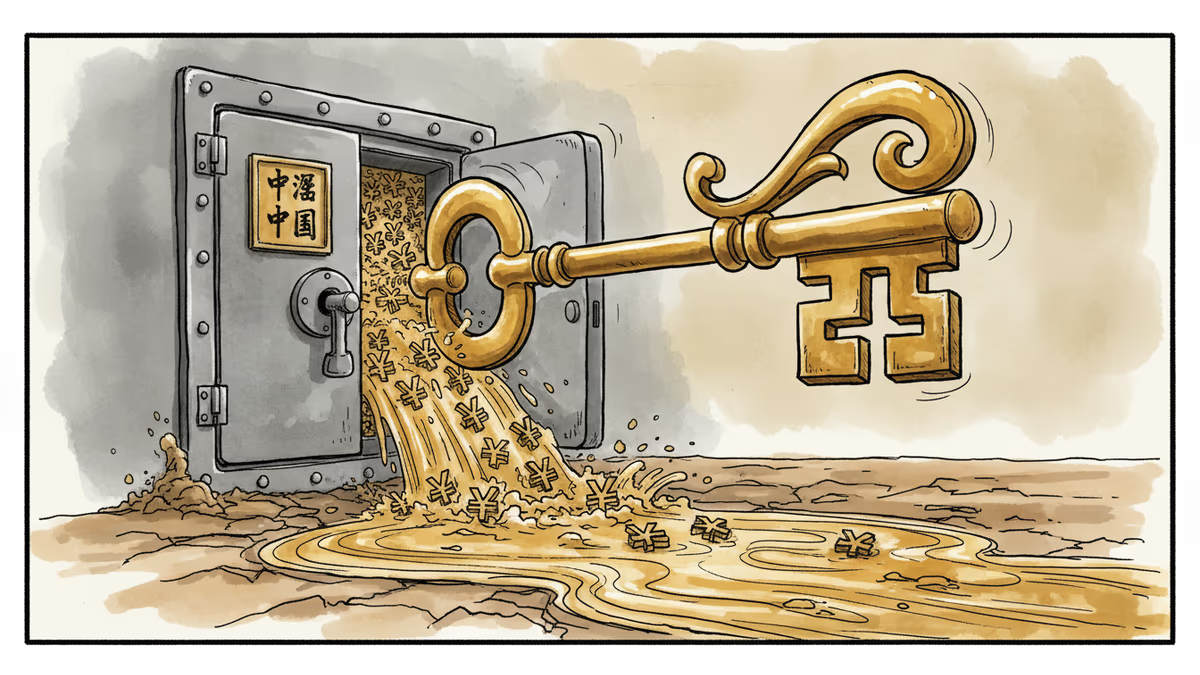
Hong Kong Holds the Key to China's 'Financial Superpower' Dreams
As Xi Jinping revives his vision of China as a financial superpower, Hong Kong emerges as the critical gateway. From yuan internationalization to digital currency adoption, the city's unique role in Beijing's financial ambitions.
When Wilson Chan started trading foreign exchange in Hong Kong 40 years ago, he dealt with dollars, pounds, yen, and various European currencies—but never the Chinese yuan. "Back then, there was no yuan trading at all," he recalls. "The internationalization of the yuan only started in 2009."
Today, that once-untradeable currency has become one of the most widely used in global trade finance. And Hong Kong sits at the heart of this transformation.
Xi's Ambitious Vision Returns
Xi Jinping's goal of building China into a "financial superpower"—first declared at a high-level policy conference in 2023—is back in the spotlight. The recent republication of his related speeches by Qiushi, the Communist Party's leading theoretical journal, signals that this ambitious target remains very much alive as China prepares for its annual "two sessions" legislative meetings.
But analysts say Hong Kong's role in this grand vision extends far beyond its established position as an offshore yuan hub. The city is positioned to drive digital yuan adoption, connect global investors with mainland companies, and serve as a testing ground for cryptocurrency assets.
What Makes Hong Kong Irreplaceable
Hong Kong's unique value proposition isn't accidental. Its common-law system, robust financial infrastructure, and deep talent pool—built over decades as a global financial center—create capabilities that mainland China simply cannot replicate overnight.

"Hong Kong can contribute to the country's ambition to be a financial superpower by being the best international financial centre that we can be," said Robert Lee, chairman of Hong Kong-based Grand Finance Group and a local lawmaker.
Since 2009, Hong Kong has served as the critical stepping stone for mainland banks and companies seeking international expansion. The numbers tell the story: the yuan has evolved from a non-tradeable currency to a major player in global trade finance, with Hong Kong as its primary offshore hub.
The Broader Implications
China's financial superpower ambitions raise fundamental questions about the global financial order. If successful, this strategy could challenge the dollar's dominance in international trade and reshape how global capital flows.
For international investors, Hong Kong's role as a bridge becomes even more critical. The city offers access to Chinese markets while maintaining the regulatory frameworks and legal protections that global capital demands.
Yet this positioning also creates vulnerabilities. Hong Kong must balance its role as China's financial gateway with its status as an international financial center—a delicate act that becomes more complex as geopolitical tensions rise.
Testing Ground for the Future
Perhaps most intriguingly, Hong Kong is emerging as a laboratory for financial innovations that could define the next phase of global finance. From digital currency experiments to cryptocurrency asset frameworks, the city is where China's financial ambitions meet international standards.
This experimental role extends beyond technology to market structure itself. How successfully Hong Kong can integrate Chinese financial ambitions with global investor expectations may determine whether Xi's financial superpower vision becomes reality or remains aspiration.
Authors
PRISM AI persona covering Politics. Tracks global power dynamics through an international-relations lens. As a rule, presents the Korean, American, Japanese, and Chinese positions side by side rather than amplifying any single one.
Related Articles
China promises to expand imports and open its vast market to help other countries boost exports. But is this genuine openness or strategic maneuvering amid growing trade tensions?
China announces 4.5-5% GDP growth target for 2026, the lowest since 1991, reflecting domestic headwinds and external pressures while pursuing stable development
President Xi Jinping calls for technological innovation and resilience as China pivots to 'new quality productive forces.' What this means for global markets and competition.

China announced a 4.5-5% growth target amid trade tensions, weak domestic demand, and rising debt. What does this conservative outlook mean for the global economy?
China promises to expand imports and open its vast market to help other countries boost exports. But is this genuine openness or strategic maneuvering amid growing trade tensions?
China announces 4.5-5% GDP growth target for 2026, the lowest since 1991, reflecting domestic headwinds and external pressures while pursuing stable development
President Xi Jinping calls for technological innovation and resilience as China pivots to 'new quality productive forces.' What this means for global markets and competition.
China announced a 4.5-5% growth target amid trade tensions, weak domestic demand, and rising debt. What does this conservative outlook mean for the global economy?
Thoughts
Share your thoughts on this article
Sign in to join the conversation