
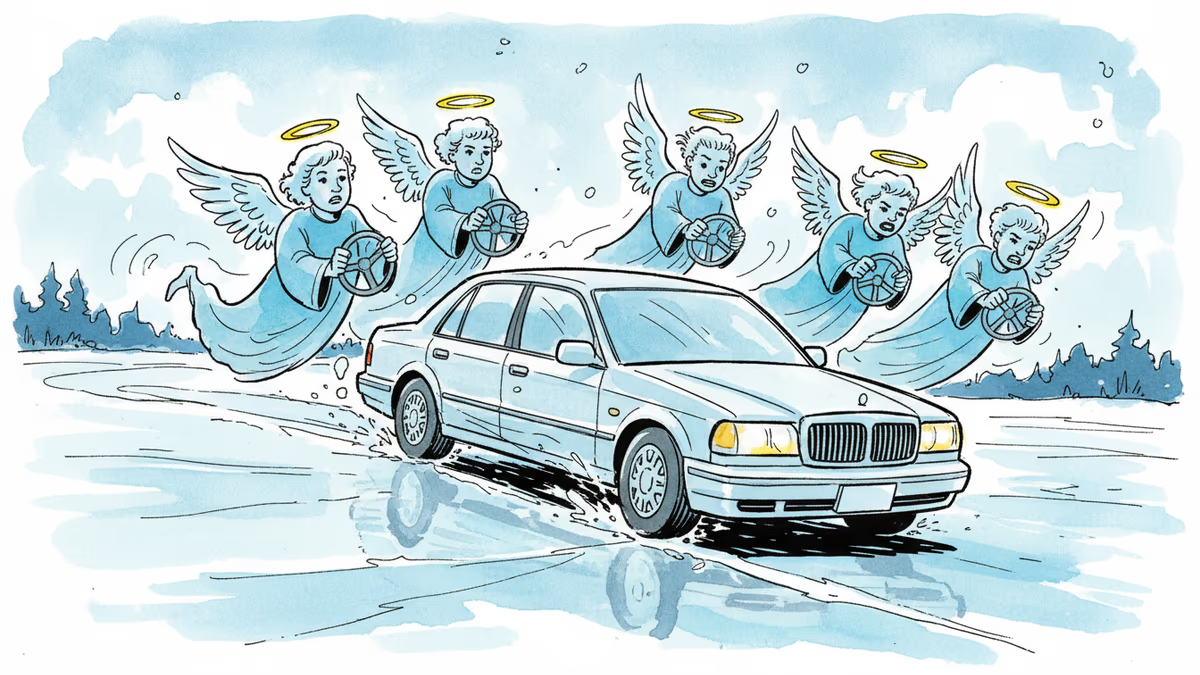
What Frozen Lakes Teach Us About Car Safety's Future
On Finland's icy terrain, McLaren's electronic safety systems reveal how 30 years of automotive innovation prevents crashes and paves the way for autonomous driving.
When Physics Meets Electronics at 50 MPH
The rear end of a McLaren breaks loose on a frozen Finnish lake. At 50 mph, there's a split second between thrill and terror—the difference between expecting the slide and being caught off guard. That moment of controlled chaos reveals something profound about modern automotive safety.
For over 30 years, electronic stability and traction control systems have been quietly revolutionizing how we drive. Made mandatory in the early 2010s, these invisible guardians have prevented countless crashes. But their real significance goes far beyond preventing fender-benders.
The Silent Revolution in Your Driveway
Every modern car is essentially a computer on wheels, constantly making split-second decisions. Electronic Stability Control (ESC) monitors wheel speed, steering angle, and lateral acceleration 100 times per second. When it detects the beginning of a skid, it applies brakes to individual wheels before most drivers even realize there's a problem.
Traction Control Systems (TCS) prevent wheel spin during acceleration. Anti-lock Braking Systems (ABS) prevent wheel lockup during emergency stops. Together, they form a safety net that's always active, always watching.
The numbers tell the story: Since ESC became mandatory in the US, single-vehicle fatal crashes have dropped by 49% for passenger cars and 59% for SUVs, according to NHTSA data.
Building Blocks for Tomorrow's Roads

But here's what's really interesting: these systems aren't just about preventing accidents today—they're teaching cars how to drive themselves tomorrow. Every sensor, every algorithm, every split-second decision is laying groundwork for autonomous vehicles.
Tesla's Autopilot builds on these foundation systems. General Motors' Super Cruise leverages decades of stability control development. Even Ford's Co-Pilot360 uses enhanced versions of traditional safety systems.
The progression is clear: from reactive safety (airbags deploy after impact) to predictive safety (systems prevent the impact entirely) to proactive safety (cars avoid dangerous situations altogether).
The Human Factor Paradox
As safety systems become more sophisticated, an interesting paradox emerges. Drivers become more confident—sometimes overconfident—in challenging conditions. Insurance data shows that while severe accidents decrease, minor incidents sometimes increase as drivers push boundaries they wouldn't have tested before.
Sports car enthusiasts often disable these systems on track days, seeking the "pure" driving experience. But on public roads? The systems stay on, silently preventing the kinds of accidents that used to be considered "driver error."
Automakers face a delicate balance: making cars safe enough to prevent accidents while preserving the engagement that makes driving enjoyable.
The Economics of Electronic Angels
These safety systems are reshaping entire industries. Insurance companies offer discounts for vehicles with advanced safety features. Repair shops invest in new diagnostic equipment to service increasingly complex electronic systems. Driving schools teach students to work with electronic aids rather than despite them.
Meanwhile, the used car market reflects this evolution. Vehicles with comprehensive safety systems hold their value better, while older cars without these features become increasingly difficult to insure affordably.
Authors
Related Articles
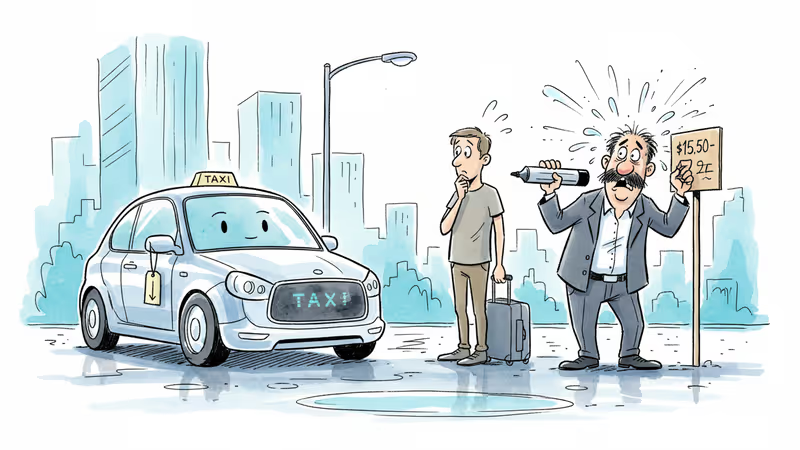
Waymo's robotaxi service is closing the price and wait time gap with Uber and Lyft in San Francisco, while Tesla takes a different approach with rock-bottom pricing and human drivers.
A California judge ruled Tesla's Autopilot marketing is deceptive. PRISM analyzes why this is a pivotal moment for the auto industry, investors, and the future of AI on wheels.
Luminar's bankruptcy is more than a business failure; it's a warning shot for the entire AV industry, exposing a fatal hardware-software disconnect.

Tesla is testing fully driverless cars in Austin. PRISM analyzes why this is a high-stakes gamble to catch Waymo, testing its camera-only AI in a key regulatory gray area.
Waymo's robotaxi service is closing the price and wait time gap with Uber and Lyft in San Francisco, while Tesla takes a different approach with rock-bottom pricing and human drivers.
A California judge ruled Tesla's Autopilot marketing is deceptive. PRISM analyzes why this is a pivotal moment for the auto industry, investors, and the future of AI on wheels.
Luminar's bankruptcy is more than a business failure; it's a warning shot for the entire AV industry, exposing a fatal hardware-software disconnect.
Tesla is testing fully driverless cars in Austin. PRISM analyzes why this is a high-stakes gamble to catch Waymo, testing its camera-only AI in a key regulatory gray area.
Thoughts
Share your thoughts on this article
Sign in to join the conversation