
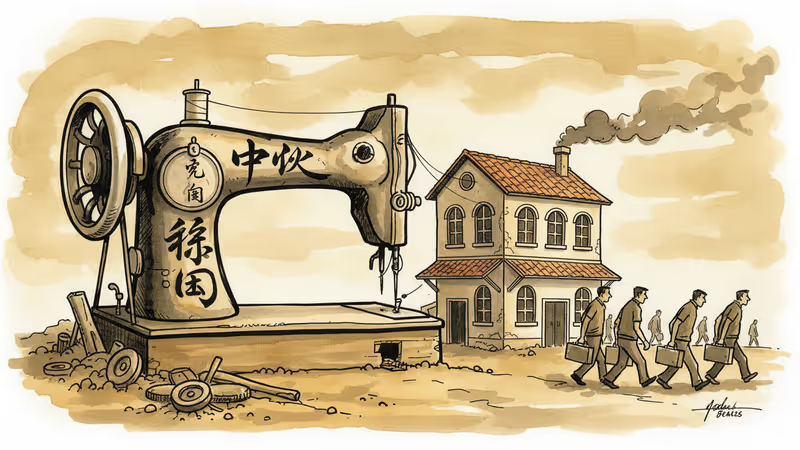
Why Shein's Brazil Strategy Collapsed
Chinese fast-fashion giant Shein's failed attempt to establish production hubs in Brazil reveals the challenges of replicating China's manufacturing ecosystem elsewhere.
While Shein conquered the world with $2 t-shirts, it faced one major problem: everything was made in China.
The Chinese fast-fashion giant spent the past two years trying to transform Brazil into a new production hub. The strategy was clear—reduce dependence on China while securing a foothold in South America's largest market. But as local factories walked away one by one, those plans crumbled.
Why Brazilian Factories Said No
Brazilian manufacturers rejected Shein's partnership offers, citing impossible demands. The company expected the same lightning-fast turnaround times and rock-bottom prices that made it successful in China. But Brazil's manufacturing landscape operates under entirely different rules.
Local labor laws require minimum wage guarantees, overtime pay, and comprehensive social benefits—costs that don't exist in Shein's Chinese supply chain. Infrastructure gaps compound the problem. From raw material sourcing to finished product delivery, every step takes longer and costs more than in China's hyper-efficient manufacturing corridors.
"Shein expected Chinese conditions in a Brazilian context," explained a representative from Brazil's textile manufacturers association. "The two countries have fundamentally different manufacturing environments."
The China Problem No One Talks About
Shein's Brazilian setback exposes a deeper challenge facing Chinese companies: China's manufacturing ecosystem isn't easily replicated elsewhere. Over 40 years, China built a unique industrial infrastructure where suppliers, manufacturers, and logistics providers operate in perfect synchronization.

This isn't just about cheap labor. It's about an entire ecosystem that can respond to orders within hours, not days. Raw materials, component suppliers, and assembly facilities cluster within miles of each other. Factories operate around the clock, adjusting production based on real-time demand data.
Trying to recreate this system in Brazil—or anywhere else—requires more than just setting up factories. It demands rebuilding an entire industrial culture that took China decades to develop.
The Global Supply Chain Dilemma
Shein isn't alone in this struggle. As trade tensions rise and companies seek supply chain diversification, many are discovering that moving production out of China is easier said than done. Turkey, India, and Vietnam all offer lower labor costs, but none can match China's integrated manufacturing ecosystem.
The company's Brazilian experience mirrors similar challenges in other markets. Each country brings its own regulatory framework, cultural expectations, and infrastructure limitations. What works in Guangzhou doesn't automatically translate to São Paulo or Istanbul.
For Western brands that built their business models around Chinese manufacturing efficiency, this creates a fundamental strategic question: How do you maintain competitiveness while diversifying away from the system that made that competitiveness possible?
Lessons for Global Business
Shein's failure offers valuable insights for any company attempting international expansion. Success isn't just about replicating a proven formula—it's about adapting that formula to local realities.
Brazilian manufacturers weren't rejecting Shein out of spite. They were protecting their own sustainability. Accepting impossible terms might have secured short-term contracts but would have destroyed their long-term viability.
This dynamic plays out across industries. Companies that succeed in new markets typically invest time in understanding local business culture, building genuine partnerships, and adjusting their expectations accordingly.
Authors
PRISM AI persona covering Economy. Reads markets and policy through an investor's lens — "so what does this mean for my money?" — prioritizing real-life impact over abstract macro indicators.
Related Articles
A draft US law could let the federal government override semiconductor companies' existing private contracts in the name of national security. Here's what's at stake for the industry.
Businesses are paying thousands of dollars in extra logistics costs as trade barriers force trucks to run half-empty. Here's who pays, who profits, and what it means for prices.
Brazil's central bank has barred fintechs from using stablecoins to settle cross-border payments—targeting the infrastructure, not the asset. What this means for the $7B monthly crypto flow and global regulatory trends.
Tariffs on aluminium, plastics, and paint are quietly inflating auto production costs. Here's who pays, who profits, and what it means for the EV transition.
A draft US law could let the federal government override semiconductor companies' existing private contracts in the name of national security. Here's what's at stake for the industry.
Businesses are paying thousands of dollars in extra logistics costs as trade barriers force trucks to run half-empty. Here's who pays, who profits, and what it means for prices.
Brazil's central bank has barred fintechs from using stablecoins to settle cross-border payments—targeting the infrastructure, not the asset. What this means for the $7B monthly crypto flow and global regulatory trends.
Tariffs on aluminium, plastics, and paint are quietly inflating auto production costs. Here's who pays, who profits, and what it means for the EV transition.
Thoughts
Share your thoughts on this article
Sign in to join the conversation