
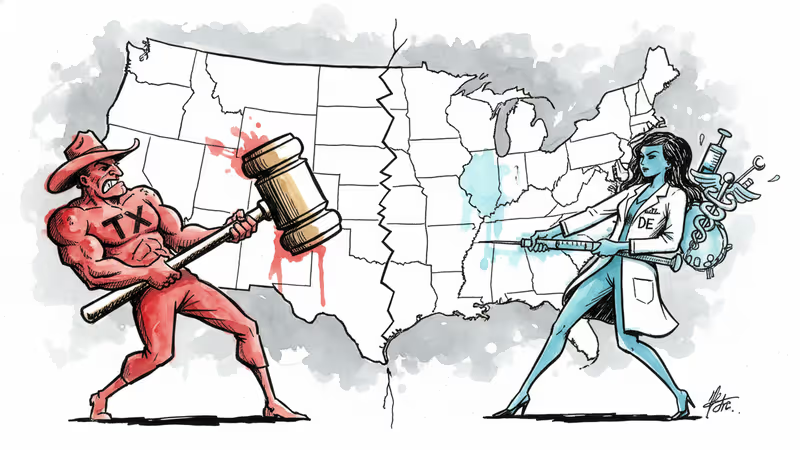
When State Laws Collide: Texas vs Delaware Over Abortion Pills
Texas AG sues Delaware nurse practitioner over abortion pill shipments, setting up potential Supreme Court battle over conflicting state laws in post-Roe America.
In an America where crossing state lines can mean the difference between legal and illegal, a Texas lawsuit against a Delaware nurse practitioner is about to test the limits of how far one state's laws can reach.
On Tuesday, Texas Attorney General Ken Paxton filed suit against Debra Lynch, a Delaware-based nurse practitioner accused of violating Texas law by shipping abortion pills to Lone Star State residents. The case could eventually force the Supreme Court to resolve an escalating conflict between states with strict abortion bans and those with shield laws protecting providers.
162 Abortions Per Week by Mail
The numbers tell the story of a new kind of interstate commerce. Lynch estimated last January that her abortion pill shipments facilitated "up to 162 abortions per week" in Texas. For Paxton, this represents a clear violation of state law. "No one, regardless of where they live, will be freely allowed to aid in the murder of unborn children in Texas," his press release declared.
But here's where it gets complicated: Lynch never set foot in Texas. She operated entirely from Delaware, where telemedicine consultations and abortion pill prescriptions are perfectly legal. She's protected by Delaware's shield law, designed specifically to safeguard providers helping out-of-state patients.
This isn't just about abortion—it's about the fundamental question of whose law applies when digital services cross state lines. In an era where medical consultations happen via video call and medications arrive by mail, the traditional boundaries that define state jurisdiction are blurring.
The Patchwork Problem
Since the Supreme Court overturned Roe v. Wade in 2022, America has become a patchwork of conflicting laws. Fourteen states now ban most abortions, while twelve states have enacted shield laws protecting providers. The result? A legal maze where identical actions can be simultaneously legal and illegal depending on which state's perspective you take.

Texas represents the restrictive end of this spectrum, banning almost all abortions since 2021. Delaware sits at the opposite pole, not only allowing abortion but actively protecting those who provide it to residents of restrictive states. When these opposing legal philosophies collide, federal courts must decide which takes precedence.
The implications extend far beyond reproductive rights. If Texas can successfully prosecute Delaware residents for actions legal in their home state, what stops other states from similar overreach? Could California prosecute Texas gun dealers? Could New York target Florida's tax advisors?
Testing Federal vs State Authority
Legal experts expect this case to climb the federal court system rapidly. The constitutional questions are too significant to resolve at lower levels. Interstate commerce, medical licensing, federal postal services, and the limits of state jurisdiction all intersect in Lynch's case.
From Lynch's perspective, she followed Delaware law completely. She's licensed in Delaware, consulted with patients via telemedicine platforms, and prescribed FDA-approved medications through legitimate pharmacies. Texas law simply doesn't—and shouldn't—apply to her Delaware-based practice.
Texas sees it differently. The state argues that its laws were violated when those pills crossed into Texas territory, regardless of where they originated. It's a jurisdictional argument that could reshape how states interact in the digital age.
The Bigger Battle Ahead
This lawsuit represents more than a single dispute—it's a preview of America's legal future. As states increasingly diverge on social issues, conflicts over jurisdictional authority will multiply. The Supreme Court will likely need to establish clearer rules about when and how state laws can reach across borders.
The stakes extend beyond individual cases. If states can't effectively enforce their laws because of interstate conflicts, the entire concept of federalism faces a crisis. But if states can prosecute residents of other states for locally legal actions, the principle of state sovereignty crumbles.
Authors
Related Articles

Samsung Electronics' union branch revealed that 84% of survey respondents oppose the government's roughly $290 billion (₩400 trillion) semiconductor megaproject in Gwangju. Government, management, the union and shareholders are all reading the same national project in sharply different ways.

Nvidia shipped roughly a billion RISC-V cores in 2024, then announced it would run CUDA on the open standard. We break down how royalty-free instruction sets and open software stacks are trying to route around CUDA's lock-in. Part 2 of the Semiconductor Sovereignty series.

US AI-chip export controls split into three layers in the first half of 2026 — January easing, a May crackdown on circumvention, and a pending bill. Nvidia erased China from its guidance and still posted a record $81.6 billion quarter. A look at the export policy that both shields and cages it.

AMD's MI325X matches or beats Nvidia on memory and bandwidth — yet Nvidia's 86-92% share holds. The real moat is CUDA, 20 years in the making. Part 1 of 4.
Samsung Electronics' union branch revealed that 84% of survey respondents oppose the government's roughly $290 billion (₩400 trillion) semiconductor megaproject in Gwangju. Government, management, the union and shareholders are all reading the same national project in sharply different ways.
Nvidia shipped roughly a billion RISC-V cores in 2024, then announced it would run CUDA on the open standard. We break down how royalty-free instruction sets and open software stacks are trying to route around CUDA's lock-in. Part 2 of the Semiconductor Sovereignty series.
US AI-chip export controls split into three layers in the first half of 2026 — January easing, a May crackdown on circumvention, and a pending bill. Nvidia erased China from its guidance and still posted a record $81.6 billion quarter. A look at the export policy that both shields and cages it.
AMD's MI325X matches or beats Nvidia on memory and bandwidth — yet Nvidia's 86-92% share holds. The real moat is CUDA, 20 years in the making. Part 1 of 4.
Thoughts
Share your thoughts on this article
Sign in to join the conversation