

Google's Foldable Breakthrough: When Durability Finally Meets Innovation
Google's Pixel 10 Pro Fold achieves IP68 rating, solving foldables' biggest weakness. How this milestone changes the game for Samsung, Motorola, and the entire foldable market
For the first time since foldables hit the market, you can take one to the beach without fear. Google's Pixel 10 Pro Fold has achieved what seemed impossible: full IP68 dust and water resistance in a folding phone. It's a milestone that could finally push foldables from premium curiosity to mainstream consideration.
The question isn't whether this matters—it's whether it's enough to overcome foldables' other lingering compromises.
The Durability Dilemma Finally Gets an Answer
Foldable phones have always carried an invisible asterisk. They offer genuinely useful functionality—the ability to run four apps simultaneously, prop up like a laptop, or fold into a compact form—but they've demanded careful handling that most smartphone users simply aren't used to. Dust infiltration, screen damage, and expensive repairs have kept many potential buyers on the sidelines.
Google's$1,799 Pixel 10 Pro Fold changes that calculus. Beyond the IP68 rating, it includes Qi2 magnetic wireless charging support and Google's more powerful Tensor G5 chip. For the first time, a book-style foldable offers the peace of mind we expect from premium smartphones.
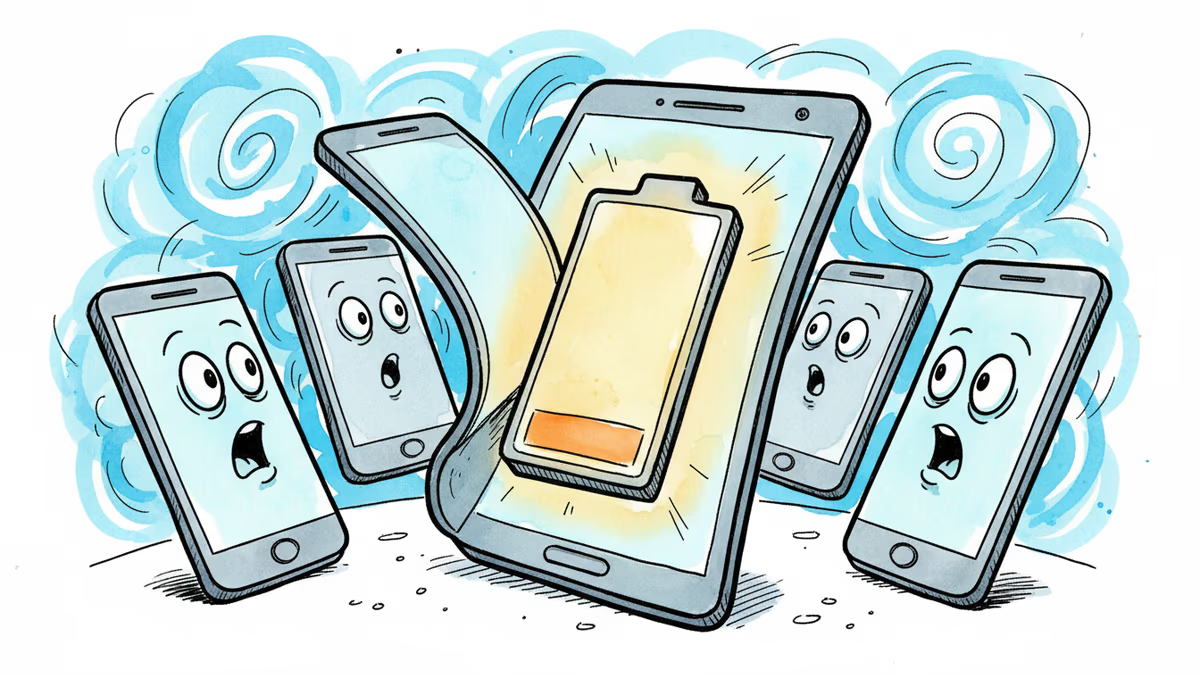
Yet compromises remain. Battery life suffers significantly when using the inner display extensively, and the camera system lags behind Google's other 10 Pro models, particularly in low light. The device is also noticeably heavier and thicker than Samsung's Galaxy Z Fold 7, though many users will consider that a fair trade for genuine durability.
Samsung and Motorola's Competing Visions
Samsung has taken a different approach with the Galaxy Z Flip 7, focusing on usability improvements rather than durability breakthroughs. The 4.1-inch cover screen wraps around the cameras, providing enough real estate for quick responses and tasks without opening the phone—addressing the "digital rabbit hole" problem that many flip phone users appreciate.
The company also managed to increase battery capacity from 4,000mAh to 4,300mAh while making the device thinner. However, the IP48 rating means fine dust particles remain a concern, and the $1,099 starting price still puts it in premium territory.

Motorola has doubled down on personality with the Razr Ultra 2025. The gold-bronze chassis and wooden back panel make it arguably the best-looking phone you can buy, while the $1,300 price includes 512GB of storage and Qualcomm's flagship Snapdragon 8 Elite processor. The 4-inch outer screen covers nearly the entire front panel, making it genuinely useful for quick tasks.
But Motorola's three-year OS update commitment feels short for such an expensive device, and camera processing remains inconsistent—a recurring issue across the company's foldable lineup.
The Asian Wild Card
Perhaps the most impressive foldable isn't available to most readers. Oppo's Find N5, launching in China and select Asian markets, showcases what's possible when manufacturers prioritize battery technology. Its 5,600mAh silicon-carbon battery provides excellent endurance while maintaining a thickness barely greater than conventional smartphones.
The device supports 80W wired and 50W wireless charging, and the crease is nearly invisible. At approximately $2,000, it's not cheap, but it demonstrates that the fundamental engineering challenges of foldables are solvable—if you're willing to invest in the right technologies.
The Trifold Future Arrives
The next phase is already beginning. Samsung's Galaxy Z TriFold launches January 30th at $2,899, featuring two hinges that open to reveal a 10-inch display. Motorola plans a book-style Razr Fold for summer 2025, though pricing remains unannounced.
Huawei continues pushing trifold boundaries with the second-generation Mate XTs at approximately $2,520, but availability remains limited to Chinese markets. The question for global consumers is whether these ultra-premium devices represent the future or remain expensive showcases.
The Repair Reality Check
One crucial consideration often gets buried in spec sheets: repairability. Even with improved durability, foldables require specialized repair facilities and expensive parts. Google, Samsung, and Motorola all recommend extended warranties, and for good reason. A catastrophic failure could mean replacing a device worth more than many people's monthly rent.
This reality shapes who should consider foldables today. Early adopters who can afford replacement costs will find genuinely useful devices. Budget-conscious buyers might want to wait for prices to drop or durability to improve further.
Authors
Related Articles
Honor's Magic V6 claims the thinnest foldable crown at 4mm, but the real innovation lies in its 6,600mAh battery. A new battleground emerges in the foldable wars.

Analyzing how foldable phones with large screens and mobile computing power are challenging the traditional laptop market, from Samsung Galaxy Fold to future mobile workstations.

Samsung's first tri-fold phone sold out on launch day despite its $2,899 price tag, while Google's Aluminum OS leak shows the future of unified platforms and Vivaldi takes an anti-AI stance.

Samsung's Galaxy Z TriFold launches at $2,899 in the US with a 10-inch display. Is this the future of premium smartphones or an expensive experiment?
Honor's Magic V6 claims the thinnest foldable crown at 4mm, but the real innovation lies in its 6,600mAh battery. A new battleground emerges in the foldable wars.
Analyzing how foldable phones with large screens and mobile computing power are challenging the traditional laptop market, from Samsung Galaxy Fold to future mobile workstations.
Samsung's first tri-fold phone sold out on launch day despite its $2,899 price tag, while Google's Aluminum OS leak shows the future of unified platforms and Vivaldi takes an anti-AI stance.
Samsung's Galaxy Z TriFold launches at $2,899 in the US with a 10-inch display. Is this the future of premium smartphones or an expensive experiment?
Thoughts
Share your thoughts on this article
Sign in to join the conversation