
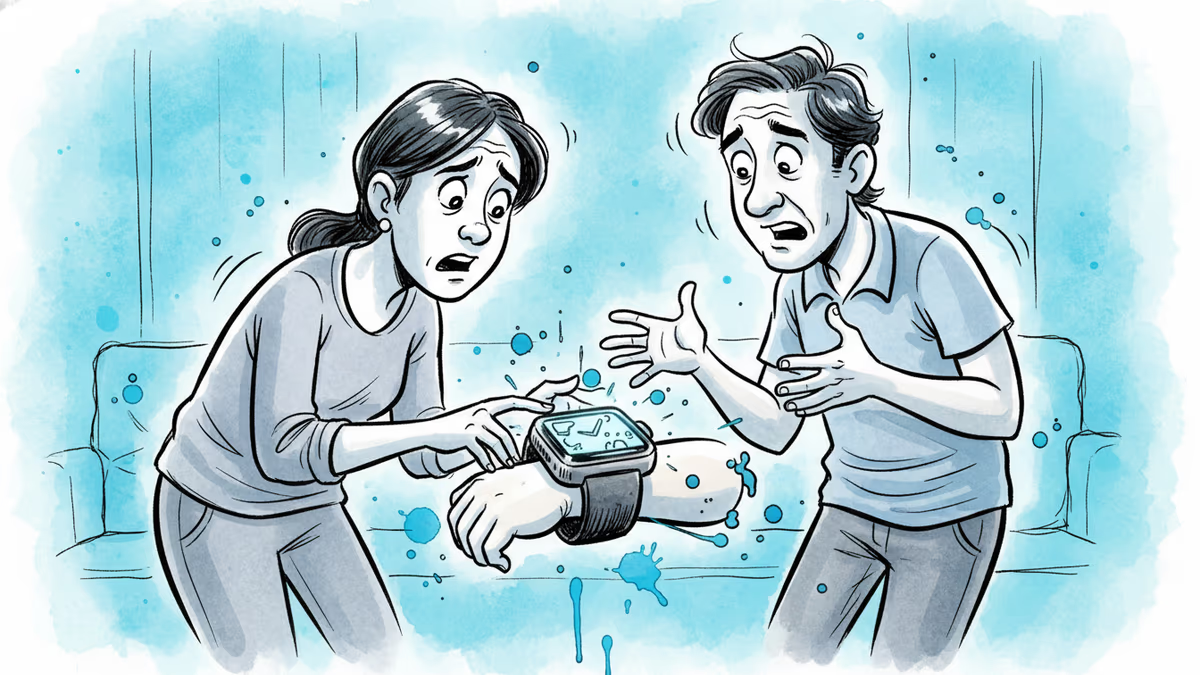
Should Your 7-Year-Old Wear a Smartwatch?
From Apple Watch Family Setup to school bans, everything parents need to know about kids' smartwatches. A realistic guide to digital safety and childhood.
When Stranger Danger Meets Smart Tech
500 feet. That's how far away I was when a Good Samaritan called the police about my "unattended" 7-year-old at the playground. I was helping her little brother with his bike, she was playing on the swings, and suddenly I became the negligent parent who "wasn't there." That sunny weekend taught me something: in 2026, parenting anxiety has reached new heights, and technology promises to solve what community connection once handled naturally.
The Apple Watch became my reluctant compromise. Not because I wanted to give my child another screen, but because I needed peace of mind in a world where 500 feet feels like 500 miles to concerned strangers.
The School Ban Paradox
Here's the contradiction: Just as parents increasingly want to track their children, schools are pushing back harder than ever. 2024 saw widespread smartphone bans in classrooms. 2025 brought smartwatch restrictions. My daughter's district joined hundreds of others in banning wearable devices entirely.
The reasoning is sound. Teachers report that kids check messages during lessons, compare devices during recess, and struggle to focus when their wrist buzzes every few minutes. Products like Pinwheel and Tin Can phones emerged as "dumb" alternatives—communication without the smart complications.
Yet parents aren't backing down. A 2024 Pew Research study found that 73% of parents with elementary-age children consider location tracking "essential" for their child's safety. The disconnect is striking: schools see distraction, parents see protection.
Apple's Family Setup Reality Check
Setting up an Apple Watch for your child isn't as simple as the marketing suggests. You'll need a Series 6 or later with cellular capabilities (older models won't run WatchOS 26), plus a separate data plan that typically costs $10-15 monthly. The setup process involves creating a child Apple ID, configuring contact restrictions, and managing app permissions—a process that can take over an hour.

The "Schooltime" feature promises to solve classroom concerns by limiting functionality during school hours. But here's what Apple doesn't advertise: kids can exit Schooltime by simply turning the digital crown. It's an honor system disguised as parental control.
More concerning is the contact management system. Parents must manually approve every contact, but children can still receive calls from unknown numbers—the very scenario many parents are trying to prevent.
What Kids Actually Do With Smartwatches
The most revealing insight? Kids don't use smartwatches the way adults expect. Gaming apps and social features take a backseat to something surprisingly old-fashioned: curiosity.
Siri becomes their primary interface with the world. "Hey Siri, what is Russia?" "How many stars are on the American flag?" "Show me pictures of the grossest animal?" These aren't distraction queries—they're learning moments that happen organically throughout the day.
The Walkie Talkie feature proves unexpectedly valuable at crowded events, while the Mindfulness app helps sensitive kids regulate emotions. One parent reported their child using breathing exercises before sibling conflicts—a use case no marketing team could have predicted.
But there's a darker pattern emerging. Some children develop what psychologists call "constant contact anxiety"—feeling compelled to update parents about every minor event. Teachers report kids messaging parents from bathrooms, during lunch, and even during fire drills.
The Overprotection Trap
Dr. Sarah Chen, a child development researcher at Stanford, points to a troubling trend: "We're creating children who can't navigate uncertainty without technological assistance. The same device that makes parents feel safer might be making children feel less capable."
Consider the original playground scenario. A generation ago, community members knew local children and parents. Today, we're strangers to our neighbors but intimately connected to our devices. We've traded social safety nets for technological ones.
The Apple Watch didn't just solve my parenting anxiety—it revealed how deeply that anxiety runs. When my daughter's watch battery died during a playdate, I found myself checking Find My obsessively, despite knowing exactly where she was.
The smartwatch isn't just a parenting tool—it's a mirror reflecting how comfortable we are with childhood itself.
Authors
Related Articles
The Apple Watch Series 4 didn't just upgrade wearables — it shifted them from fitness tools to health monitors. Here's what that shift really means for consumers, medicine, and your data.
Apple's new $599 MacBook Neo has created an awkward pricing paradox that makes the $800 Apple Watch Ultra 3 seem absurdly overpriced. Consumers are questioning the logic.

xAI's chatbot Grok generated millions of sexualized images, prompting unprecedented coordinated action from US attorneys general. The AI safety reckoning has begun.

Strava and Komoot bring offline maps to Apple Watch, ending iPhone dependency for runners and cyclists. A glimpse into the future of independent wearables or just catching up?
The Apple Watch Series 4 didn't just upgrade wearables — it shifted them from fitness tools to health monitors. Here's what that shift really means for consumers, medicine, and your data.
Apple's new $599 MacBook Neo has created an awkward pricing paradox that makes the $800 Apple Watch Ultra 3 seem absurdly overpriced. Consumers are questioning the logic.
xAI's chatbot Grok generated millions of sexualized images, prompting unprecedented coordinated action from US attorneys general. The AI safety reckoning has begun.
Strava and Komoot bring offline maps to Apple Watch, ending iPhone dependency for runners and cyclists. A glimpse into the future of independent wearables or just catching up?
Thoughts
Share your thoughts on this article
Sign in to join the conversation