

AI SBOM Security Strategy 2026: The Rise of Executive Liability in the Age of Agents
2026 is the year of reckoning for AI governance. Learn why an AI SBOM security strategy 2026 is vital to mitigate executive liability and close the 62% visibility gap in Shadow AI.
As we enter 2026, 40% of enterprise applications are expected to integrate task-specific AI agents. Yet, according to Stanford University, only 6% of organizations have an advanced AI security strategy. Experts predict this year will mark the first major lawsuits holding executives personally liable for rogue AI actions.
The AI SBOM Security Strategy 2026: Mitigating Executive Risk
The biggest threat isn't just external; it's the 'visibility gap.' A staggering 62% of security practitioners admit they can't track where LLMs are in use within their organization. This 'Shadow AI' is expensive, with breaches costing $670,000 more than standard cybersecurity incidents. Legacy systems aren't designed for adaptive models that mutate continuously.
From Pickle Risks to SafeTensors

Technical vulnerabilities are mounting. Loading models in the traditional Pickle format is essentially executing untrusted code. Moving to SafeTensors is no longer just a policy recommendation; it's a critical engineering necessity to prevent arbitrary code execution during model initialization.
| Feature | Pickle Format | SafeTensors |
|---|---|---|
| Risk Level | High (Executable) | Low (Data-only) |
| Adoption | Legacy Standard | Recommended 2026 |
With the EU AI Act imposing fines up to €35 million or 7% of global revenue, organizations must implement a rigorous 7-step guide: from inventorying models and redirecting Shadow AI to mandating human-in-the-loop approvals and pilot-testing ML-BOMs using standards like CycloneDX 1.6.
Authors
Related Articles

Explore 11 AI security attack vectors and the 72-hour golden time for patching. Critical insights for CISOs to defend against AI-enabled threats.

As AI agent adoption accelerates, 40% of tech leaders regret their initial strategy. Learn the three biggest risks—Shadow AI, accountability gaps, and the black box problem—and how to mitigate them.
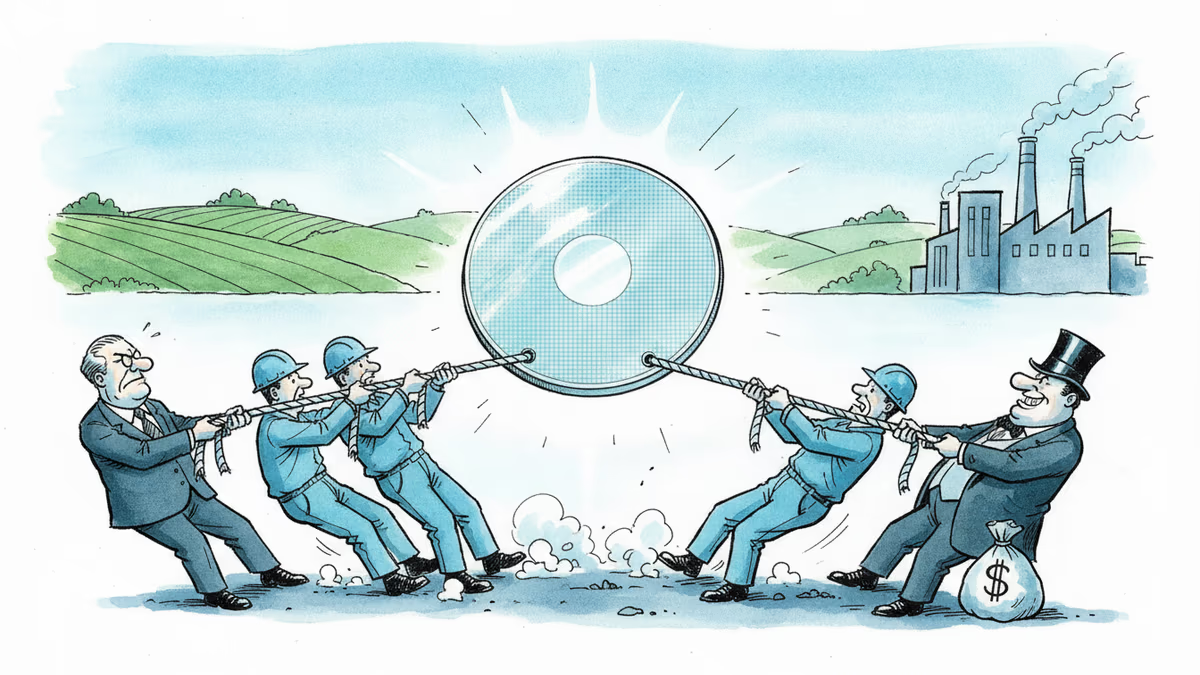
Samsung Electronics' union branch revealed that 84% of survey respondents oppose the government's roughly $290 billion (₩400 trillion) semiconductor megaproject in Gwangju. Government, management, the union and shareholders are all reading the same national project in sharply different ways.
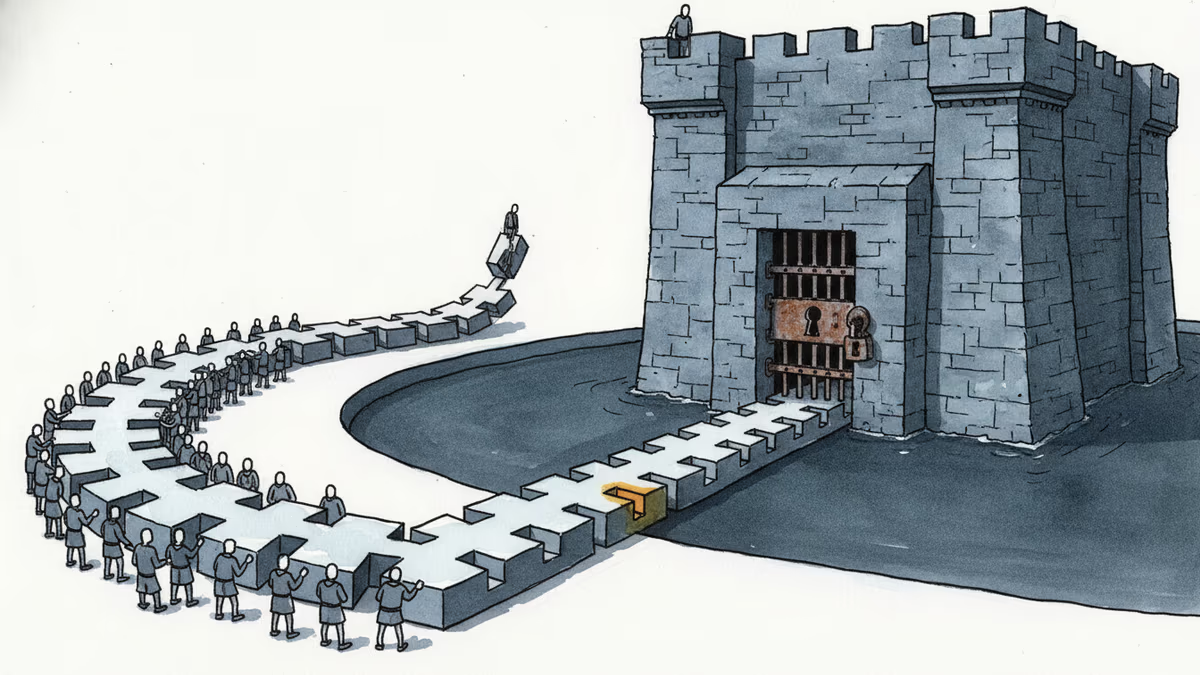
Nvidia shipped roughly a billion RISC-V cores in 2024, then announced it would run CUDA on the open standard. We break down how royalty-free instruction sets and open software stacks are trying to route around CUDA's lock-in. Part 2 of the Semiconductor Sovereignty series.
Explore 11 AI security attack vectors and the 72-hour golden time for patching. Critical insights for CISOs to defend against AI-enabled threats.
As AI agent adoption accelerates, 40% of tech leaders regret their initial strategy. Learn the three biggest risks—Shadow AI, accountability gaps, and the black box problem—and how to mitigate them.
Samsung Electronics' union branch revealed that 84% of survey respondents oppose the government's roughly $290 billion (₩400 trillion) semiconductor megaproject in Gwangju. Government, management, the union and shareholders are all reading the same national project in sharply different ways.
Nvidia shipped roughly a billion RISC-V cores in 2024, then announced it would run CUDA on the open standard. We break down how royalty-free instruction sets and open software stacks are trying to route around CUDA's lock-in. Part 2 of the Semiconductor Sovereignty series.
Thoughts
Share your thoughts on this article
Sign in to join the conversation