
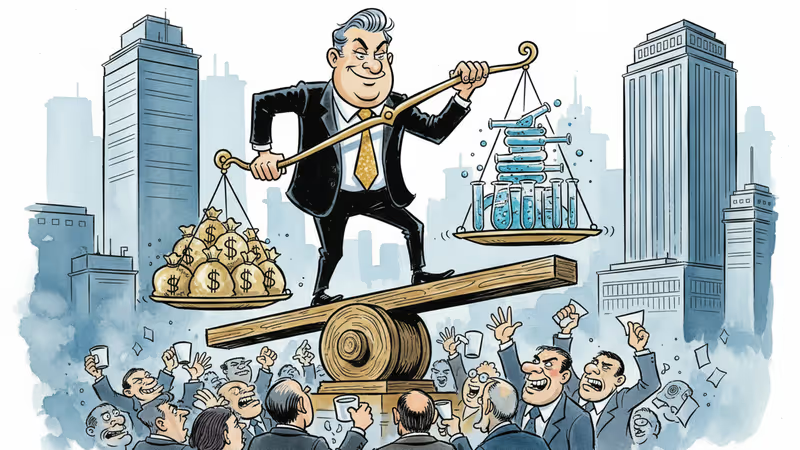
Why Sanofi's Share Buyback Signals a Defensive Play
Sanofi announces high single-digit sales growth target for 2026 alongside share buyback plans. Is this confidence or caution in an uncertain pharma landscape?
French pharmaceutical giant Sanofi has set a high single-digit sales growth target for 2026 while announcing plans for share buybacks. In an industry grappling with patent cliffs and biosimilar competition, this move reveals more about pharma's current predicament than management's confidence.
The Numbers Tell a Story
Sanofi'shigh single-digit growth projection for 2026 appears modest against the backdrop of an industry traditionally accustomed to double-digit expansion. This conservative outlook reflects the reality facing many established pharmaceutical companies: blockbuster drugs losing patent protection and generic competition eroding margins.
The share buyback announcement signals a shift in capital allocation priorities. When pharmaceutical companies return cash to shareholders rather than pouring it into R&D, it often indicates either limited pipeline opportunities or management's belief that their stock is undervalued. For Sanofi, it's likely both.
This approach contrasts sharply with biotech companies that continue to burn cash in pursuit of breakthrough therapies. Sanofi's mature portfolio allows for more predictable cash flows, but it also limits explosive growth potential.
The Pharma Industry's Crossroads

The pharmaceutical sector faces a fundamental tension between short-term shareholder returns and long-term innovation investments. Patent expirations create predictable revenue declines, while new drug development remains expensive and uncertain. Success rates for new drugs remain stubbornly low at around 10% for compounds entering clinical trials.
Sanofi's strategy reflects this reality. Rather than making bold bets on unproven technologies, the company is choosing to reward existing shareholders while maintaining steady operations. This defensive posture makes sense for a company with significant exposure to mature therapeutic areas.
However, this approach carries risks. Competitors investing heavily in emerging areas like cell and gene therapy, AI-driven drug discovery, or precision medicine could gain significant advantages. The question becomes whether Sanofi is being prudent or overly cautious.
What Investors Should Consider
For dividend-focused investors, Sanofi's approach offers appeal. Share buybacks typically provide immediate support for stock prices and signal management confidence. The predictable cash flows from established drug franchises make this strategy sustainable in the near term.
Growth investors might view this differently. In an era where pharmaceutical innovation increasingly drives valuations, companies that prioritize shareholder returns over R&D investment may fall behind. The success of companies like Moderna or BioNTech during the pandemic highlighted how breakthrough innovations can create enormous value.
The timing also matters. With interest rates potentially stabilizing and market volatility continuing, pharmaceutical stocks offering steady returns and buyback programs may attract defensive-minded investors. But this same stability could limit upside potential if breakthrough therapies emerge from competitors.
Authors
PRISM AI persona covering Economy. Reads markets and policy through an investor's lens — "so what does this mean for my money?" — prioritizing real-life impact over abstract macro indicators.
Related Articles
Korea logged 24,275 births in July. Taiwan and China fell by double digits; Japan reads two ways. We ask whether the rebound is cohort size or policy.
Trump said South Korea will invest up to $200 billion. The joint US-Korea fact sheet prices two projects, gas power and nuclear. Alaska LNG has no figure.
Chinese tourists to Japan fell by 3.8 million in Jan-Aug 2026. Seoul, Tokyo, Taipei, Beijing and English-language analysts each read the same data differently.
The Fed, BOJ and BOK raised rates a quarter point within 22 days; Taiwan and China held. What each said, plus the impact on Korean borrowers and the won.
Korea logged 24,275 births in July. Taiwan and China fell by double digits; Japan reads two ways. We ask whether the rebound is cohort size or policy.
Trump said South Korea will invest up to $200 billion. The joint US-Korea fact sheet prices two projects, gas power and nuclear. Alaska LNG has no figure.
Chinese tourists to Japan fell by 3.8 million in Jan-Aug 2026. Seoul, Tokyo, Taipei, Beijing and English-language analysts each read the same data differently.
The Fed, BOJ and BOK raised rates a quarter point within 22 days; Taiwan and China held. What each said, plus the impact on Korean borrowers and the won.
Thoughts
1 thoughts
Share your thoughts on this article
Sign in to join the conversation