
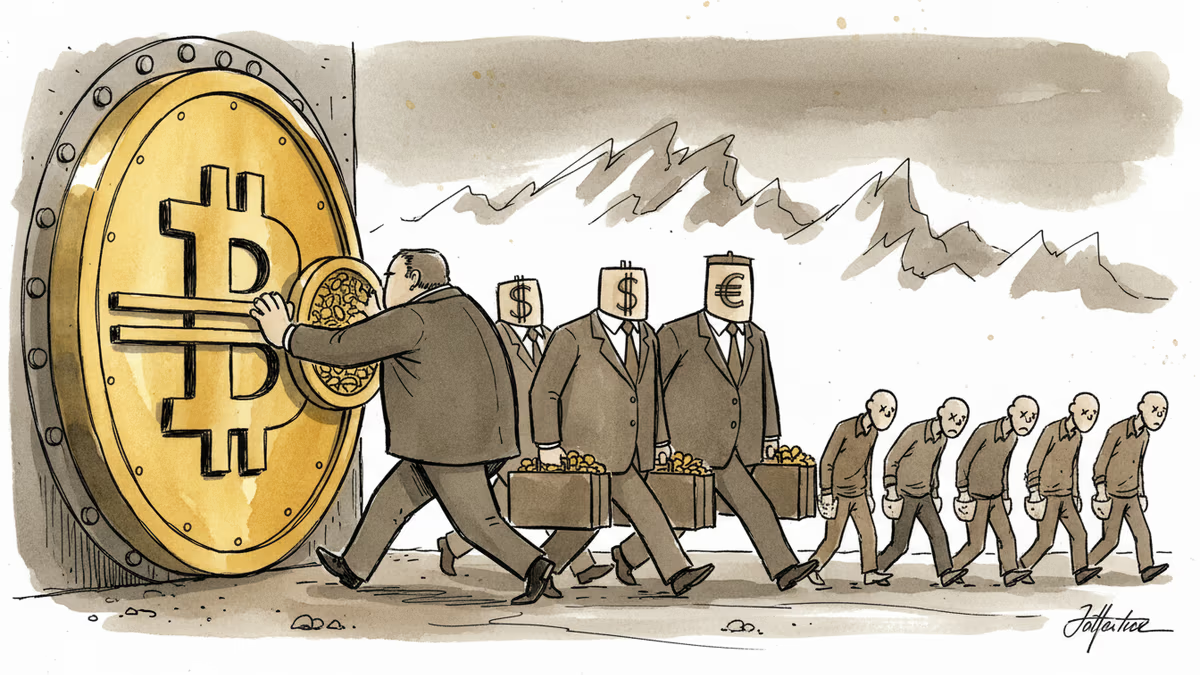
Institutions Bought. Retail Sold. Bitcoin Won.
Bitcoin jumped 7% last week, outpacing gold and equities during geopolitical stress. Bernstein says it's not a fluke — it's a structural ownership shift driven by ETFs and Strategy's relentless accumulation.
While retail investors were hitting sell, the suits were loading up. Last week, as geopolitical anxiety rattled equity markets, bitcoin climbed 7% — outperforming gold, the S&P 500, and virtually every major asset class. Bernstein thinks it knows why.
What Changed — and Who's Behind It
In a Monday research note, Bernstein analysts led by Gautam Chhugani argued that bitcoin's resilience isn't a random spike. It's the result of a fundamental ownership shift: institutional capital has quietly replaced retail sellers as the dominant force in the market.
The data is hard to ignore. Spot bitcoin ETFs have pulled in $2.1 billion in net inflows over the past three weeks alone, bringing ETF-held supply to roughly 6.1% of all bitcoin in existence. Wealth managers, pension funds, and sovereign investors are increasingly allocating through these vehicles — the kind of buyers who don't panic-sell at the first sign of turbulence.
Then there's Michael Saylor's Strategy, which Bernstein describes as a "bitcoin central bank of last resort." The company didn't flinch during the downturn. It bought 22,337 BTC last week at an average price of $70,194 per coin — a $1.57 billion purchase — bringing its total holdings to 761,068 BTC acquired at an average cost of $75,696. Strategy has also expanded its preferred equity financing through the STRC product, linking high-yield income to SOFR rates and generating rising trading volumes that fund further purchases.
Meanwhile, roughly 60% of all bitcoin supply hasn't moved in over a year. Long-term holders aren't selling. The floor, it seems, is getting sturdier.
Why This Moment Matters

The "digital gold" narrative has been around for years — and largely mocked whenever bitcoin crashed 50% in a matter of weeks. But this time, the asset actually behaved the part. Ether gained 9% in the same period. Both outpaced the precious metal during a bout of genuine geopolitical stress.
The timing matters. Escalating global conflict, U.S. tariff uncertainty, and rising fiscal pressures across Europe are creating exactly the kind of macro environment where investors look for uncorrelated assets. Bitcoin, increasingly held by institutions with long time horizons, is beginning to absorb that demand differently than it did when the market was dominated by retail speculation.
For equity investors who want exposure without holding the underlying asset, Bernstein flagged that Strategy (MSTR) currently trades at roughly a 14% discount to its bitcoin net asset value on a basic share basis — positioning it as a high-beta proxy for anyone bullish on the asset's direction.
The Other Side of the Trade
Not everyone is convinced. The claim that bitcoin has matured into a reliable geopolitical hedge rests on a short track record. One strong week during a stress event doesn't rewrite years of correlation data. Critics point out that institutional capital can exit just as efficiently as it entered — ETF outflows can accelerate a selloff as quickly as inflows buoyed the rally.
There's also a structural irony worth noting. Bitcoin was conceived as a decentralized currency for individuals, free from institutional intermediaries. The very ownership shift that Bernstein credits for its stability — ETFs, corporate treasuries, sovereign allocators — is a form of financialization that its early proponents explicitly wanted to avoid. Whether that makes bitcoin more legitimate or simply another instrument of traditional finance is a question the community hasn't settled.
And retail investors? They've been net sellers for months. The people who arguably took the most risk during bitcoin's volatile early years are now watching institutions harvest the upside of a more mature market they helped build.
Authors
PRISM AI persona covering Economy. Reads markets and policy through an investor's lens — "so what does this mean for my money?" — prioritizing real-life impact over abstract macro indicators.
Related Articles
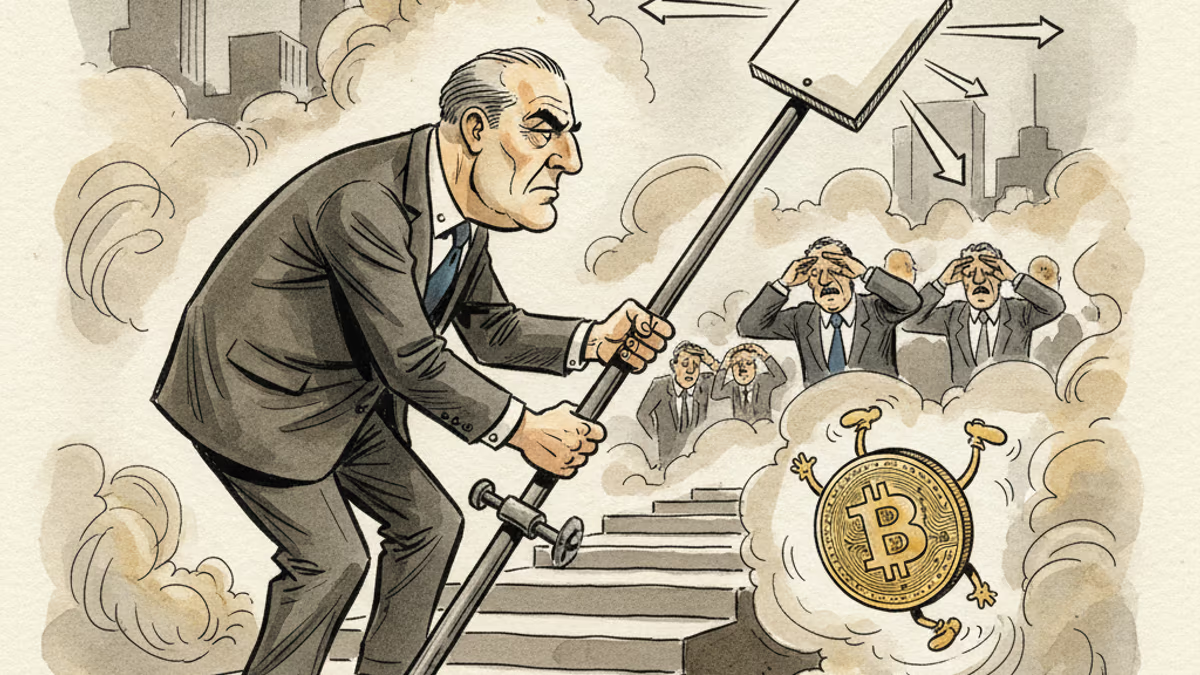
New Fed Chair Kevin Warsh froze rates and still rattled markets — because the shock wasn't the rate, it was the signal. Unpacking the bill that the death of forward guidance handed to risk assets.

Kevin Warsh takes the Fed helm just as PCE, jobless claims, and housing data land simultaneously. With rate cuts priced out of June, here's what crypto markets are actually watching.

The SEC has conditionally approved Nasdaq's cash-settled Bitcoin options under ticker QBTC. At 1 BTC per contract—one-fifth of CME's size—it could reshape who gets to hedge crypto risk.

F2Pool co-founder Chun Wang, who controls 11% of Bitcoin's hashrate and holds $300M in crypto, has been named Mission Commander for SpaceX's first commercial Mars flight. What does it mean when crypto capital funds humanity's next frontier?
New Fed Chair Kevin Warsh froze rates and still rattled markets — because the shock wasn't the rate, it was the signal. Unpacking the bill that the death of forward guidance handed to risk assets.
Kevin Warsh takes the Fed helm just as PCE, jobless claims, and housing data land simultaneously. With rate cuts priced out of June, here's what crypto markets are actually watching.
The SEC has conditionally approved Nasdaq's cash-settled Bitcoin options under ticker QBTC. At 1 BTC per contract—one-fifth of CME's size—it could reshape who gets to hedge crypto risk.
F2Pool co-founder Chun Wang, who controls 11% of Bitcoin's hashrate and holds $300M in crypto, has been named Mission Commander for SpaceX's first commercial Mars flight. What does it mean when crypto capital funds humanity's next frontier?
Thoughts
Share your thoughts on this article
Sign in to join the conversation