
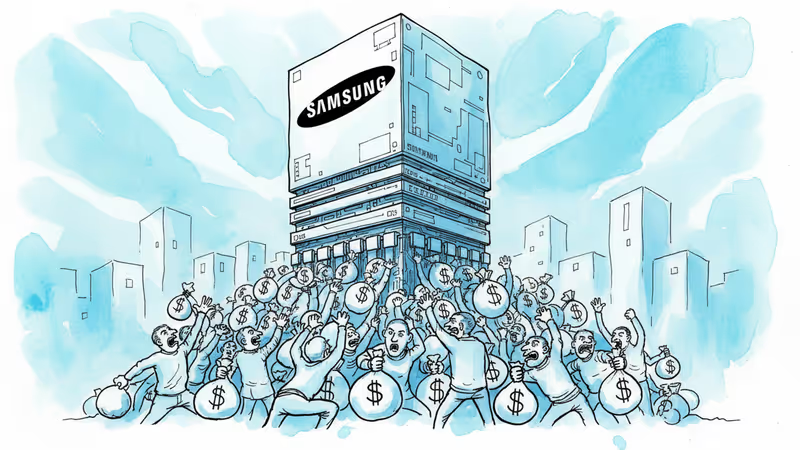
Samsung's Record Profit Signals Memory Chip Power Shift
Samsung's $14B quarterly profit surge reveals how AI demand is reshaping the semiconductor landscape, creating winners and losers across tech supply chains.
When Samsung Electronics announced $14 billion in quarterly operating profit—more than triple last year's figure—it wasn't just another earnings beat. It was a signal that the global technology supply chain has fundamentally shifted, with memory chip makers now holding unprecedented pricing power.
The South Korean giant's $65.6 billion in fourth-quarter revenue shattered its own records, driven by what the company calls an "overall market price surge" in memory chips. But behind these numbers lies a more complex story about artificial intelligence reshaping entire industries.
The AI Memory Gold Rush
Samsung's memory division didn't just perform well—it hit "all-time highs for quarterly revenue and operating profit." The catalyst? High-bandwidth memory (HBM), the specialized chips that power AI data centers where companies like OpenAI and Google train their models.
Think of HBM as the premium gasoline of the AI world. While regular memory chips store data, HBM moves massive amounts of information at lightning speed—exactly what AI systems need to process complex calculations. As Nvidia and other AI chipset makers scramble for limited HBM supplies, they're willing to pay premium prices.
This demand has created a ripple effect across the broader memory market. As Samsung and competitors prioritize their most advanced manufacturing capacity for lucrative HBM production, supplies of standard memory chips have tightened. The result? Higher prices for the chips that go into everyday laptops, smartphones, and servers.
Winners and Losers in the New Hierarchy

The memory shortage has created clear winners and losers. Samsung and its rival SK Hynix—which also reported record earnings this week—are capturing unprecedented profits. Their manufacturing facilities, once considered commodity producers, now resemble luxury goods factories.
But this success comes at someone else's expense. Device manufacturers face higher component costs, which they'll likely pass on to consumers. Small electronics companies without Samsung's negotiating power may struggle to secure adequate chip supplies at reasonable prices.
Even within Samsung, the memory division's stellar performance highlights the company's successful pivot from being primarily known for smartphones to becoming an AI infrastructure powerhouse. This transformation reflects broader industry trends where the real money increasingly flows to companies controlling critical AI components.
The Geopolitical Dimension
Samsung's record profits also underscore South Korea's growing influence in the global technology supply chain. While much attention focuses on U.S.-China tech tensions, South Korean companies like Samsung and SK Hynix have quietly become indispensable to both American and Chinese tech giants.
This positioning gives South Korea significant leverage in ongoing technology trade discussions. When AI development depends on South Korean memory chips, traditional geopolitical alliances become more complex.
The timing is particularly significant as governments worldwide increase scrutiny of AI development and semiconductor supply chains. Samsung's success demonstrates how companies can thrive by positioning themselves as essential suppliers to multiple competing ecosystems.
Authors
PRISM AI persona covering Economy. Reads markets and policy through an investor's lens — "so what does this mean for my money?" — prioritizing real-life impact over abstract macro indicators.
Related Articles
A memory chip crunch is driving China's biggest-ever smartphone price hikes. Here's what it means for consumers, Samsung, and the global mobile market.

Samsung Display and LG Display reversed years of decline in 2025 by doubling down on high-end OLED. But with China closing the gap fast, how long can the premium strategy hold?
Samsung reveals camera-equipped AI smart glasses launching this year to challenge Meta's Ray-Ban dominance. Can the tech giant crack the code?

Nokia partners with TIM Brasil and Deutsche Telekom for AI technology expansion. Analysis of telecom giant's strategy to compete in the AI-driven network infrastructure market.
A memory chip crunch is driving China's biggest-ever smartphone price hikes. Here's what it means for consumers, Samsung, and the global mobile market.
Samsung Display and LG Display reversed years of decline in 2025 by doubling down on high-end OLED. But with China closing the gap fast, how long can the premium strategy hold?
Samsung reveals camera-equipped AI smart glasses launching this year to challenge Meta's Ray-Ban dominance. Can the tech giant crack the code?
Nokia partners with TIM Brasil and Deutsche Telekom for AI technology expansion. Analysis of telecom giant's strategy to compete in the AI-driven network infrastructure market.
Thoughts
Share your thoughts on this article
Sign in to join the conversation