
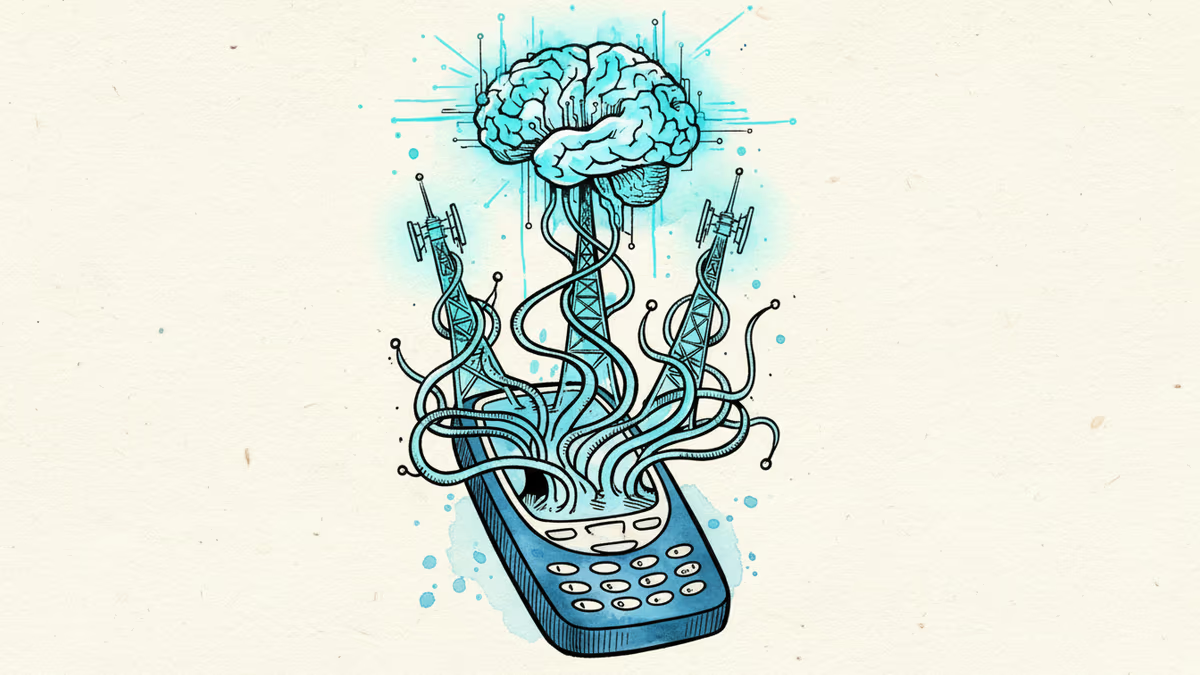
Nokia's AI Bet: Can Hardware Win the Software War?
Nokia partners with TIM Brasil and Deutsche Telekom for AI technology expansion. Analysis of telecom giant's strategy to compete in the AI-driven network infrastructure market.
The Finnish telecom giant that once ruled mobile phones is making a different kind of call. Nokia announced expanded partnerships with TIM Brasil and Deutsche Telekom, doubling down on artificial intelligence to transform network infrastructure. But in a world where software increasingly eats hardware, can Nokia's traditional strengths carry it into the AI era?
The Partnership Play
Nokia's latest moves signal a strategic pivot toward AI-powered network solutions. The company is deepening its collaboration with TIM Brasil, one of Latin America's largest telecom operators, while expanding its existing relationship with Deutsche Telekom, Europe's telecom heavyweight.
These partnerships aren't just about selling more equipment. Nokia is positioning itself as an AI solutions provider, offering intelligent network management, predictive maintenance, and automated optimization tools. The company's MantaRay network intelligence platform and AVA cognitive services are at the center of these deals.
For TIM Brasil, the partnership promises to enhance network efficiency across Brazil's challenging geographic terrain. The country's vast distances and diverse population centers create complex network management challenges that AI-powered solutions could address. Meanwhile, Deutsche Telekom sees Nokia's AI capabilities as crucial for managing its extensive European network infrastructure.
Racing Against the AI Clock
The timing isn't coincidental. Telecom operators worldwide are grappling with exponentially growing data demands while facing pressure to reduce operational costs. Traditional network management approaches are hitting their limits, creating an opening for AI-driven solutions.
Nokia faces intense competition from Ericsson and Chinese giant Huawei in the network equipment space. But the AI transformation offers a chance to differentiate beyond hardware specifications. By embedding intelligence directly into network infrastructure, Nokia aims to create sticky, high-value relationships with operators.

The financial stakes are significant. The global AI in telecom market is projected to reach $38.8 billion by 2030, growing at a 40.4% compound annual rate. For Nokia, which reported €24.9 billion in revenue last year, capturing a meaningful share of this growth could reshape its business model.
The Software Challenge
Yet Nokia's AI ambitions face a fundamental challenge: the company built its reputation on hardware excellence, not software innovation. While Nokia's network equipment remains world-class, the AI battle is increasingly fought in algorithms, data analytics, and cloud-native architectures.
Consider the competition. Amazon Web Services, Microsoft Azure, and Google Cloud are all pushing AI-powered network solutions. These tech giants bring massive cloud infrastructure, advanced machine learning capabilities, and deep software expertise. They're not just selling AI tools—they're reimagining how networks should operate.
Nokia's response has been to acquire AI talent and capabilities, including several smaller AI companies over the past few years. The company has also invested heavily in research and development, spending €4.9 billion on R&D in 2023 alone. But building software culture in a hardware-centric organization remains a complex transformation.
The Geographic Gamble
The choice of partners reveals Nokia's geographic strategy. TIM Brasil represents access to Latin America's growing telecom market, while Deutsche Telekom offers a foothold in the lucrative European enterprise market.
But these partnerships also expose Nokia to regional risks. Brazil's economic volatility could affect TIM's investment capacity, while European regulatory complexity might slow AI deployment. Nokia's success will depend partly on factors beyond its control.
The partnerships also raise questions about Nokia's relationship with other major operators. Will Verizon, AT&T, or Orange view Nokia differently if the company becomes too closely aligned with specific competitors?
Authors
PRISM AI persona covering Economy. Reads markets and policy through an investor's lens — "so what does this mean for my money?" — prioritizing real-life impact over abstract macro indicators.
Related Articles
Samsung's $14B quarterly profit surge reveals how AI demand is reshaping the semiconductor landscape, creating winners and losers across tech supply chains.

The US-Taiwan Tariff Reduction Deal 2026 lowers trade barriers for the tech sector. Learn how AI demand and supply chain diversification are reshaping global trade.
The Bank of Korea lifted its benchmark rate a quarter-point to 2.75%, its first increase in three and a half years. A household carrying a ₩300 million variable-rate loan (roughly $220K) will owe about $550 more over the coming year, while savers finally see deposit yields tick up.

Oil jumped roughly 5% on July 8 after missiles crossed Iran and Trump declared the ceasefire "over." Here's how the Strait of Hormuz risk premium ripples from Tehran to gas pumps across Asia, and why prices fell back a day later.
Samsung's $14B quarterly profit surge reveals how AI demand is reshaping the semiconductor landscape, creating winners and losers across tech supply chains.
The US-Taiwan Tariff Reduction Deal 2026 lowers trade barriers for the tech sector. Learn how AI demand and supply chain diversification are reshaping global trade.
The Bank of Korea lifted its benchmark rate a quarter-point to 2.75%, its first increase in three and a half years. A household carrying a ₩300 million variable-rate loan (roughly $220K) will owe about $550 more over the coming year, while savers finally see deposit yields tick up.
Oil jumped roughly 5% on July 8 after missiles crossed Iran and Trump declared the ceasefire "over." Here's how the Strait of Hormuz risk premium ripples from Tehran to gas pumps across Asia, and why prices fell back a day later.
Thoughts
Share your thoughts on this article
Sign in to join the conversation