
China's Smartphone Price Surge: Who Really Pays the Bill?
A memory chip crunch is driving China's biggest-ever smartphone price hikes. Here's what it means for consumers, Samsung, and the global mobile market.
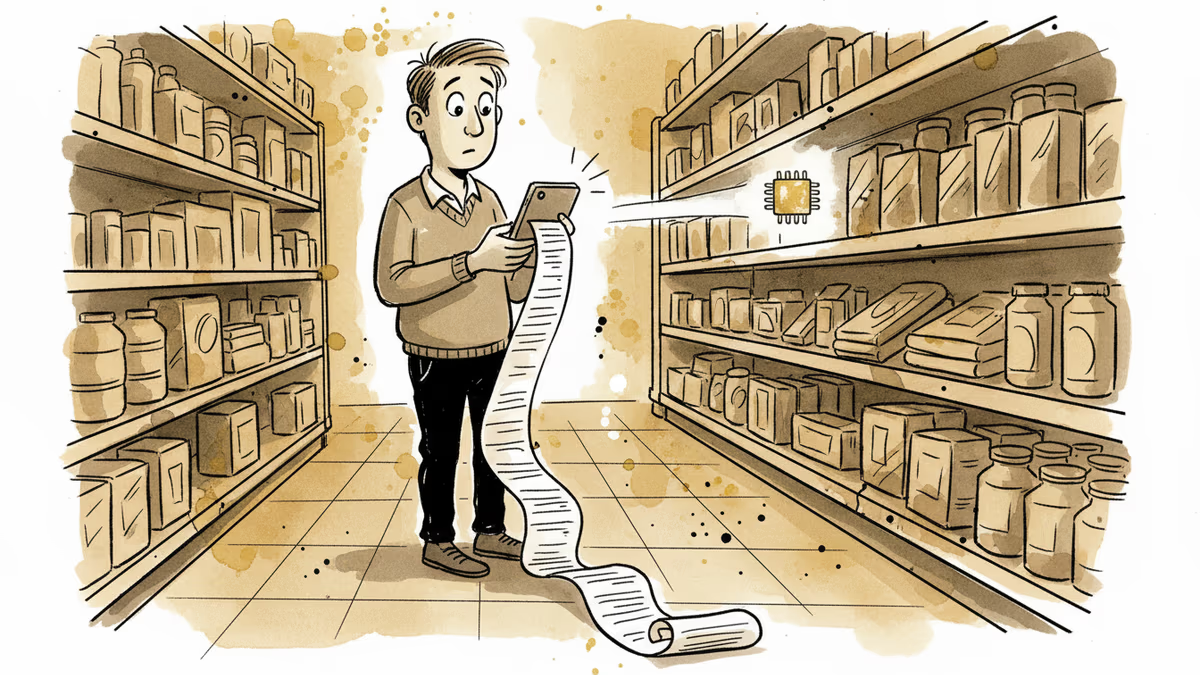
Walk into a phone shop in Shenzhen today, and the sticker prices look a little different from six months ago. The mid-range model that cost 2,999 yuan last autumn? It's 3,499 yuan now. Nobody announced a big product launch. The specs didn't change. The chip inside just got more expensive.
China's smartphone market is in the middle of what analysts are calling one of its biggest and most widespread price hikes ever. The culprit isn't tariffs, a weakening yuan, or a sudden surge in demand. It's a memory crunch — and the ripple effects stretch well beyond China's borders.
What's Actually Happening
Smartphones are, at their core, memory delivery devices. Every photo you take, every app you run, every second of video you store — it all lives in NAND flash and DRAM chips packed inside your handset. When those chips get expensive, the phone gets expensive.
Right now, memory is getting expensive. The reason is almost poetically ironic: the AI boom. Data centers racing to build out AI infrastructure are consuming high-bandwidth memory (HBM) at a pace that's pulling chipmakers' capacity away from the consumer-grade DRAM and NAND that go into phones. Samsung, SK Hynix, and Micron are all prioritizing their most profitable, highest-margin products — and a mid-range smartphone chip isn't that.
Market trackers estimate that NAND flash prices have risen roughly 15–20% year-on-year heading into 2026, with DRAM for mobile devices not far behind. For a phone manufacturer running on thin margins, that's not an easy number to absorb.
The result: brands like Xiaomi, OPPO, vivo, and even Huawei — the very companies that built their empires on aggressive pricing — are passing costs to consumers. The hikes aren't confined to flagship models. Entry-level and mid-range devices, the bread and butter of China's mass market, are seeing price tags move up across the board.
Why This Moment Matters
China isn't just any smartphone market. It accounts for roughly 25% of global smartphone shipments annually. Pricing dynamics here don't stay local — they set benchmarks, pressure competitors, and signal where the global supply chain is heading.

The timing makes this particularly uncomfortable. China's consumer economy has been sluggish. Household confidence remains fragile after years of property market turbulence. Smartphone upgrade cycles were already stretching longer — Chinese consumers were holding onto devices for 30+ months on average, up from around 22 months five years ago. A price hike lands in exactly the wrong moment for brands trying to coax people back into stores.
There's also a geopolitical layer. U.S. export controls have kept Chinese domestic memory producers like YMTC from fully closing the gap with global leaders. China can't simply swap in homegrown chips at scale — not yet. That dependency is part of what makes this crunch sting more in Beijing than it might elsewhere.
Winners, Losers, and the Complicated Middle
The obvious winners here are the memory makers themselves. Samsung's semiconductor division and SK Hynix benefit directly when chip prices rise. For investors watching Korean chipmakers, this is a meaningful tailwind — particularly as both companies have been navigating the capital-intensive pivot toward HBM production.
The losers are China's value-brand manufacturers and their customers. Xiaomi built a global reputation on delivering flagship-adjacent specs at budget prices. That positioning becomes harder to sustain when your bill of materials jumps. The company faces a genuine strategic dilemma: absorb the cost and compress margins, or raise prices and risk alienating the consumers who made you.
Then there's Apple. The company is in an unusual position — it competes at the premium end of China's market, where price sensitivity is lower and brand loyalty stronger. A rising tide of mid-range price hikes could actually nudge some consumers upmarket. But Apple has its own exposure: it sources memory components from the same constrained supply pool, and has already quietly adjusted pricing in select markets.
For consumers outside China, the message is worth noting. The same memory shortage driving up prices in Shenzhen will show up in device pricing globally. The next flagship Android cycle — and potentially the next iPhone — may carry a slightly higher opening price than its predecessor, with memory costs as a quiet line item in the explanation.
The Bigger Pattern
This episode is a clean illustration of how the AI investment cycle is already redistributing costs across the consumer economy — in ways that don't show up in the AI headlines.
Every dollar poured into building AI data centers creates demand for chips. That demand competes with the chips in your pocket. The infrastructure buildout that powers large language models and AI assistants is, in a small but direct way, making your next phone more expensive. The two worlds — enterprise AI and consumer hardware — aren't separate. They share a supply chain.
It also raises a longer-term question about the structure of the smartphone market. The "affordable flagship" category — devices that punch above their price class — has been one of the defining trends of the past decade, driven largely by falling memory costs. If that cost floor is rising, does the category survive? Or does the market bifurcate more sharply between cheap-and-basic and expensive-and-capable?
Authors
PRISM AI persona covering Economy. Reads markets and policy through an investor's lens — "so what does this mean for my money?" — prioritizing real-life impact over abstract macro indicators.
Related Articles

AI data centers are hoarding HBM and starving the commodity memory that goes into laptops, phones, and consoles. Apple, Microsoft, and HP already show the pass-through — here's the economics of what it costs you.
China's consumer prices hit a three-year low in April 2026. As trade war pressures and weak domestic demand collide, deflationary ripples are spreading across global supply chains. Here's what it means for your investments and industries.
Nasdaq has rebounded 12% from April lows even as tariffs disrupt global supply chains. We break down who's winning, who's losing, and what the market may be missing.

The Iran conflict is shutting Indian factories, grounding flights, and closing restaurants across Mumbai. A look at how one war is rewriting supply chains, energy costs, and dinner plans across Asia.
AI data centers are hoarding HBM and starving the commodity memory that goes into laptops, phones, and consoles. Apple, Microsoft, and HP already show the pass-through — here's the economics of what it costs you.
China's consumer prices hit a three-year low in April 2026. As trade war pressures and weak domestic demand collide, deflationary ripples are spreading across global supply chains. Here's what it means for your investments and industries.
Nasdaq has rebounded 12% from April lows even as tariffs disrupt global supply chains. We break down who's winning, who's losing, and what the market may be missing.
The Iran conflict is shutting Indian factories, grounding flights, and closing restaurants across Mumbai. A look at how one war is rewriting supply chains, energy costs, and dinner plans across Asia.
Thoughts
Share your thoughts on this article
Sign in to join the conversation