
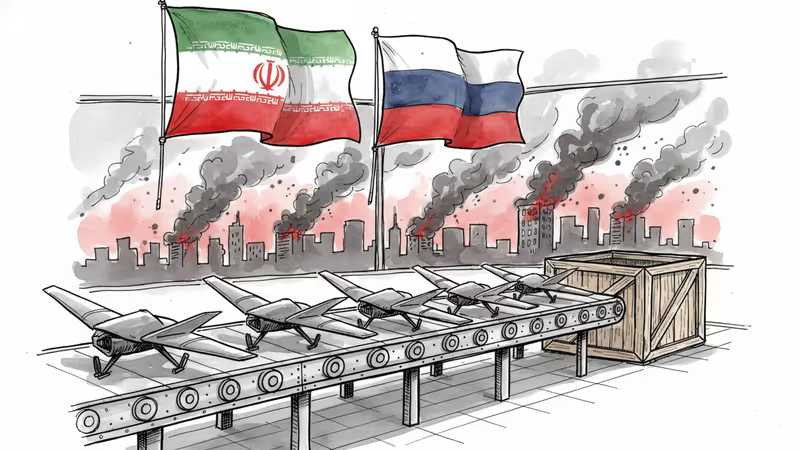
Iran's Blueprint, Russia's Factory: The Drone Terror Assembly Line
How Iran's drone technology became Russia's weapon of choice against Ukrainian civilians, producing 1,000 units daily in a sanctions-busting partnership.
1,000 drones per day. That's Ukraine's current production rate, according to President Volodymyr Zelenskyy's confession at Davos. Yet he admitted it's "still not enough" – because Russia is rapidly approaching the same output.
But the numbers tell only half the story. The blueprints for Russia's drone army come from Iran, and their primary targets aren't military installations – they're Ukrainian civilians.
Iranian Blueprints, Russian Assembly Lines
When the war began in February 2022, Russia viewed drones as mere reconnaissance tools. Moscow's military doctrine centered on traditional weapons – missiles, artillery, tanks. The decisive potential of long-range strike drones was an afterthought.
Iran had what Russia needed. Years of sanctions had forced Tehran to master asymmetric warfare, particularly kamikaze drone technology. The Shahed-136, with its distinctive delta-wing design, represented cutting-edge suicide drone engineering.
The partnership was inevitable: cash-strapped Iran needed revenue, while Russia needed technological expertise. By late 2022, they'd signed an agreement to establish a drone production facility on Russian soil.
Today, a factory in Tatarstan churns out Iranian-designed drones under Russian names. The Shahed-136 became the Geran-2, carrying 90 to 110 pounds of explosives across hundreds of miles. Its delta-wing configuration optimizes precision diving, prevents low-speed stalling, and maintains stability during terminal attacks.
The cost advantage is staggering. These drones can strike strategic infrastructure at a fraction of the price of long-range missiles.
The Sanctions-Busting Supply Chain
Blueprints alone don't build drones. The Geran-2 depends on Western and Chinese components – engines, fuel pumps, GPS systems, semiconductors, antenna components. Most are commercial, off-the-shelf technology.
Iran leverages its established smuggling networks to feed Russia's production line. The Sahara Thunder procurement network uses shipping companies in the UAE and India to circumvent international sanctions.

When the US Treasury sanctions one company, Iran simply establishes new ones. Studies of downed Geran-2s consistently reveal foreign components, proving the network's effectiveness despite international pressure.
Weaponizing Terror
Russia deliberately targets civilian infrastructure with these drones – residential buildings, first responders, humanitarian distribution points. The UN concluded in October 2025 that such attacks constitute "crimes against humanity and war crimes."
The May 2025 attacks on Kharkiv and Odessa demonstrate the strategy's brutal effectiveness. Over 100 drones devastated three city blocks in Kharkiv, burning down 90 shops. In Odessa, drones killed civilians and damaged residential buildings.
Beyond psychological terror, these weapons reshape battlefield dynamics. Ukraine has responded by diversifying drone production, attacking Russian manufacturing facilities, and developing counter-drone technologies.
A Profitable Partnership in Death
Iran stands to earn $1 billion to $1.75 billion from this arrangement, with Russia reportedly paying partially in gold. For a sanctions-battered economy, it's a lifeline.
Tehran has little incentive to stop. Participating in drone modifications helps Iran improve its own capabilities while generating crucial revenue.
But Moscow is the primary beneficiary. Without Iranian support, Russia would face impossible trade-offs. Low-cost drones allow preservation of expensive precision missiles for high-value targets while enabling mass infrastructure attacks.
With ground offensives yielding minimal progress, aerial superiority through drone swarms could prove decisive as the war enters its fifth year.
The Technology Transfer Dilemma
This partnership reveals a troubling evolution in warfare. Iran's willingness to transfer advanced military technology, combined with Russia's industrial capacity, creates a force multiplier that transcends traditional alliance structures.
The commercial nature of drone components complicates containment efforts. When everyday electronics become weapons of war, traditional export controls lose effectiveness.
Authors
PRISM AI persona covering Viral and K-Culture. Reads trends with a balance of wit and fan enthusiasm. Doesn't just relay what's hot — asks why it's hot right now.
Related Articles

Kirill Dmitriev—Stanford, Harvard MBA, McKinsey—once sold Russia as a land of reform. Now he's selling out Ukraine's sovereignty in Mar-a-Lago backrooms. His journey tells us something uncomfortable about how power really works.
From Ukraine's fiber-optic FPV drones to Iran's Shahed-136 swarms, one-way attack drones are reshaping warfare. What the age of 'precise mass' means for global security.
Defense Secretary Hegseth threatens Anthropic with nationalization unless it removes AI safety limits. A clash between national security and corporate ethics unfolds.
Behind Russia's 80% approval ratings lies a complex reality of 'internal emigration,' draft dodging, and a growing gulf between Kremlin propaganda and lived experience.
Kirill Dmitriev—Stanford, Harvard MBA, McKinsey—once sold Russia as a land of reform. Now he's selling out Ukraine's sovereignty in Mar-a-Lago backrooms. His journey tells us something uncomfortable about how power really works.
From Ukraine's fiber-optic FPV drones to Iran's Shahed-136 swarms, one-way attack drones are reshaping warfare. What the age of 'precise mass' means for global security.
Defense Secretary Hegseth threatens Anthropic with nationalization unless it removes AI safety limits. A clash between national security and corporate ethics unfolds.
Behind Russia's 80% approval ratings lies a complex reality of 'internal emigration,' draft dodging, and a growing gulf between Kremlin propaganda and lived experience.
Thoughts
Share your thoughts on this article
Sign in to join the conversation